
Fiat Panda III Type 319 (2012-2015) has two principal fuse boxes: an engine compartment electrical junction unit immediately beside the battery, and a smaller cabin holder on the left of the steering column. The original Fiat 2012 handbook provides the exact 27 positions shown in this article. Do not confuse this third-generation Panda with the older 169-model Panda or the later changed equipment on some 4×4, Natural Power, LPG and Start-Stop vehicles.
This guide reproduces all 27 documented source rows across two tables, including optional slots and the difference between ignition-operated +15 power and permanent battery-positive +30 power. Both original full-car fuse drawings are kept directly before the corresponding table. Some electrical components share a common protected supply, so the amperage and physical slot must always be confirmed against the card fitted to the vehicle.
Where are the fuses in a Fiat Panda Type 319?
Engine compartment: switch off the ignition and all consumers, open the bonnet and locate the black fuse housing directly beside the battery. Fiat’s official drawing identifies the locking screw as A: unscrew it, then lift the cover B upwards. The numbered fuse positions are marked on the unit or inside its lid. Replace the cover firmly and refit the screw when finished; direct water spray into this housing can damage its contacts.
Passenger compartment: move the driver’s seat back and look below the left-hand side of the steering wheel, at the lower dashboard immediately beside the steering column. The fuses are reached from underneath, without removing the complete dashboard. The puller is secured by Fiat to the nearby left-side access-cover holder. An equipped four-wheel-drive Panda can have other auxiliary electrical protection; identify the actual panel before removing any fuse.
Engine compartment fuse box – 15 complete entries
The front 12 V socket/cigarette lighter is F20 (15 A). F21 (15 A) supplies the fuel pump, F08 (40 A) supplies the interior blower, F89 (30 A) the heated rear window and F88 (7.5 A) the electric heated mirrors. The main body computer feed F01 (60 A) and heated windscreen F15 (70 A) are higher-current links. A vehicle without the heated screen or electric sunroof may not have F15 or F82 populated.
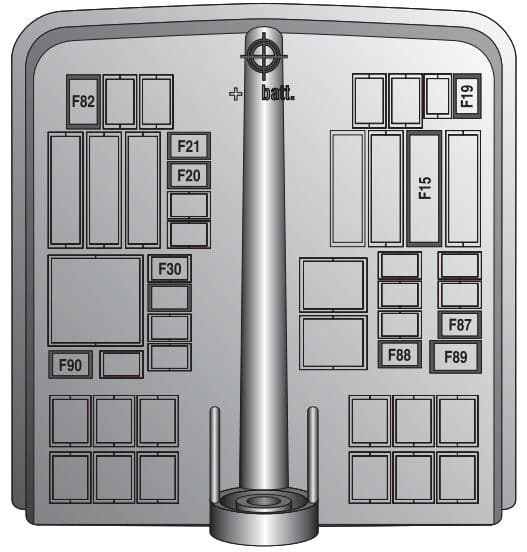
| Pozycja | Amperaż [A] | Chroniony obwód / funkcja |
|---|---|---|
| F01 | 60 | Body Computer control node and main passenger electrical supply |
| F08 | 40 | Passenger compartment heating and ventilation blower motor |
| F09 | 15 | Front fog lamps, where fitted |
| F10 | 15 | Horn |
| F14 | 15 | High-beam headlamps |
| F15 | 70 | Electrically heated front windscreen, optional |
| F19 | 7.5 | Air-conditioning compressor clutch |
| F20 | 15 | Front 12 V socket or cigarette lighter |
| F21 | 15 | Electric fuel pump |
| F30 | 5 | Crankcase blow-by ventilation system |
| F82 | 20 | Electric sunroof motor, optional |
| F87 | 5 | Reversing light circuit powered with the ignition on (+15) |
| F88 | 7.5 | Heated exterior door mirrors |
| F89 | 30 | Heated rear-window demister |
| F90 | 5 | Battery charging status sensor, equipped versions |
Under-dashboard fuse holder – 12 complete entries
F43 (20 A) feeds the two-way windscreen washer pump, F38 (20 A) the central door locking and F47/F48 (20 A each) the driver and passenger electric front windows. F37 (7.5 A) is the normally open brake pedal switch. F13 (5 A) supplies headlamp height adjustment, while some other entries provide general +15 or +30 electrical feeds rather than just one explicitly named device.
F36, F49, F50, F51 and F53 are not unoccupied; the period handbook identifies their electrical power terminal but does not provide a universal list of all connected equipment. The table leaves these original functions intact instead of inventing a specific recipient.
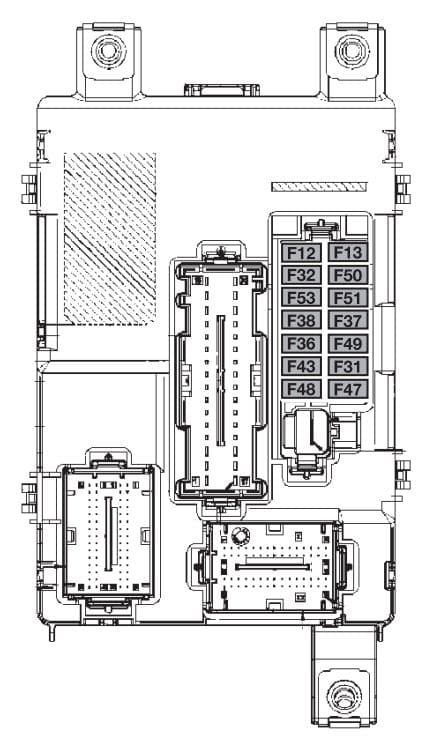
| Pozycja | Amperaż [A] | Chroniony obwód / funkcja |
|---|---|---|
| F13 | 5 | Headlamp beam height adjuster, ignition-operated (+15) |
| F31 | 5 | Ignition-operated feed disconnected while cranking |
| F36 | 10 | Permanent battery-positive (+30), equipment-dependent loads |
| F37 | 7.5 | Brake pedal normally open switch, ignition-operated (+15) |
| F38 | 20 | Central door locking |
| F43 | 20 | Two-way front/rear windscreen washer pump |
| F47 | 20 | Driver front electric window |
| F48 | 20 | Passenger front electric window |
| F49 | 7.5 | Ignition-operated (+15) equipment circuits, model dependent |
| F50 | 7.5 | Ignition-operated (+15) equipment circuits, model dependent |
| F51 | 5 | Ignition-operated (+15) equipment circuits, model dependent |
| F53 | 7.5 | Permanent battery-positive (+30), equipment-dependent loads |
Engine, model year and equipment differences
Fiat used different trim and electrical options across the 1.2 petrol, 0.9 TwinAir, diesel, LPG, Natural Power and 4×4 ranges. F15 is relevant to factory heated windscreens, F82 to the powered roof and F90 to battery-charge monitoring. Some later owner’s handbooks list different variants of the fuse cards. Model year, engine and original lid layout are more reliable than first registration date.
Electrical circuits in the Fiat Punto II Classic and Fiat Uno are different, even when the fuse serves the same device. Refer to this 319-series Panda chart rather than another Fiat model’s position numbers.
Common Fiat Panda III fuse and wiring issues
Cigarette lighter/phone charger stopped: check under-bonnet F20 (15 A), remove the accessory and look for debris or corrosion in the socket. No fuel-pump noise: F21 (15 A) may be relevant, but first distinguish between a dead electrical pump and a functioning immobiliser/engine ECU supply.
Windscreen washers silent but wipers still run: check dashboard F43 (20 A), then the washer pump, hoses and steering-column switch. Both electric front windows stopped: check dashboard F47/F48 individually and their door wiring; central locking has its own F38 (20 A).
Blower not running: under-bonnet F08 (40 A) provides the main supply, but a failed regulator can interrupt individual fan speeds even with a good fuse. Rear window fails to heat: inspect F89 (30 A), heater terminals and the printed glass elements. Electric door mirrors remain cold: F88 (7.5 A) should be checked separately.
Battery or Start-Stop charging warning: F90 (5 A) is a sensor feed on equipped vehicles. Weak battery, connections and the monitoring module require testing before replacing the fuse. A properly rated fuse that immediately fails again indicates a short circuit or an overloaded device, not a reason to fit a larger one.