The 2004 Peugeot 407 has three separate electrical distribution areas: an engine-bay fuse box by the battery, a dashboard fuse panel with supplementary G36-G40 equipment supplies, and a luggage-compartment fuse box. This guide translates all 40 listed fuse and shunt positions from the initial Peugeot 407 handbook dated 17 May 2004. Values and equipment descriptions can differ in later 2006-2011 models and among saloon, SW estate, petrol and HDi configurations.
Locations of the Peugeot 407 fuse boxes
Engine bay: With the ignition off, lift the bonnet, locate the battery and remove its protective trim as needed. Unclip the adjacent engine-fuse-box cover to inspect F1-F14. Close both covers securely against water. The larger F10-F14 protection links require the correct high-current service procedure.
Fascia: In the usual European left-hand-drive layout, open the lower dashboard fuse-access compartment on the driver’s side, release its retaining clips and fold the cover down. Right-hand-drive owner handbooks can show access via the passenger glovebox instead. The panel has several gaps in its numbering and a PARC parking shunt; G36-G40 are a separately designated supplementary group.
Luggage compartment: Open the boot, locate the rear service trim panel and remove the retaining fasteners to reach the five-position fuse board. The Polish 2004 source describes the left-hand side; some regional manuals and trim configurations show another side, so confirm the access panel on the actual vehicle. Rear power outlet and rear heated glass supplies are independent from their front equivalents.
Engine-compartment fuses – F1 to F14
The 17 May 2004 factory manual lists engine F2 for the horn at 15 A; older online charts sometimes incorrectly give 10 A. F5 supplies the fuel pump at 15 A, F12 protects the wiper motor at 30 A, and F11 provides the heating and A/C blower feed at 40 A. The diagram below is retained from the original Polish post.
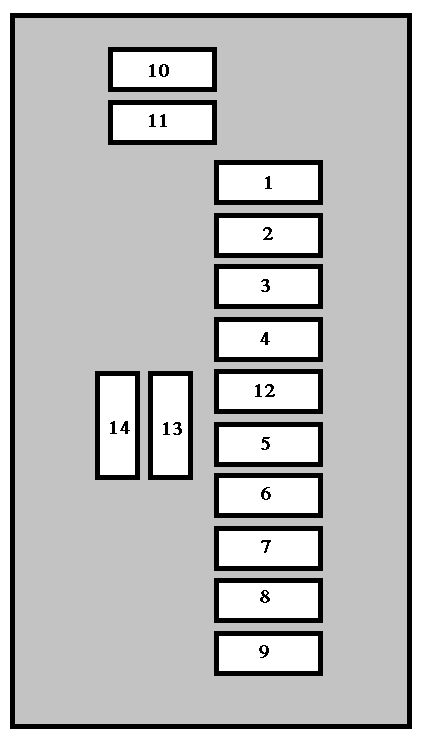
| Pozycja | Amperaż [A] | Chroniony obwód / funkcja |
|---|---|---|
| F1 | 20 | Engine management control unit |
| F2 | 15 | Horn – 15 A in the original 17 May 2004 handbook |
| F3 | 10 | Front windscreen washer pump |
| F4 | 20 | Headlamp washers if installed |
| F5 | 15 | Fuel pump |
| F6 | 10 | Automatic gearbox control unit |
| F7 | 10 | Power steering controller and coolant-level sensor |
| F8 | 15 | Starter motor solenoid |
| F9 | 10 | Xenon lamp power module and halogen beam height adjuster |
| F10 | 30 | Engine ECU actuators, ignition coil, solenoids and oxygen sensors |
| F11 | 40 | Heater and air-conditioning blower |
| F12 | 30 | Front windscreen wiper motor |
| F13 | 40 | BSI main supply after the ignition switch |
| F14 | 30 | Secondary air-injection pump on appropriate petrol engines |
Dashboard fuse box and FS2 PARC shunt
The cabin panel includes steering controls, radio, rear and front window motors, central locking, airbags and the 12 V lighter. The initial 2004 chart explicitly lists F20, F21 and F22 as not used even though nominal ratings are printed beside those positions. They should not be fitted automatically. FS2 is the parking-mode configuration shunt, not a conventional fuse.

| Pozycja | Amperaż [A] | Chroniony obwód / funkcja |
|---|---|---|
| F1 | 15 | Boot service box, diagnostic connection, low-current anti-theft and steering lock / vehicle access controller |
| F4 | 20 | Steering-wheel switches, radio/telephone, factory alarm, navigation, display, automatic gearbox and electric-seat memory |
| F5 | 15 | Factory alarm siren and tyre-pressure control module |
| F6 | 10 | Brake switch, automatic transmission, clutch switch, electrochromatic mirror, glovebox and vanity lamps, ESP/steering-angle sensor |
| F7 | 15 | Optional additional alarm |
| F9 | 30 | Rear electric windows, one-touch function |
| F10 | 20 | Front 12 V accessory socket and cigarette lighter |
| F11 | 15 | Electronic rear child lock and deadlocking |
| F12 | 30 | Front one-touch windows and optional electric sunroof |
| F14 | 10 | Engine/boot fuse box control, optional towbar and wiper relay |
| F15 | 15 | Instrument cluster, air-conditioning, rain/light sensors, electric seats and airbag controller |
| F16 | 30 | Central locking and deadlocking |
| F20 | 10 | Unused position despite nominal 10 A in the manual |
| F21 | 15 | Unused position despite nominal 15 A in the manual |
| F22 | 20 | Unused position despite nominal 20 A in the manual |
| FS2 | Shunt | FS2 PARC/parking mode configuration shunt; not a normal blade fuse |
Additional equipment supplies G36-G40
G36-G40 are separately identified accessory power positions, not fuses F36-F40. They protect optional Hi-Fi audio, a six-speed automatic gearbox, front heated seats and electrically adjustable front seats. A vehicle without the corresponding equipment may not have an active circuit at every position.
| Pozycja | Amperaż [A] | Chroniony obwód / funkcja |
|---|---|---|
| G36 | 30 | Hi-Fi audio amplifier |
| G37 | 15 | Six-speed automatic gearbox power feed |
| G38 | 30 | Both heated front seats |
| G39 | 30 | Passenger electric seat adjustment |
| G40 | 30 | Driver electric seat adjustment |
Luggage-compartment fuses F1-F5
The rear fuse box supplies the fuel-filler flap lock, rear 12 V socket, optional diesel FAP equipment and rear-window demister. The original 2004 handbook lists F1 as unused, despite showing a nominal 15 A at that location. Its label must not be confused with engine F1 or the fascia F1.

| Pozycja | Amperaż [A] | Chroniony obwód / funkcja |
|---|---|---|
| F1 | 15 | Unused in the 2004 factory manual |
| F2 | 15 | Fuel-filler flap electric lock |
| F3 | 15 | Rear luggage-compartment 12 V accessory socket |
| F4 | 15 | Diesel FAP particulate filter controller on equipped HDi |
| F5 | 40 | Rear-window demister |
Saloon, SW estate and HDi differences
Equipment such as Xenon headlamps, six-speed automatic gearboxes, Hi-Fi audio, heated seats, electronic child locks and the diesel particulate filter is option-dependent. The 407 SW estate also has different rear-body trim and tailgate equipment from the saloon. The dashboard and luggage carrier must be identified from the correct handbook and fuse cover; later 2006 and 2007-2011 407 wiring should not be treated as interchangeable with May 2004.
Which fuse should you check for a common fault?
Front 12 V lighter stops working: Dashboard F10 (20 A) supplies the socket. Rear 12 V outlet fails: Luggage F3 (15 A) is its separate protection. Fuel filler flap does not unlock: Inspect luggage F2 (15 A) and the latch actuator.
Horn not sounding: Engine F2 (15 A). Wipers not moving: Engine F12 (30 A); then check motor and linkage. Heater blower stops: Engine F11 (40 A), followed by blower speed-control electronics and connectors. Rear glass demister fails: Luggage F5 (40 A).
Diesel FAP warning: Luggage F4 (15 A) is used in models fitted with the particulate filter, although an intact fuse cannot rule out faults in sensors, fluid dosing or the filter itself. Fuel pump is not receiving power: The 2004 engine diagram identifies F5 (15 A) for the pump, after which the relay and fuel-pump wiring should be examined.
Peugeot 407 versus predecessor 406
For an earlier but overlapping production era, see the Peugeot 406 from DAM 8421. That car uses BH28, BSI1 and BM34, while the 407 has separate engine, fascia and luggage electrical groups. Their fuse positions and amperages are not interchangeable.
Technical reference: Peugeot 407 Owner’s Manual of 17 May 2004, “Changing a fuse”, including engine compartment, dashboard, G-series and luggage compartment power distribution.