
The Toyota Land Cruiser Prado J150 (2010-2018) is the fourth-generation Prado introduced for the 2009 model year. Depending on market, it was available with 1GR-FE 4.0 L V6 petrol, 1KD-FTV 3.0 D-4D diesel, and later 1GD-FTV 2.8 L diesel, in three- or five-door body styles. Equipment includes optional KDSS suspension stabilisation, rear air suspension, powered seat folding, heated windscreen equipment and off-road differential controls.
This guide preserves all 115 source entries in two complete tables: 39 passenger compartment positions and 76 distinct engine-table rows covering physical fuse numbers 1-73. Engine positions 9, 37 and 46 appear twice because different petrol, diesel or steering-side configurations require different circuits or current ratings. Positions 71-73 are stored spares without documented amperages in the provided chart. Both original drawings remain immediately ahead of their matching tables.
Front 12 V socket / cigarette lighter: the driver’s dashboard panel uses position 1 P/OUTLET (15 A) for the front accessory socket. A separate ACC accessory circuit is at position 2 (7.5 A). Remove adapters and inspect the socket for foreign metal objects if an outlet repeatedly blows its correctly rated fuse.
Applicability: the original diagrams cover a family of 2010-2018 Prado J150 electrical configurations, not every facelift or regional specification. Toyota’s October 2012 Japanese-market Prado owner’s handbook shows a different 45-position engine-bay layout, so its diagram must not be substituted for the 73-position box illustrated below. Likewise, the later 2.8 L 1GD-FTV cannot be assumed to use the older 1KD-FTV electrical installation.
Where are the Land Cruiser Prado J150 fuse boxes?
Passenger compartment: park with the engine off and all electric loads switched off. On a left-hand-drive Prado, slide the driver’s seat back and locate the fuse carrier beneath the lower dashboard near the driver’s left knee and footwell. Carefully release the protective access cover to reveal numbered positions 1-39. Look for familiar factory codes P/OUTLET, ACC, BKUP LP, OBD and STOP. On right-hand-drive models the access is arranged on the opposite side; use the cover label from the actual vehicle.
Engine compartment: open the bonnet once the engine is off and has cooled. The large covered engine fuse and relay box is beside the left side of the engine compartment on the illustrated installation. Press or release its plastic cover tabs, lift the lid and compare the cavity numbers and power-distribution section with the diagram below. Avoid dropping metal objects into the open enclosure and refit all latches to stop water ingress.
High-current protection: the main ALT 120/140 A link, GLOW 80 A, and 50 A suspension, ABS or fan protection may use bolted fusible links rather than ordinary small push-in blade fuses. Use the VIN-matched factory service procedure and battery isolation for high-current carrier repairs. Do not replace a fuse with a higher rating because it is printed in a different engine’s column.
Dashboard fusebox – all 39 positions
The passenger panel protects front and rear power windows, heated seats, air suspension controls, KDSS, factory 4WD and rear differential locks, reverse lights, dashboard electronics, automatic steering adjustment, infotainment, cabin and trailer lights, wipers and accessory sockets. All unassigned positions remain in the table, including 10, 14, 19, 23, 30 and 34.
The most useful entries for fault finding are 1 P/OUTLET (15 A) for the accessory socket, 3 BKUP LP (10 A) for reversing lights, 6 KDSS (10 A), 7 4WD (20 A), 15 OBD (7.5 A), 32 WIP (30 A) and 33 WASHER (20 A). Position 17 AM1 (7.5 A) has no downstream function described by the source, so it is not given an invented consumer.

| Position | Amperage [A] | Protected circuit / function |
|---|---|---|
| 1 | 15 | P/OUTLET – front 12 V accessory socket |
| 2 | 7.5 | ACC – exterior mirror motors, body ECU, climate, radio/navigation, parking sensors, shift-lock, reverse lamp relays and associated communication modules |
| 3 | 10 | BKUP LP – reverse lights, audio and multi-information display, parking assist |
| 4 | 10 | TOWING BKLP – trailer reverse lamp electrical circuit |
| 5 | 20 | AVS – active height control/air suspension, if fitted |
| 6 | 10 | KDSS – Kinetic Dynamic Suspension System electronic controller |
| 7 | 20 | 4WD – four-wheel drive electronics and rear differential locking system |
| 8 | 30 | P/SEAT FL – front left electric seat motor |
| 9 | 25 | D/L NO.2 – door lock actuators, rear glass/hatch release and body control unit |
| 10 | – | Unoccupied or unassigned cavity in this variant |
| 11 | 30 | PSB – active seatbelt/pre-crash belt electronics controller, equipment dependent |
| 12 | 15 | TI&TE – electrical tilt and telescopic steering column adjustment |
| 13 | 15 | FOG FR – front fog lamps |
| 14 | – | Unoccupied or unassigned cavity in this variant |
| 15 | 7.5 | OBD – onboard diagnostic connector DLC3 |
| 16 | 7.5 | A/C – passenger climate-control electronic supply |
| 17 | 7.5 | AM1 – 7.5 A ignition/accessory feed; the underlying source does not specify downstream consumers |
| 18 | 25 | DOOR RL – left rear electric window |
| 19 | – | Unoccupied or unassigned cavity in this variant |
| 20 | 10 | ECU-IG NO.1 – shift lock, VSC, steering/yaw sensors, auto wipers, heated mirrors, steering adjustment and radar/parking assistance controllers |
| 21 | 7.5 | IG1 – front/rear/side indicators, trailer indicators, alternator and VSC/cruise-related ignition supply |
| 22 | 10 | ECU-IG NO.2 – rear glass defogger, seat heating, inverter, climate control, dimming mirror, body ECU, sunroof, rain sensor, suspension and parking modules |
| 23 | – | Unoccupied or unassigned cavity in this variant |
| 24 | 20 | S/HTR FR – heated front seats |
| 25 | 30 | P/SEAT FR – front right electric seat motor |
| 26 | 30 | DOOR P – front passenger electric window |
| 27 | 10 | DOOR – power-window electronics |
| 28 | 25 | DOOR D – driver’s front electric window |
| 29 | 25 | DOOR RR – right rear electric window |
| 30 | – | Unoccupied or unassigned cavity in this variant |
| 31 | 25 | S/ROOF – electrically powered sunroof |
| 32 | 30 | WIP – front windscreen wiper and washer control |
| 33 | 20 | WASHER – front and rear washer/wiper circuits |
| 34 | – | Unoccupied or unassigned cavity in this variant |
| 35 | 10 | COOLING – optional refrigerated centre console / coolbox |
| 36 | 10 | IGN – fuel-injection ECU, rear-glass controller, VSC/SRS, Smart Key and steering-lock electronics |
| 37 | 7.5 | GAUGE – vehicle instrument cluster |
| 38 | 7.5 | PANEL – dashboard, glovebox and switch illumination, navigation, climate and audio controls, seat and mirror switch lights, information display |
| 39 | 10 | TAIL – front position lamps, rear/tail and number-plate lighting, trailer lamps and fog lamp feeds |
Engine compartment – all 76 entries for positions 1-73
Here are the engine fuses covering petrol/diesel EFI, ABS/VSC, headlights, radiator and condenser fans, air conditioning, rear window defogger, Smart Key, security, powered folding seats, suspension, rear windscreen equipment, trailer controls and diesel fuel/glow heating.
Position 9: FUEL HTR 25 A is for the 1KD-FTV diesel fuel heating system, while AIR PMP HTR 10 A is an alternative for the 1GR-FE petrol secondary-air pump heater. These are not two separate fuses numbered 9 in the same vehicle.
Position 37: the starter ST is 30 A on the petrol configuration or 40 A on the diesel, depending on its starter motor and power distribution. Position 46 ALT: the main fuse is 120 A on petrol or selected 1KD-FTV right-hand-drive vehicles, and 140 A on specified 1KD-FTV left-hand-drive models. Those are factory alternatives, not interchangeable upgrades.
Diesel-specific circuits: GLOW 48 (80 A) supplies the glow plug system, while supplementary PTC HTR circuits 2, 10 and 12 and VISCUS 18 (10 A) can affect cabin warm-up. A petrol 1GR-FE instead may have AIR PMP 56 (50 A) and electronic throttle ETCS 42 (10 A). The optional second fuel tank adds FUEL PMP 43 (15 A) to certain 1KD-FTV vehicles.
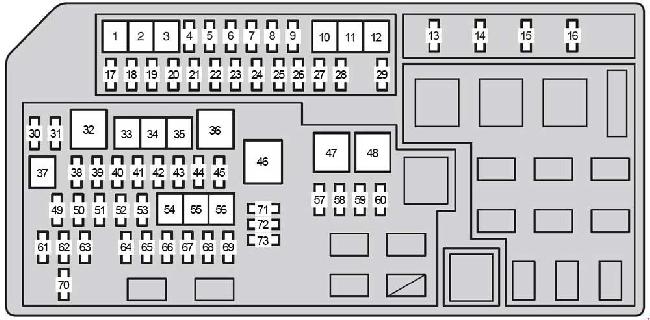
| Position | Amperage [A] | Protected circuit / function |
|---|---|---|
| 1 | 40 | A/C RR – auxiliary rear passenger compartment air conditioning |
| 2 | 30 | PTC HTR NO.3 – supplementary electric cabin heater, stage 3 |
| 3 | 50 | AIR SUS – optional air-suspension compressor and height regulation system |
| 4 | 15 | INV – factory AC inverter power circuit |
| 5 | – | Unoccupied or unassigned engine fuse position |
| 6 | 30 | DEF – heated rear windscreen defogger |
| 7 | 7.5 | FOG RR – rear fog lamp |
| 8 | 20 | DEICER – protected de-icer supply, equipment/circuit not further identified in this source |
| 9 | 25 | FUEL HTR – 1KD-FTV diesel fuel preheater, 25 A alternative for position 9 |
| 9 | 10 | AIR PMP HTR – 1GR-FE petrol secondary-air pump heater, 10 A alternative for position 9 |
| 10 | 30 | PTC HTR NO.2 – supplementary electric cabin heater stage 2 |
| 11 | – | Unoccupied or unassigned engine fuse position |
| 12 | 50 | PTC HTR NO.1 – supplementary electric cabin heater stage 1 |
| 13 | 20 | IG2 – engine injectors, ignition coils and dashboard instruments |
| 14 | 10 | HORN – main vehicle horn |
| 15 | 25 | EFI – fuel injection ECU, EDU, gearbox control, fuel pump and additional EFI NO.2/air-fuel control circuits |
| 16 | 20 | A/F – petrol air/fuel ratio electronic sensor or solid-state relay supply |
| 17 | 15 | MIR HTR – heated exterior mirrors |
| 18 | 10 | VISCUS – 1KD-FTV diesel viscous heating equipment |
| 19 | – | Unoccupied or unassigned engine fuse position |
| 20 | 30 | FOLD SEAT LH – powered folding left rear seat |
| 21 | 30 | FOLD SEAT RH – powered folding right rear seat |
| 22 | – | Unoccupied or unassigned engine fuse position |
| 23 | – | Unoccupied or unassigned engine fuse position |
| 24 | 10 | A/C COMP – air-conditioning compressor control |
| 25 | – | Unoccupied or unassigned engine fuse position |
| 26 | 20 | CDS FAN – condenser/electric cooling fan |
| 27 | 10 | STOP – stop lamps, brake switch, VSC/ABS and trailer brake signalling, Smart Key and automatic transmission electronics |
| 28 | – | Unoccupied or unassigned engine fuse position |
| 29 | 7.5 | AIR SUS NO.2 – separate low-current air-suspension ECU supply |
| 30 | 15 | H-LP RH-HI – right high-beam headlamp |
| 31 | 15 | H-LP LH-HI – left high-beam headlamp |
| 32 | 50 | HTR – high-current heater and air-conditioning blower circuit |
| 33 | 30 | WIP WSH RR – rear wiper and washer main power |
| 34 | 30 | H-LP CLN – headlamp washer/cleaning system |
| 35 | – | Unoccupied or unassigned engine fuse position |
| 36 | – | Unoccupied or unassigned engine fuse position |
| 37 | 30 | ST – petrol 1GR-FE starter motor power, 30 A |
| 37 | 40 | ST – diesel starter motor power, 40 A; alternative at the same position 37 |
| 38 | 25 | H-LP HI – headlamp high-beam / dimmer relay supply |
| 39 | 7.5 | ALT-S – alternator charge-voltage sensing |
| 40 | 15 | TURN & HAZ – directional indicators, hazard warning lamps and trailer indicators |
| 41 | 25 | D/L NO.1 – central door locking and rear glass/hatch release |
| 42 | 10 | ETCS – petrol engine electronic throttle / EFI controller |
| 43 | 15 | FUEL PMP – 1KD-FTV diesel with secondary fuel tank: extra fuel transfer pump circuit |
| 44 | – | Unoccupied or unassigned engine fuse position |
| 45 | 30 | TOWING – factory trailer electrical system |
| 46 | 120 | ALT – 120 A main generator/battery distribution on petrol or selected 1KD-FTV RHD; high-current HVAC, ABS, screen, lights, accessories and trailer feeds |
| 46 | 140 | ALT – 140 A main generator/battery distribution on selected 1KD-FTV LHD; not interchangeable with 120 A variant |
| 47 | 80 | P/I-B – 80 A ignition/injection main protected distribution feed |
| 48 | 80 | GLOW – diesel glow plug high-current control circuit |
| 49 | 15 | RAD NO.1 – primary radio, navigation and rear-seat entertainment system |
| 50 | 7.5 | AM2 – ignition and starter electronic power |
| 51 | 10 | RAD NO.2 – second navigation/radio electronic feed |
| 52 | 7.5 | MAYDAY – optional emergency/telematics circuit; original chart unusually associates 1GR-FE fuel injection; verify exact model and fuse-cover assignment |
| 53 | 30 | AMP – factory premium audio amplifier |
| 54 | 50 | ABS NO.1 – primary ABS / Vehicle Stability Control electrical supply |
| 55 | 30 | ABS NO.2 – secondary ABS / Vehicle Stability Control supply |
| 56 | 50 | AIR PMP – petrol 1GR-FE secondary air injection pump |
| 57 | 10 | SECURITY – theft alarm siren, security horn and door double-lock ECU |
| 58 | 7.5 | SMART – Smart Key keyless access/start electronic system |
| 59 | 20 | STRG LOCK – electronic steering-column lock |
| 60 | 30 | TOWING BRK – factory trailer brake electrical circuit |
| 61 | 15 | WIP RR – rear windscreen wiper |
| 62 | 10 | DOME – cabin, courtesy, entry and footwell lights, overhead console |
| 63 | 10 | ECU-B – main body ECU, cluster, steering sensors, remote key system, seat memory, folding seats, coolbox, display and Smart Key controls |
| 64 | 7.5 | WSH FR NO.2 – front washer secondary sensing/control supply |
| 65 | 15 | H-LP RH-LO – right dipped-beam headlamp and headlight levelling |
| 66 | 15 | H-LP LH-LO – left dipped-beam headlamp |
| 67 | 10 | INJ – ignition coils, fuel injectors and transmission control circuit |
| 68 | 10 | EFI NO.2 – second injection supply, oxygen/MAF sensors, variable intake, emissions/EGR and air-control solenoids |
| 69 | 7.5 | WIPFR NO.2 – secondary front wiper-control electronics |
| 70 | 15 | WSH RR – rear windscreen washer pump |
| 71 | – | SPARE – replacement spare fuse with no protected electrical consumer; current rating not stated in this source |
| 72 | – | SPARE – second replacement spare fuse with no protected electrical consumer; current rating not stated in this source |
| 73 | – | SPARE – third replacement spare fuse with no protected electrical consumer; current rating not stated in this source |
2010-2018 engine, facelift and destination-market differences
3.0 D-4D 1KD-FTV: diesel fuel preheating, glow plugs, supplementary electric cabin heating, injection drivers and additional fuel transfer equipment can be installed. In Australia and other markets, long-range secondary tanks and towing electrics may introduce extra loads not found on every European J150.
4.0 V6 petrol 1GR-FE: different starter fuse, secondary-air injection pump, electronic throttle, fuel injection and emissions circuits. Petrol and diesel versions with similar fusebox housings can still have different wire looms and fuses at the same position.
2.8 diesel 1GD-FTV and facelifts: the Prado J150 received major equipment changes around 2013 and 2017, and the later 1GD-FTV powertrain uses a revised emission/injection system. Do not use the chart’s 1KD-FTV 25 A fuel-heater or 80 A GLOW assumptions for the later engine without a VIN-specific Toyota electrical manual.
Regional manual warning: the official Japanese Prado handbook issued in October 2012 documents an engine fuse carrier with 45 numbered positions, visibly different from the 73-position drawing used here. It is evidence of market- and equipment-specific electrical differences, not a replacement source for these English tables. Always compare the fitted fuse cover, chassis/engine code, steering side and factory handbook.
Typical Toyota Prado J150 electrical problems
12 V phone charger or cigarette lighter is dead: first check cabin 1 P/OUTLET (15 A) and inspect the socket. A damaged adapter or small metal object can repeatedly short the power contact.
Reverse lights fail: inspect cabin 3 BKUP LP (10 A), then the automatic gear selector/reversing switch, bulb connections and rear harness. BKUP LP means reverse lamps, not emergency hazard flashers.
Rear window washer stops working: check engine 70 WSH RR (15 A). The rear wiper motor has separate 61 WIP RR (15 A) protection and combined supply at 33 WIP WSH RR (30 A); check the pump and tailgate cable loom if fuses are intact.
Rear differential lock or 4WD engagement fails: inspect cabin 7 4WD (20 A), then check actuator power, the transfer-case mechanism and stored fault codes. KDSS uses a separate cabin 6 (10 A) control circuit; don’t confuse it with the differential lock.
Diesel does not start easily in winter: verify the correct engine 48 GLOW (80 A) and engine 9 FUEL HTR (25 A) only if this is the relevant 1KD-FTV vehicle. Check battery voltage, glow-plug relay and injection fuel pressure before replacing components.
ABS/VSC warning lamps illuminate: the engine carrier has 54 ABS NO.1 (50 A) and 55 ABS NO.2 (30 A). Read the braking ECU codes and inspect wheel speed sensors and connections; a warning does not necessarily indicate fuse failure.
Rear glass or mirror heating does not operate: check engine 6 DEF (30 A) for rear defogging and 17 MIR HTR (15 A) for heated mirrors. A loose terminal or broken heater element may cause a localised failure without a blown fuse.
Related Toyota commercial and 4WD fusebox generations
The Toyota Hilux VII (2004-2015) shared some 1KD-FTV diesel engine technology in specified regions but does not share the Prado’s complete fuseboard wiring. The Toyota HiAce H200 (2004-2013) also used selected 1KD-FTV versions; its starter, heater and accessory socket fuse numbers are different. Never adopt either diagram in place of a Prado J150 cover.
Manufacturer and reference information: the original 39-position cabin and 73-position engine diagrams correspond to selected Prado J150 configurations from 2010-2018. They were cross-checked against the detailed model/year allocations in Prado fusebox references. Toyota’s official Japanese “Land Cruiser Prado” owner’s handbook of October 2012, section 4-2 “Fuse layout and ratings”, was also checked to establish the market-specific 45-position layout and prevent incorrect substitution.