
Renault Clio IV facelift (2016-2018), 2017 model year has a cabin fuse panel and a separate engine-compartment fuse unit. This guide lists all 39 numbered cabin fuse positions shown in the Renault Clio IV phase 2 owner’s handbook. It should not be confused with the earlier 35-position C and D diagrams used on some 2012-2015 vehicles.
Cigarette lighter and front 12 V socket: check cabin position 17. The manufacturer identifies position numbers and protected circuits but does not give a single universal amp rating for every position. A dash in the Amperage [A] column indicates that the rating must be confirmed against the installed fuse, box label or VIN-specific service documentation. It does not necessarily mean an empty slot. Never install a fuse with a higher rating.
Where are the fuse boxes in the 2017 Renault Clio IV?
Passenger compartment, cover A: the main panel is behind a removable cover in the lower driver-side dashboard. Turn off the ignition and all electrical consumers, open the driver’s door and remove cover A. The plastic fuse puller is attached to the inside of the flap. Compare the installed board with the numbered drawing before removing a fuse, then refit the cover until its clips engage. Renault advises against connecting aftermarket equipment to vacant fuse sockets.
Engine compartment, unit B: the second protective unit sits near the battery. After stopping the engine, allow the cooling fan to stop before approaching the casing. High-current fuses and some relays can be difficult to access, and Renault recommends that work on this unit be carried out by an authorised repairer. The cabin diagram is not a guide to the engine-bay module’s internal numbering.
Cabin fuse box – complete diagram and positions 1-39
The Renault phase 2 drawing places the tall positions 1-3 at the top left, positions 18-19 near the centre, and four vertical locations 36-39 on the right. Check the shape of your panel as well as the model year: similarly named Clio IV versions may have different layouts.
Useful first checks include 17 for the cigarette lighter, 18 for radio and OBD diagnostics, 22 for injection, starting and fuel-pump systems, 32 for central locking and 38 for the heated rear window. Options such as factory LPG, automatic transmission, heated seats, rain sensors and towbar wiring can affect which positions are occupied.
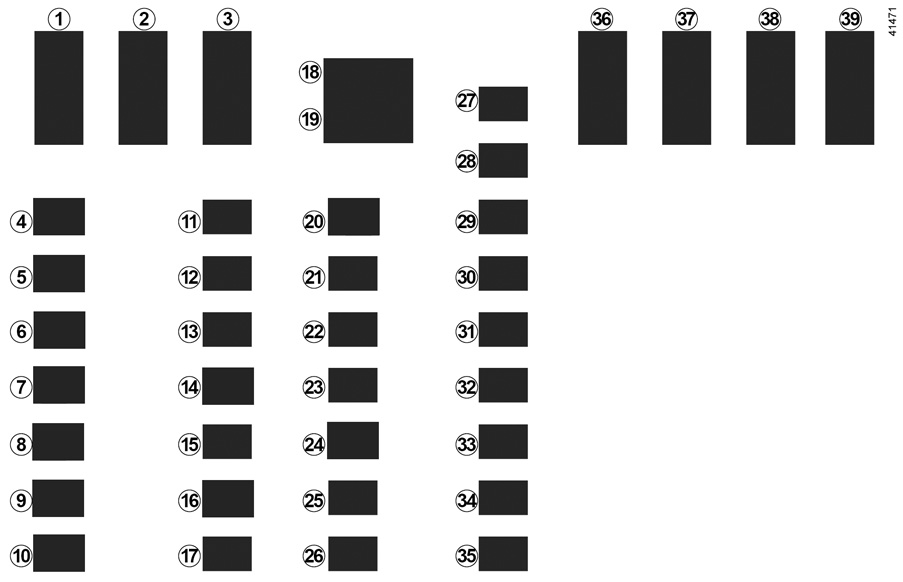
| Position | Amperage [A] | Protected circuit / function |
|---|---|---|
| 1 | – | Front windscreen wipers and steering-column switches |
| 2 | – | Left front daytime running light, right position lights, left main beam, right dipped beam and front fog lamps |
| 3 | – | Interior and number plate lighting; fog lamps |
| 4 | – | Right front and rear position lights |
| 5 | – | Left front and rear position lights |
| 6 | – | Dipped-beam headlights, right front daytime running light, left position lights and right main beam |
| 7 | – | Left dipped-beam headlamp |
| 8 | – | Right main-beam headlamp |
| 9 | – | Left main-beam headlamp and steering-column controls |
| 10 | – | Steering-column switches, speed limiter and cruise control, interior mirror, seat-belt reminder, parking sensors, auxiliary heating, headlamp levelling and heated rear window |
| 11 | – | Central locking, rain and light sensor, steering-angle sensor, engine start button and rear electric windows |
| 12 | – | Passenger-compartment and boot lights, air conditioning and electric windows |
| 13 | – | ABS/ESC control unit and brake-light switch |
| 14 | – | Steering-column switches and brake-light switch |
| 15 | – | Horn |
| 16 | – | Rear fog lamps |
| 17 | – | Cigarette lighter and front 12 V accessory socket |
| 18 | – | Radio, multimedia equipment and OBD diagnostic socket |
| 19 | – | Electric power steering |
| 20 | – | Factory LPG system – where fitted |
| 21 | – | SRS airbags and electric steering-column lock |
| 22 | – | Fuel-injection control, engine starting and fuel pump |
| 23 | – | Brake-light switch, rear wiper and UCH body control module |
| 24 | – | Daytime running lights |
| 25 | – | Electric headlamp levelling, heated rear window, parking assistance, cruise control, radio, heated seats and seat-belt reminder |
| 26 | – | Automatic transmission control module – depending on equipment |
| 27 | – | Reversing lamps, rear window wiper, UCH body module and automatic transmission |
| 28 | – | Instrument cluster |
| 29 | – | Steering-column switches and factory alarm |
| 30 | – | Air conditioning, steering-column switches and energy management module |
| 31 | – | Front and rear wipers, reversing lamps and energy management module |
| 32 | – | Central locking for doors and tailgate |
| 33 | – | Direction indicators and their telltale lamps |
| 34 | – | UCH body module and keyless-entry system |
| 35 | – | Interior lighting, electric windows, air conditioning, exterior mirrors, brake lights, ABS and UCH body module |
| 36 | – | Towbar electrical socket – if fitted |
| 37 | – | Front seat heating – on equipped vehicles |
| 38 | – | Heated rear window |
| 39 | – | Electric adjustment of exterior mirrors |
Engine compartment fuse box – engine-specific protection
Under-bonnet unit B protects high-current systems including engine electronics, cooling, ABS/ESC and the starter. The layout can differ between 0.9 TCe and 1.2 TCe petrol versions and the 1.5 dCi diesel. The Renault Clio 2017 handbook does not contain one complete, universal numbered list for this unit. Do not apply an engine-bay diagram from another engine or year without checking the VIN and wiring specification.
Common electrical problems – which fuse to inspect?
Cigarette lighter or power socket does not work: start with position 17 behind cover A. Unplug the charger and look inside the socket for metallic debris. If a replacement with the correct rating blows immediately, find the short circuit rather than installing a larger fuse.
Indicators do not operate: position 33 serves the direction-indicator circuit. For a fault on one side, inspect the bulb holder, plug and earth connection. Loss of both sides may require diagnosis of the UCH body module.
Central locking is unresponsive: check position 32. If the issue concerns only keyless entry, position 34 is also relevant. A single-door failure can be due to damaged wiring in the door gaiter or a faulty locking actuator.
Rear window does not heat: check position 38. On Sport Tourer estate models, inspect wiring where it passes between the body and tailgate as well as the heater connectors and tracks on the glass.
ABS/ESC warning lamp is on: position 13 includes ABS/ESC and the brake-light switch. When the fuse is intact, retrieve fault codes and inspect wheel-speed sensors and their wiring.
Radio and diagnostic socket have no power: inspect position 18. If the fault followed an audio upgrade, check the installation and its permanent and ignition-switched supplies.
Clio IV 2017 versus the earlier fuse layouts
The 2017 Clio belongs to the facelifted phase 2 range. Earlier Clio IV handbooks separate some cabin diagrams according to the presence of automatic lights and rain-sensing wipers. The two original 35-position layouts are explained in Renault Clio IV 2012-2016 fuse box diagrams C and D. A separate configuration appears in the Renault Clio IV 2015-2016 fuse guide. The newer Renault Clio V uses a different generation of electrical installation.
Technical reference: Renault Clio IV phase 2 owner’s handbook, 2017 edition, chapter 5, “Fuses”, pages 5.25-5.29. The cabin position numbers follow the manufacturer’s 1-39 drawing; installed fuse ratings and circuits may vary by trim level, market and engine.