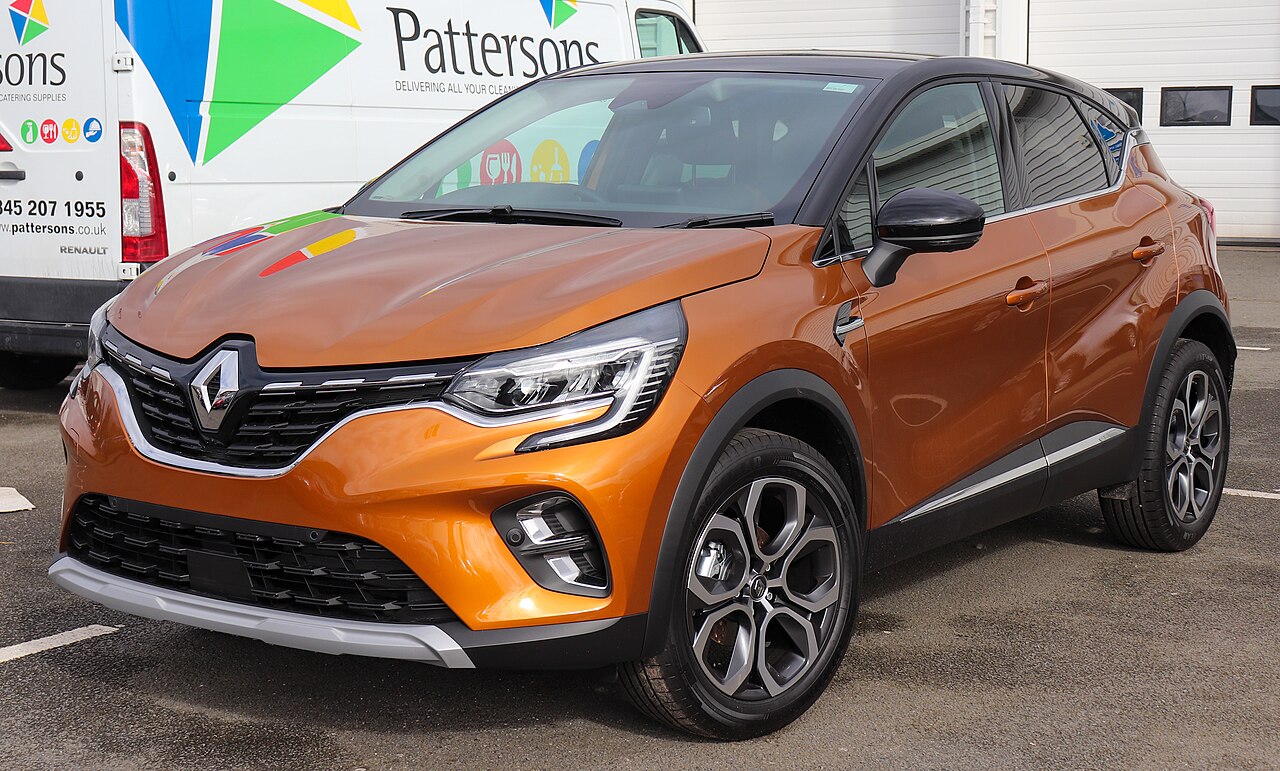
The second-generation Renault Captur II (2019-2022) is a European crossover with passenger-compartment fuse panels and additional electrical protection under the bonnet. The following tables use documented European fuse assignments from 2020-2022: 35 identified cabin positions, six relay locations and 13 front-compartment fuse positions.
Engine, gearbox, equipment and hybrid technology can change the installed protection. Early 2019 cars, LPG conversions and E-Tech plug-in hybrid versions require special care when checking their own fuse diagrams. Some fuse locations in the source have a verified current rating but no identified function: these are described as function not identified, not assumed empty.
Where are the Renault Captur II fuse boxes?
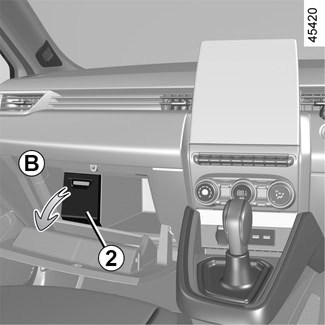
Cabin: the main fuse box is behind a lower dashboard trim panel. Some versions have an additional fuse access flap near the passenger glovebox. Switch the ignition off and release the relevant trim cover using the procedure in your owner’s manual. Match the labels on the installed panel.
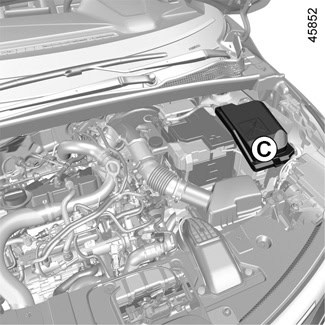
Engine compartment: additional fuses are located in electrical block C under the bonnet. Some entries can be difficult to access, and Renault recommends workshop attention for certain modules. LPG vehicles can have additional gas safety supply protection. Do not open any orange high-voltage cables or traction-system enclosures on E-Tech vehicles.
Renault Captur II cabin fuse positions
The 35 listed positions use the documented 2020 layout, also found in selected 2021-2022 references. The numbering is not continuous, and omitted positions must not be treated as universally unused. Identified circuits include door locks, BCM electronics, lighting, audio, parking brake, accessories, horn and power windows.
| Position | Amperage [A] / type | Protected circuit / function |
|---|---|---|
| 4 | 15 | Rear position lights, door mirrors, front direction indicators and trailer electrics |
| 5 | 15 | Rear door central locking, tailgate lock and high-level brake light |
| 6 | 10 | Body Control Module (BCM) |
| 7 | 10 | Function not identified in the model-year reference |
| 8 | 15 | Turn signals and anti-theft warning |
| 9 | 15 | Body Control Module (BCM), secondary feed |
| 10 | 30 | Electronic parking brake control unit |
| 12 | 10 | Function not identified in the model-year reference |
| 14 | 5 | Body Control Module (BCM), additional circuit |
| 15 | 10 | Function not identified in the model-year reference |
| 16 | 10 | Instrument cluster |
| 17 | 25 | Function not identified in the model-year reference |
| 18 | 20 | Function not identified in the model-year reference |
| 19 | 15 | Radio and multimedia |
| 20 | 10 | Function not identified in the model-year reference |
| 21 | 5 | Function not identified in the model-year reference |
| 22 | 5 | Function not identified in the model-year reference |
| 23 | 20 | Factory audio amplifier |
| 24 | 30 | Electronic parking brake controller, secondary circuit |
| 25 | 10 | Rear lights and brake lamps |
| 27 | 5 | Electric exterior mirror adjustment |
| 28 | 20 | Trailer wiring module |
| 29 | 20 | Horn |
| 30 | 15 | Cigarette lighter and 12 V accessory power outlet |
| 31 | 15 | 12 V luggage compartment socket |
| 32 | 10 | Front and rear windscreen washer system |
| 34 | 40 | Cabin heating and climate control blower |
| 35 | 40 | Heated rear window |
| 36 | 40 | Rear door electrical supply |
| 38 | 15 | Function not identified in the model-year reference |
| 39 | 25 | Power window supply, circuit 1 |
| 40 | 25 | Power window supply, circuit 2 |
| 41 | 25 | Power window supply, circuit 3 |
| 42 | 25 | Power window supply, circuit 4 |
| 43 | 5 | Function not identified in the model-year reference |
Renault Captur II interior relay assignments
The six lettered locations include one spare position C in the documented configuration. Relays are different from blade fuses; they must never be replaced with a fuse or bypass wire.
| Position | Amperage [A] / type | Protected circuit / function |
|---|---|---|
| A | Relay | Battery supply disconnected during engine starting |
| B | Relay | Delayed retention of accessory power |
| C | Spare | Spare relay position, unused in this version |
| F | Relay | Rear window defogger |
| G | Relay | Horn |
| H | Relay | Heated steering wheel, where fitted |
Renault Captur II front compartment fuse box
These 13 front-compartment entries cover ABS, fuel pump, engine controller ACTUATOR1-ACTUATOR5 outputs, windscreen wipers, cabin/injector supply, automatic transmission or LPG equipment, airbags and reverse-lamp controls. The source identifies ACTUATOR groups generically, and no speculative sensor names have been added.
| Position | Amperage [A] / type | Protected circuit / function |
|---|---|---|
| F2 | 30 | ABS hydraulic valves |
| F3 | 20 | Fuel pump |
| F4 | 15 | Engine controller – first ACTUATOR1 output circuit |
| F5 | 15 | Engine controller – third ACTUATOR3 output circuit |
| F6 | 10 | Engine controller – second ACTUATOR2 output circuit |
| F7 | 10 | Engine controller – fourth ACTUATOR4 output circuit |
| F8 | 15 | Engine controller – fifth ACTUATOR5 output circuit |
| F9 | 30 | Front windscreen wipers |
| F10 | 15 | Cabin electrical and LCS_CABIN/INJECTOR circuits |
| F11 | 10 | Automatic transmission or LPG equipment, depending on version |
| F12 | 10 | Airbag SRS and ABS circuits |
| F13 | 10 | Reversing lamps and air-conditioning valve |
| F15 | 5 | Engine Control Module (ECM) |
Which fuse protects the 12 V outlet, radio, horn or fuel pump?
Front cigarette lighter or 12 V power socket: cabin position 30 (15 A). Luggage compartment 12 V outlet: cabin position 31 (15 A). The two outlets have separate supply fuses in this documented version.
Radio: cabin position 19 (15 A). Vehicles with the factory amplifier may also use position 23 (20 A). Horn: cabin position 29 (20 A), in conjunction with relay G. Heated rear windscreen: cabin position 35 (40 A) and relay F.
Front windscreen wipers: under-bonnet F9 (30 A). Washers: cabin position 32 (10 A). Fuel pump: under-bonnet F3 (20 A). For a no-start fault, check the 12 V battery, earthing and engine-specific relays as well.
Captur II versus Renault Clio V and earlier Captur
The Captur II shares technical architecture with the Renault Clio V, but fuse assignments are not identical. For example, Captur II in this documented setup has a 20 A audio amplifier fuse at cabin position 23, while the Clio V 2020 source lists 30 A at the same position. Engine-bay F10 and ACTUATOR circuits can also differ. Never transfer fuse ratings between the two models without checking the installed specification.
The earlier Renault Captur I (2014-2016) uses a different electrical architecture. Check your vehicle’s year, engine (TCe, LPG or E-Tech), market and specific factory fuse-box label before installing a new protection element.
Renault Captur II fuse box FAQ
Where is the interior fuse box?
Behind the lower dashboard trim, with an additional glovebox-area access panel on certain equipment versions.
Which fuse supplies the 12 V power outlet?
Cabin position 30 (15 A) for the front outlet and cabin position 31 (15 A) for the luggage compartment socket in the documented configuration.
Which fuse protects the fuel pump?
Front-compartment F3 (20 A) on applicable combustion-engine variants.
Are Captur II and Clio V fuse diagrams interchangeable?
No. Even similar fuse positions can have different ratings and protected circuits. Use the exact vehicle’s documentation.
Can the guide be used for all 2019-2022 vehicles?
No. The documented 2020-2022 reference may not match every 2019, LPG or E-Tech version. Compare the installed panel and original fuse.
Replace ordinary fuses only with the same type and amperage. Repeated failure is a reason to investigate a circuit fault rather than fitting a higher-rated fuse.