The first-generation Skoda Karoq (NU7, 2017-2019) has two main low-voltage fuse boxes, one behind a small driver’s-side dashboard compartment and the other near the battery under the bonnet. The following tables reproduce 53 interior fuse positions and 32 engine-compartment positions in an early Karoq specification.
Fuse population can differ between 1.0 TSI, 1.5 TSI, 2.0 TDI, 4×4 and DSG cars, as well as by model year and optional equipment. The reference documents only a handful of individual amperage values. A dash means the source did not confirm a universal value and does not authorise an arbitrary replacement rating. Match the original installed fuse and its factory label.
Where are the Skoda Karoq fuse boxes?
Cabin: on left-hand-drive vehicles, the dashboard fuse holder sits behind a small storage compartment on the driver’s side. Switch off the ignition and electrical loads, open the compartment and carefully release its hinges or catches to access the fuse holder.
Engine compartment: a covered fuse box is located beside the battery. Release the lid catches without stressing the wiring, and close the cover securely to keep moisture out. Several entries in this box supply engine controls, ESC, fuel pump and front wipers.
Skoda Karoq 2017-2019 – cabin fuse box positions 1-53
The panel includes headlamps, driver assistance, KESSY, comfort equipment, power sockets, safety systems and optional towbar circuits. Unused locations remain in the table so numbering matches the original diagram. Rated currents are retained exactly where documented.
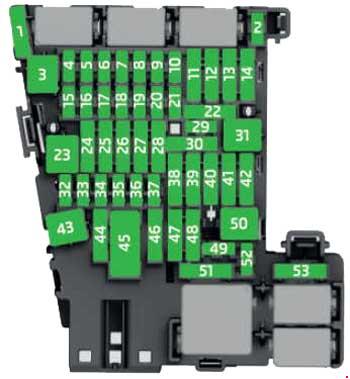
| Position | Amperage [A] | Protected circuit / function |
|---|---|---|
| 1 | – | SCR / AdBlue system |
| 2 | – | Heated steering wheel |
| 3 | – | Unused position |
| 4 | – | Unused position |
| 5 | – | Vehicle data bus diagnostics |
| 6 | – | Anti-theft alarm sensor |
| 7 | – | Air conditioning, auxiliary heater remote receiver, heated rear window and automatic transmission |
| 8 | – | Light switch, rain sensor, electric parking brake, ambient lighting and headlamps |
| 9 | – | Steering column stalk switches |
| 10 | – | Infotainment display |
| 11 | – | Left headlamp |
| 12 | – | Infotainment system |
| 13 | – | Left front seatbelt pretensioner |
| 14 | – | Cabin blower and heating / air-conditioning system |
| 15 | – | Electronic steering column lock |
| 16 | – | USB ports, diagnostic connector and Phonebox |
| 17 | – | Instrument cluster and eCall |
| 18 | – | Reversing camera |
| 19 | – | KESSY keyless access and start |
| 20 | – | SCR / AdBlue system |
| 21 | – | All-wheel drive controller |
| 22 | – | Towbar wiring module |
| 23 | – | Sunroof or panoramic roof motor |
| 24 | – | Right headlamp |
| 25 | – | Central locking for left-side doors, left power window and left exterior mirror heating / folding / adjustment |
| 26 | – | Front seat heating |
| 27 | – | Interior lighting |
| 28 | – | Towbar wiring module |
| 29 | – | Unused position |
| 30 | – | Unused position |
| 31 | – | Unused position |
| 32 | – | Park Assist parking assistance system |
| 33 | – | Airbag SRS control module |
| 34 | – | Air conditioning, reversing lamp switch, auto-dimming interior mirror, heated seat, parking brake, light switches, dashboard controls and USB ports |
| 35 | – | Diagnostic connector, front camera and distance monitoring such as ACC or Front Assist |
| 36 | – | Right LED headlamp or AFS control module |
| 37 | – | Left LED headlamp or AFS control module |
| 38 | – | Towbar wiring module |
| 39 | – | Central locking for right-side doors, right power window and right exterior mirror heating / folding / adjustment |
| 40 | 20 | 12 V accessory power sockets |
| 41 | – | Right front seatbelt pretensioner |
| 42 | – | Luggage compartment lock, rear door lock, fuel flap lock, headlamp washing and front/rear screen washers |
| 43 | 30 | Audio system amplifier |
| 44 | – | Towbar wiring module |
| 45 | – | Electrically adjustable driver’s seat |
| 46 | 30 | 230 V socket inverter |
| 47 | 15 | Rear window wiper |
| 48 | – | Blind-spot detection and lane-change monitoring |
| 49 | 5 | Clutch pedal sensor and starter control |
| 50 | – | Electric tailgate controller |
| 51 | – | Rear seat heating |
| 52 | – | Unused position |
| 53 | 30 | Heated rear window |
12 V accessory sockets: cabin position 40 (20 A). Optional 230 V power outlet inverter: cabin 46 (30 A). They are separate protection circuits and must not be confused.
Skoda Karoq 2017-2019 – engine compartment fuse box
In this configuration, the under-bonnet source lists positions 1-24 and 31-38. It does not provide entries for 25-30, so they have not been invented or inserted. The list includes engine, fuel pump, radiator fan, ESC, auxiliary heating, starter and optional automatic gearbox equipment.
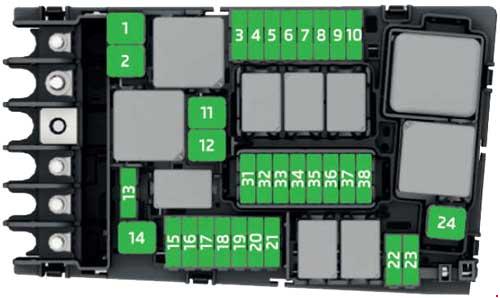
| Position | Amperage [A] | Protected circuit / function |
|---|---|---|
| 1 | – | ESC stability control and electric parking brake |
| 2 | – | Electronic Stability Control (ESC) |
| 3 | – | Engine Control Module (ECM) |
| 4 | – | Radiator fan, oil level and temperature sensors, auxiliary electric heating, SCR / AdBlue and engine equipment |
| 5 | – | Engine actuators and sensors |
| 6 | – | Brake pedal sensor |
| 7 | – | Coolant pump, exhaust valve and engine accessories |
| 8 | – | Oxygen (lambda) and NOx sensors |
| 9 | – | Preheating/glow-plug system, mass airflow meter and engine equipment |
| 10 | – | Fuel pump |
| 11 | – | Additional electric heating |
| 12 | – | Additional electric heating |
| 13 | – | Automatic gearbox control unit |
| 14 | – | Heated front windscreen |
| 15 | – | Horn |
| 16 | – | Unused position |
| 17 | – | ESC, engine controller and main relay coil |
| 18 | – | Battery management controller and data interface |
| 19 | – | Front windscreen wipers |
| 20 | – | Anti-theft alarm siren |
| 21 | – | Unused position |
| 22 | – | Engine Control Module (ECM) |
| 23 | – | Starter circuit |
| 24 | – | Additional electric heater |
| 31 | – | Vacuum pump |
| 32 | – | Unused position |
| 33 | – | Automatic gearbox oil pump |
| 34 | – | Unused position |
| 35 | – | Unused position |
| 36 | – | Unused position |
| 37 | – | Auxiliary heater |
| 38 | – | Position without confirmed assignment in the source |
Specific engine options change the installed fuses and some factory ratings. The labels for SCR/AdBlue, preheating and auxiliary heaters may refer only to diesel or particular equipment variants.
12 V socket, 230 V inverter, infotainment and wiper fuses
Cigarette lighter / 12 V socket: position 40 (20 A) in the cabin. 230 V accessory outlet: cabin 46 (30 A) if equipped. When troubleshooting, unplug appliances and never replace a fuse with a higher current rating.
Rear wiper: cabin 47 (15 A). Front wipers: engine compartment position 19, with the actual ampere value checked on the fitted vehicle. Heated rear window: cabin 53 (30 A).
Audio: cabin positions 10 and 12 serve the infotainment screen and controller, while the optional amplifier uses 43 (30 A). Engine start: engine compartment positions 3 and 22 supply engine management, 10 the fuel pump, and 23 the starter circuit. Check the battery, vehicle data and immobiliser before concluding a fuse is at fault.
Karoq, Kamiq, Scala and other Skoda fuse boxes
The Karoq has an electrical architecture and equipment range different from the smaller Skoda Kamiq and Skoda Scala. Similar position numbers do not make the fuses interchangeable.
The Skoda Enyaq uses a high-voltage electric drivetrain and a different fuse arrangement. Never transfer circuit names between model families without confirming the manufacturer’s specific diagram.
Skoda Karoq 2017-2019 fuse box FAQ
Where is the passenger-compartment fuse box?
Behind the small compartment on the driver’s side of the dashboard on European left-hand-drive vehicles.
Which fuse supplies the cigarette lighter or 12 V socket?
Dashboard position 40 (20 A) in the early Karoq specification used here.
Which fuse supplies the 230 V outlet?
Dashboard 46 (30 A) for the factory-fitted inverter, where this feature is present.
Which fuse is used for the heated rear window?
Dashboard position 53 (30 A).
Are all missing amperage figures zero?
No. A dash indicates that the general source did not confirm an individual rating. Inspect the original fuse and vehicle-specific label.
Featured vehicle photograph: Mike-fiesta, Wikimedia Commons, CC BY-SA 4.0. Original diagrams retained from the earlier Skoda Karoq 2017-2019 article.