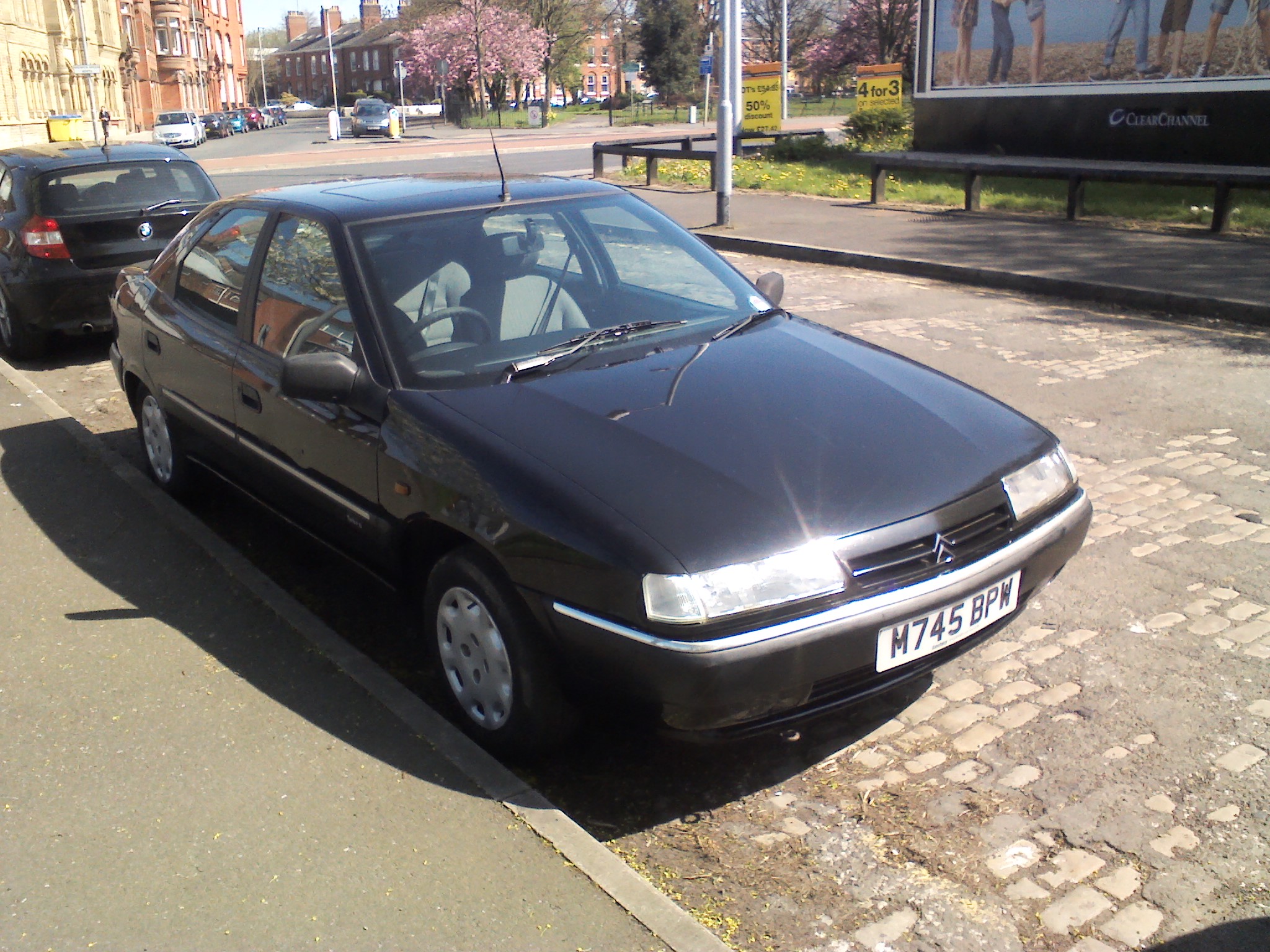
Citroen Xantia X1 (1992-1997) has two principal fuse boxes, one beneath the driver’s dashboard and another beside the battery in the engine compartment. Their contents changed during the first-generation production run. The tables below compare actual allocations from the 1993 and 1996 original Citroen Xantia X1 owner’s handbooks rather than presenting a single universal fuse list for every model year.
Cigarette lighter: both examined handbooks list cabin F16 (20 A). The 1993 book also mentions an auxiliary lighter circuit at F19 (10 A), whereas the 1996 F19 (5 A) has a different assignment. Do not assume both fuses power the lighter on every car.
Where are the Xantia X1 fuse boxes?
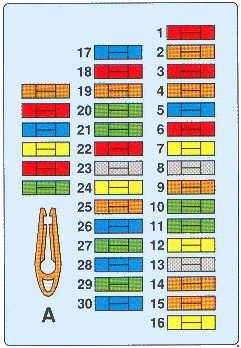
Passenger compartment: on left-hand-drive cars, the main fuse carrier sits behind a panel at the lower left of the dashboard on the driver’s side. Switch off the ignition and accessories, locate the fastener beneath the dashboard and turn it a quarter-turn to release the cover. Lower the panel carefully to expose F1-F30. The factory extractor tool is identified as A; spare fuses sit near the board and must not be mistaken for live fuse slots. On right-hand-drive cars the access arrangement can differ.
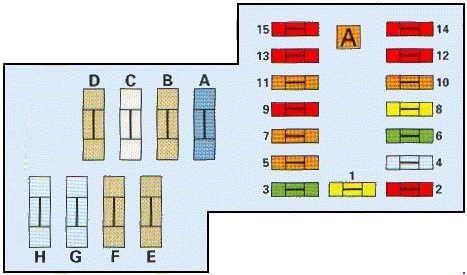
Engine compartment: open the bonnet with the ignition off and find the covered fuse assembly next to the battery. Release its retaining clips and compare F1-F15 with the illustration below. Later first-generation vehicles also have MAXI high-current fuses A-H. The manufacturer recommends workshop attention for those circuits; never bridge the fuse terminals with cable.
Xantia equipment could include Hydractive suspension, air conditioning, electrically adjustable seats, sunroof and an automatic gearbox. Confirm the installed carrier, engine and destination market before acting on a listing from another year.
Cabin fuse box F1-F30 – complete 1993 and 1996 variants
The table retains all thirty numbered locations and separate 1993/1996 rows wherever the current rating or assignment differs. Repeated positions such as F3, F14 and F21 describe different wiring versions, not simultaneous fuses. The F8/F23 SHUNT is a movable power-supply jumper, not a standard blade fuse.
| Position | Amperage [A] | Protected circuit / function |
|---|---|---|
| F1 | 10 | 1993 and 1996: radio and CD player, switched or permanent feed depending on the fuse setting |
| F2 | 5 | 1993: immobiliser keypad, dashboard illumination, gauges, lights-on warning, washer fluid level and A/C relay |
| F2 | 5 | 1996: immobiliser, lights-on warning, speed sensor, seat-belt pretensioners, diagnostics and blower controls |
| F3 | 15 | 1993: reversing lights, radiator cooling fan and diagnostic connector |
| F3 | 10 | 1996: Hydractive suspension control |
| F4 | 10 | 1993: left front and right rear side lamps and lights-on warning |
| F4 | 5 | 1996: left front and right rear side lamps, lights-on warning and Swedish daytime running lights |
| F5 | 15 | 1993: engine coolant temperature warning |
| F5 | 15 | 1996: heated-seat and rear-window heater switches |
| F6 | 10 | 1993: ABS |
| F6 | 10 | 1996: ABS and cruise control |
| F7 | 20 | 1993: horn and horn relay |
| F7 | 20 | 1996: horn, horn relay and trailer wiring |
| F8 | 30 | 1993: SHUNT jumper supplying F15 and F25; not an ordinary 30 A blade fuse |
| F8 | – | 1996: SHUNT jumper between F8 and F23 in the PARC position; not an ordinary fuse |
| F9 | 5 | 1993 and 1996: instruments, right front side lamp and left rear side lamp |
| F10 | 30 | 1993 and 1996: rear electric windows |
| F11 | 30 | 1993: electric sunroof |
| F11 | 30 | 1996: electric sunroof and heated front seats |
| F12 | 10 | 1993: air conditioning, cruise control, Hydractive suspension, alarm and instrument cluster |
| F12 | 20 | 1996: A/C, cooling, reversing lights, brake lamps and instrument cluster |
| F13 | 30 | 1993: trailer towbar electrics |
| F13 | 40 | 1996: electric seat adjustment |
| F14 | 30 | 1993: electrically adjustable seats |
| F14 | 5 | 1996: engine temperature electronics, injection ECU memory and A/C cut-off relay |
| F15 | 15 | 1993: heated seats, alarm indicator, interior and boot lighting and immobiliser |
| F15 | 10 | 1996: diagnostic circuit, CD interface and cabin and boot lighting |
| F16 | 20 | 1993 and 1996: cigarette lighter, ignition-switched or permanent according to the fuse position |
| F17 | 15 | 1993: antitheft alarm power |
| F17 | 15 | 1996: manufacturer’s guide does not assign a consumer to this position |
| F18 | 10 | 1993 and 1996: rear fog lamps |
| F19 | 10 | 1993: cigarette lighter auxiliary feed and switches |
| F19 | 5 | 1996: side-lamp potential-equalisation circuit, not designated as a lighter fuse |
| F20 | 30 | 1993 and 1996: cabin heater blower motor |
| F21 | 30 | 1993: central locking |
| F21 | 30 | 1996: front electric windows |
| F22 | 20 | 1993: rear wiper motor and controls |
| F22 | 10 | 1996: sunroof switch, rear window child lock, mirrors and powered seats |
| F23 | 15 | 1993: heated-seat and heated rear-window switches |
| F23 | – | 1996: SHUNT jumper at F8/F23 in the CLIENT position |
| F24 | 30 | 1993: front wiper motor control, intermittent wipers and automatic transmission circuit |
| F24 | 20 | 1996: front wiper controls, motor and automatic selector illumination |
| F25 | 5 | 1993: radio memory, clock, diagnostic port, CD interface and fan control |
| F25 | 2 | 1996: radio memory, clock and remote central locking |
| F26 | 15 | 1993 and 1996: hazard warning switch |
| F27 | 30 | 1993: heated rear window and mirrors |
| F27 | 30 | 1996: central locking |
| F28 | 15 | 1993: sunroof, rear electric window lock, indicators, instruments, ABS and cruise control |
| F28 | 15 | 1996: rear wiper, indicators and washer pump |
| F29 | 30 | 1993: front electric windows |
| F29 | 30 | 1996: heated rear window and mirrors |
| F30 | 15 | 1993: reading lamps, vanity mirror, glovebox, seat/window controls, mirror adjustment and car phone |
| F30 | 15 | 1996: cabin and glovebox lights, electric window switches and instrument cluster |
Engine compartment fuses F1-F15 and high-current MAXI A-H
The under-bonnet box serves ABS, radiator fans, injection, Hydractive electronics, fuel pump and headlamps. The 1993 book assigns F5 (30 A) to the radiator fan; in 1996 F5 is only 5 A for the control circuit. Hydractive F8 also changes from 5 A to 20 A. These are real version differences, not a reason to fit a higher-rated fuse.
For 1993, F3 can be 20 or 30 A depending on the fan equipment. The 1996 book shows F3 at 30 A. The two manuals identify F12/F13 as main-beam fuses and F14/F15 as dipped-beam fuses, each 10 A; these are not interchangeable descriptions.
The 1996 MAXI list includes A (60 A), B (40 A), C (80 A), D/E/F (40 A each), with G/H unused. The owner’s manual does not identify an individual consumer for each MAXI fuse, so no unverified circuit assignments have been added. Their exact physical positions need checking in the 1996 factory drawing, which differs from the F1-F15 illustration.
| Position | Amperage [A] | Protected circuit / function |
|---|---|---|
| F1 | 20 | 1993 and 1996: ABS supply |
| F2 | 10 | 1993: factory car telephone |
| F2 | 10 | 1996: no circuit specified by the manufacturer |
| F3 | 20/30 | 1993: radiator fan motor, 20 or 30 A depending on equipment |
| F3 | 30 | 1996: radiator cooling fan |
| F4 | 10 | 1993: unused position, nominally listed as 10 A |
| F4 | – | 1996: unoccupied position |
| F5 | 30 | 1993: radiator cooling fan motor |
| F5 | 5 | 1996: radiator fan control circuit |
| F6 | 30 | 1993 and 1996: timed headlamp washers and front fog lamps |
| F7 | 5 | 1993 and 1996: injection control unit power |
| F8 | 5 | 1993: Hydractive suspension controller |
| F8 | 20 | 1996: Hydractive suspension controller |
| F9 | 10 | 1993 and 1996: fuel pump relay |
| F10 | 5 | 1993: dipped/main beam switching controls |
| F10 | 5 | 1996: dipped/main beam switching and headlamp washer controls |
| F11 | 5 | 1993 and 1996: oxygen sensor relay |
| F12 | 10 | 1993 and 1996: left main-beam headlamp |
| F13 | 10 | 1993 and 1996: right main-beam headlamp |
| F14 | 10 | 1993 and 1996: left dipped-beam headlamp |
| F15 | 10 | 1993 and 1996: right dipped-beam headlamp |
| A | 60 | 1996 MAXI A: main high-current fuse, exact protected circuit not specified in owner’s handbook |
| B | 40 | 1996 MAXI B: main high-current fuse, exact protected circuit not specified in owner’s handbook |
| C | 80 | 1996 MAXI C: main high-current fuse, exact protected circuit not specified in owner’s handbook |
| D | 40 | 1996 MAXI D: main high-current fuse, exact protected circuit not specified in owner’s handbook |
| E | 40 | 1996 MAXI E: main high-current fuse, exact protected circuit not specified in owner’s handbook |
| F | 40 | 1996 MAXI F: main high-current fuse, exact protected circuit not specified in owner’s handbook |
| G | – | 1996 MAXI G: unused high-current position |
| H | – | 1996 MAXI H: unused high-current position |
What changed between the 1993 and 1996 fuse layouts?
Cabin F3: in 1993 it is 15 A for reversing lights, cooling fan and diagnostics; in 1996 it is 10 A for Hydractive control. Cabin F14 changes from 30 A electric seats to 5 A for engine electronics, with electric seats moving to F13 (40 A).
Central locking, windows and heated rear glass: the 1993 manual places central locking at F21, heated rear glass at F27 and front windows at F29. By 1996 those functions are at F27, F29 and F21 respectively. For 1994-1995 and 1997 vehicles, do not select a configuration solely from the date of first registration.
Practical Xantia X1 fault checks
Cigarette lighter does not work: start with cabin F16 (20 A) for both documented versions. The 1993 auxiliary F19 (10 A) may be relevant, but 1996 F19 (5 A) is not listed for the lighter. Disconnect the charger and inspect the socket for a short circuit.
No cabin blower: check F20 (30 A). A blower working only on maximum speed may have a failed resistor or electronic regulator even when the fuse is intact.
Hydractive malfunction: the 1993 wiring uses cabin F12 and engine F8 (5 A), while the 1996 version uses cabin F3 (10 A) and engine F8 (20 A). If those supplies are good, diagnosis may require checking suspension sensors, wiring, the ECU and hydraulic operation.
Heated rear window fails: inspect cabin F27 (30 A) for 1993 or F29 (30 A) for 1996. On estate versions, also check wires crossing the tailgate gaiter.
Front wipers fail: the 1993 F24 is rated 30 A, whereas 1996 F24 is 20 A. Check the mechanism and motor, and never replace the correct fuse with a higher rating.
Single headlamp not working: engine F12 is the left main beam, F13 the right main beam, F14 the left dipped beam and F15 the right dipped beam in the compared X1 layouts, all 10 A.
Related Citroen fuse box guides
The updated version has its own detailed list: Citroen Xantia X2 (1998-2002). The later Citroen C3 I (2003-2009) uses a newer electrical architecture. Fuse numbers from another PSA vehicle should not be copied into an Xantia without verifying the circuit.
Factory sources: Citroen Xantia “Notice d’emploi X1-F-3004/2” (1993), pages 82-85, and “Notice d’emploi X1-F-3007” (1996), pages 122-125. Ratings and year-specific functions have been compared with those editions.
Featured car photograph: Kieran White, 1995 Citroen Xantia 1.9 D LX, Wikimedia Commons, CC BY 2.0.