
The first-generation Citroen DS4 has two fuse groups in the lower dashboard and a fuse box in the engine compartment next to the battery. The information below covers cars produced from 2011 to 2018. After DS became a separate brand, later examples were sold as the DS 4, but the basic user-serviceable fuse layout described by the manufacturer remained very similar.
For this guide, early-production DS4 owner’s manuals were compared with documentation from 2015-2016. We mainly list fuses that the manufacturer identifies in the owner’s manual as positions intended for user identification. Much longer BSI and BSM module lists can be found online, but Citroen warns that replacing a fuse not listed in the owner’s manual tables can cause serious vehicle damage.
Contents
- Fuse box locations
- Dashboard fuse box 1
- Fuse box 2 – F36-F40
- Engine compartment fuse box
- Model-year and version differences
- Relays and other module positions
- FAQ
Citroen DS4 fuse box locations
The passenger-compartment fuse boxes are located in the lower left-hand part of the dashboard. On a left-hand-drive car, access is gained after removing the cover. Access is different on right-hand-drive versions, and some equipment – particularly the 230 V socket – may use a different configuration.
The engine compartment fuse box is located next to the battery on the left-hand side of the engine bay. After checking the fuses, close the cover securely because the manufacturer specifically notes that the housing must remain properly sealed.
The DS4 is closely related to the Citroen C4 Mk2. Similar electrical modules are used in both cars, but fuse numbers should not be transferred between the two models without checking the correct table.
Dashboard fuse box 1
The diagram below shows the fuse module itself. It is not a screenshot of an entire manual page, so the individual fuse positions are easy to identify.
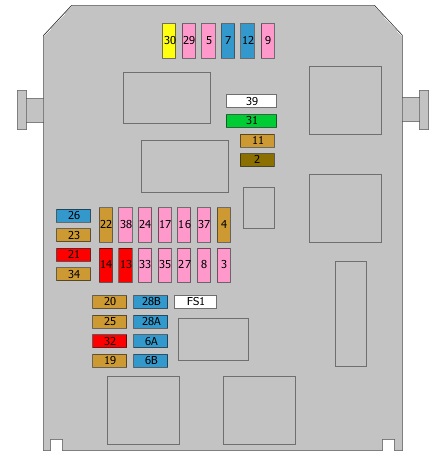
The 2011 and 2015 DS4 owner’s manuals identify the following fuse-box 1 positions as user-serviceable:
| Fuse | Rating [A] | Function |
|---|---|---|
| F8 | 3 | Alarm siren, alarm control unit |
| F13 | 10 | Cigarette lighter; later documentation also lists the front 12 V socket |
| F14 | 10 | 12 V socket in the luggage compartment |
| F16 | 3 | Large multifunction storage-compartment light, rear reading lights, dashboard glove-box light |
| F17 | 3 | Sun-visor vanity mirror lights, front reading lights |
| F28 | 15 | Audio system, non-factory radio |
| F30 | 20 | Rear window wiper |
| F32 | 10 | Hi-Fi amplifier |
The most commonly searched fuse in this box is F13 10 A. The early owner’s manual describes it as the cigarette-lighter fuse, while later editions also identify it with the front 12 V socket.
Fuse box 2 – F36-F40
The second, smaller module contains positions F36-F40. The drawing below shows its shape and fuse locations clearly without relying on the small illustration from a full owner’s manual page.
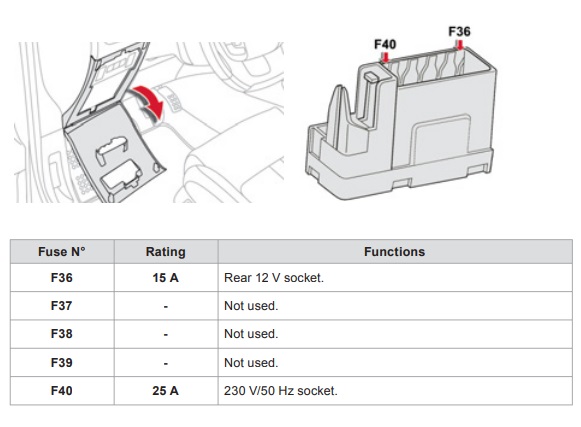
| Fuse | Rating [A] | Function |
|---|---|---|
| F36 | 15 | Rear 12 V socket |
| F37 | – | Unused |
| F38 | – | Unused |
| F39 | – | Unused |
| F40 | 25 | 230 V / 50 Hz socket – on vehicles equipped with this circuit |
Take care with F40 when using owner’s manuals from other markets. On left-hand-drive documentation it appears as 25 A for the 230 V / 50 Hz socket, while some later right-hand-drive manuals mark the position as unused.
Engine compartment fuse box
The fuse box is next to the battery. The diagram below shows the physical positions of F19-F28 and the other module slots.
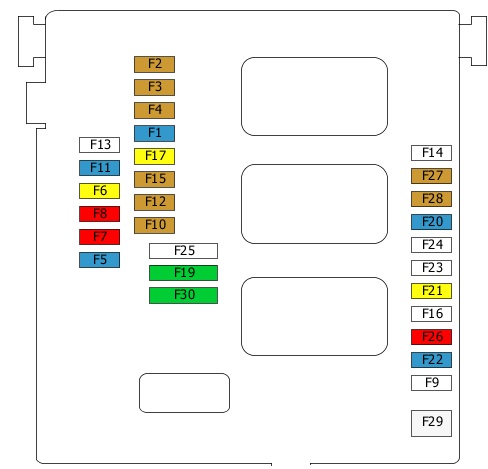
Citroen’s 2011, 2014, 2015 and 2016 DS4 manuals list the same set of eight main user-serviceable fuses:
| Fuse | Rating [A] | Function |
|---|---|---|
| F19 | 30 | Windshield wipers – low and high speed |
| F20 | 15 | Front and rear washer pump |
| F21 | 20 | Headlight washer pump |
| F22 | 15 | Horn |
| F23 | 15 | Right high-beam headlight |
| F24 | 15 | Left high-beam headlight |
| F27 | 5 | Left low-beam headlight |
| F28 | 5 | Right low-beam headlight |
Separate protection for the left and right headlights makes diagnosis easier. If only one low- or high-beam lamp stops working, its fuse can be checked independently of the opposite side.
The same model family also includes the Citroen DS5, but its electrical system assigns some circuits differently and has its own diagram.
Differences between DS4 model years and versions
Comparing early-production manuals with 2015-2016 documentation shows that the main table of user-serviceable fuses remained very stable.
| Position | Earlier documentation | Later documentation / other version |
|---|---|---|
| F13 10 A | Cigarette lighter | Cigarette lighter / front 12 V socket |
| F40 25 A | 230 V / 50 Hz socket on LHD versions | Unused on some RHD versions |
| F19-F28 under the hood | Same set of eight positions | Same set in 2014-2016 manuals |
On a vehicle imported from the UK, pay particular attention to F40. Do not install a 25 A fuse simply because that rating appears on the European left-hand-drive version.
Relays and other module fuses
Older online DS4 tables sometimes list additional positions including F3, F4, F5, F6, F11, F12, F13 30 A, F22 and relays R1 and R2. Some of that information comes from very early documentation or from the related Citroen C4.
We do not treat those positions as one universal 2011-2018 DS4 table. Verified production DS4 manuals from 2011 and 2015 identify the positions shown above as the fuses intended for owner identification. Citroen itself warns that replacing a fuse not listed in its tables can cause serious electrical-system damage.
The complete BSI and BSM modules contain more fuses and relay components than the driver’s manual shows. Their population depends on engine, transmission, equipment and module version. For diagnosing those circuits, VIN-specific service documentation is more appropriate than a universal online table.
FAQ – Citroen DS4 fuses
Which fuse is for the cigarette lighter in the Citroen DS4?
The cigarette lighter and – in later manufacturer descriptions – the front 12 V socket are protected by F13 10 A in the dashboard fuse box.
Which fuse is for the 12 V socket in the luggage compartment?
The luggage-compartment 12 V socket is protected by F14 10 A. An additional rear 12 V socket is assigned to F36 15 A in the second passenger-compartment fuse box.
Which fuse is for the 230 V socket?
On vehicles equipped with the factory 230 V / 50 Hz outlet, it is protected by F40 25 A. F40 is unused on some right-hand-drive versions.
Which fuse is for the radio?
The manufacturer lists F28 15 A for the audio system / radio. Vehicles with the factory Hi-Fi amplifier also use F32 10 A.
Which fuse is for the rear wiper?
The rear wiper is protected by F30 20 A in the passenger-compartment fuse box.
Which fuse is for the front wipers?
The windshield wipers are protected by F19 30 A in the engine compartment fuse box.
Which fuse is for the horn?
The horn is assigned to F22 15 A in the under-hood fuse box.
Which fuses are for the high-beam headlights?
The right high-beam headlight is protected by F23 15 A, and the left one by F24 15 A.
Which fuses are for the low-beam headlights?
The left low-beam headlight is protected by F27 5 A, and the right one by F28 5 A in the engine compartment fuse box.
Can I use a complete BSM-module fuse list found online?
Not without confirming the module version. Different DS4 configurations were used depending on engine and equipment. For routine checks, use the manufacturer’s tables; for fuses outside those tables, use service documentation for the specific vehicle.