The Peugeot 206 SW estate (2003-2008) retains an under-bonnet fuse and Maxi-fuse carrier next to the battery and a BSI-associated fuse panel beneath the driver’s dashboard. Different production years, engine controls and optional ABS/ESP or air conditioning created more than one valid fuse assignment. The three tables preserve all 50 source entries, including alternative values at the same position, rather than replacing them with one unreliable “universal” 206 layout. In particular, the rear electric window and tailgate circuits belong to the SW estate, not the hydraulic folding roof of a 206 CC.
Where are the Peugeot 206 SW fuse boxes?
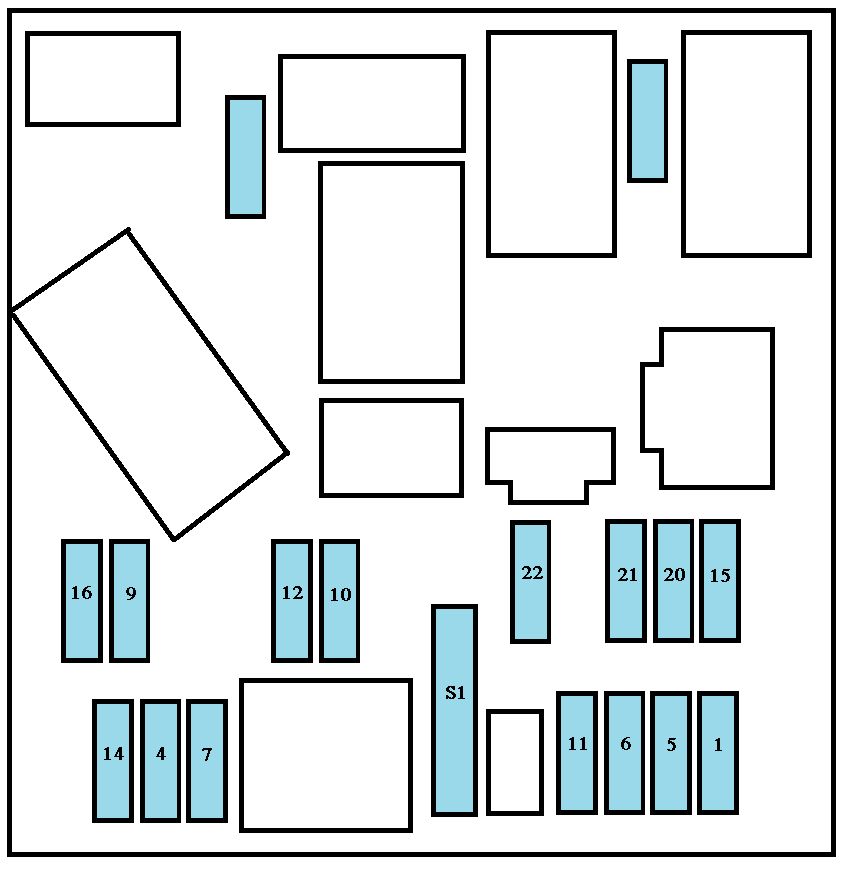
Passenger compartment: Switch off the engine and electrical accessories. Beneath the dashboard at the driver’s side of a left-hand-drive car, open the small fuse access cover. Turn its catch one quarter turn using a coin, then lower the flap. The spare blades and puller are mounted on the cover. The electrical board is associated with the BSI module, and its harnesses must not be pulled simply to reach the fuse locations.
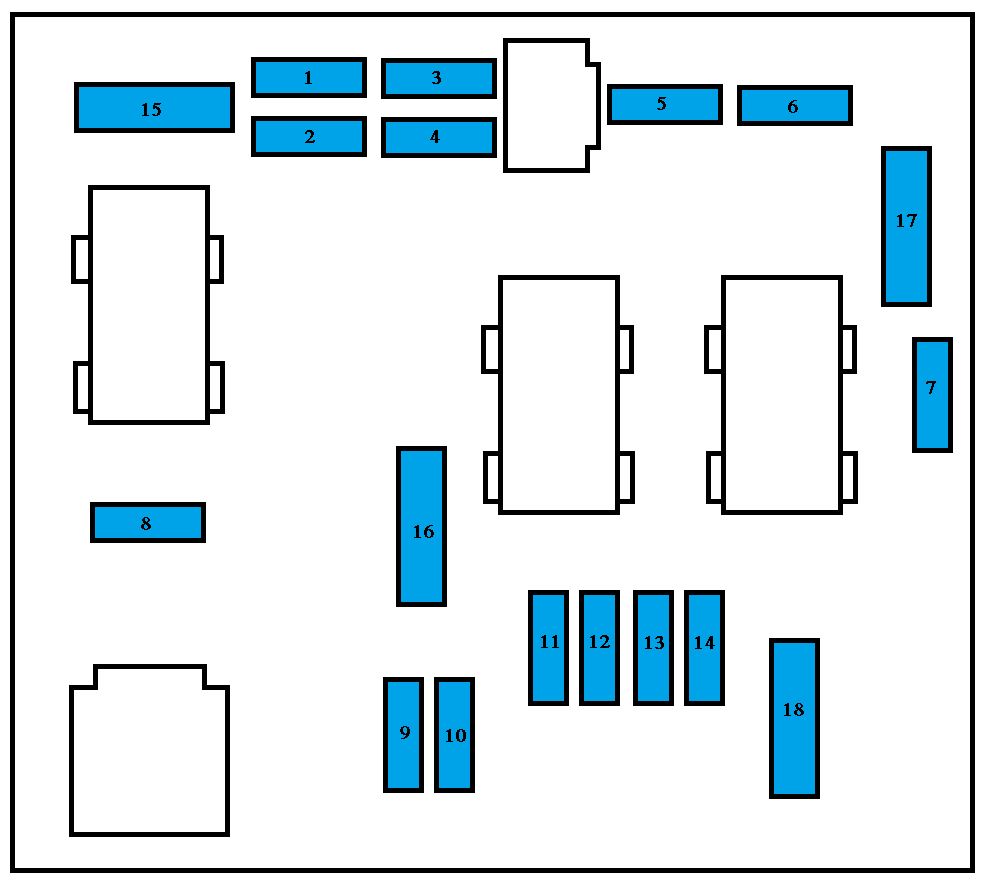
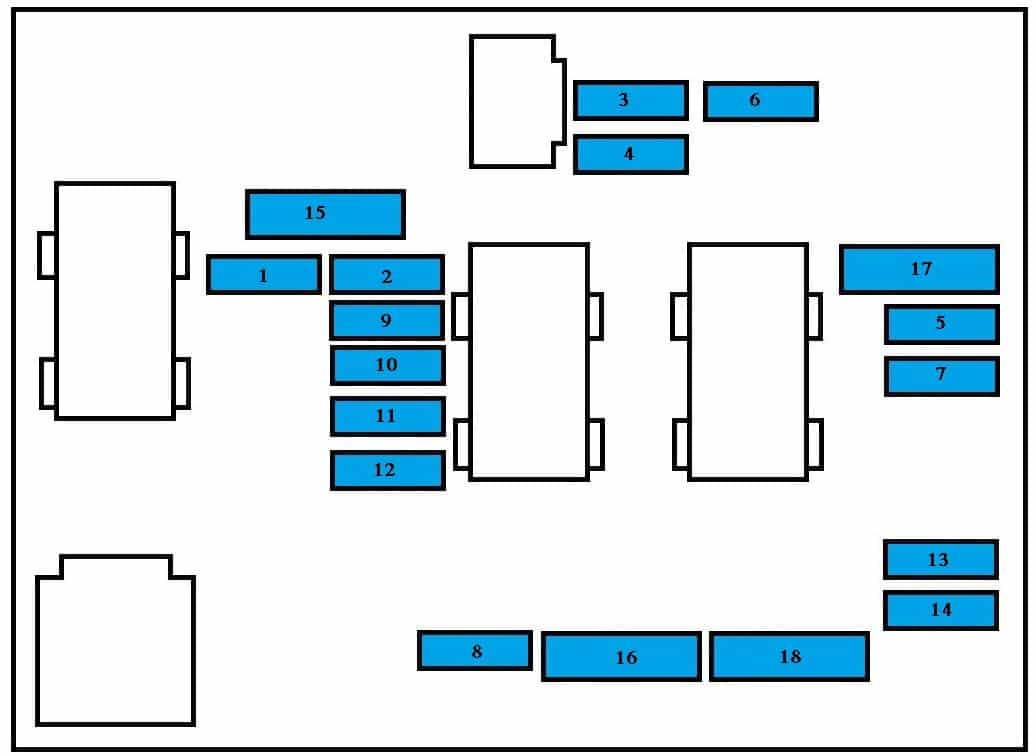
Engine compartment: Locate the black distribution box immediately beside the battery. Release the lid catches to identify ordinary fuse sockets F1-F18 and the additional MF1-MF8 high-current links. Box layouts changed during production, so compare the actual cover and installed fuse with the correct year and equipment specification. Maxi links are not conventional low-current blade fuses and should be serviced according to the manufacturer’s instructions.
Maxi fuses MF1-MF8 – power distribution and ABS/ESP
The early 2003 source layout includes MF1 at 20 A, MF2 at 60 A, MF3 at 30 A, the two BSI supplies MF4/MF5 at 70 A each, and MF7 at 30 A. Later or different engine-bay variants can show MF1 at 20/50 A and MF2/MF3 at 20/30 A according to fan, air-conditioning and ABS/ESP configuration. These repeated rows are alternative vehicle installations, not simultaneous fuses. Never substitute a different rating without a matching fuse-box specification.
| Pozycja | Amperaż [A] | Chroniony obwód / funkcja |
|---|---|---|
| MF1 | 20 | Factory 2003 layout: radiator cooling fan circuit, 20 A |
| MF1 | 20/50 | Alternative cooling configuration: 20 A without air conditioning or 50 A with air conditioning – verify as-built fuse |
| MF2 | 60 | Factory 2003 layout: ABS/ESP primary power, 60 A |
| MF2 | 20/30 | Alternative later installation: ABS/ESP supply at 20 A or 30 A; not interchangeable with the 60 A layout |
| MF3 | 30 | Factory 2003 layout: second ABS/ESP circuit, 30 A |
| MF3 | 20/30 | Alternative installation: second ABS/ESP supply at 20 A or 30 A |
| MF4 | 70 | BSI body control module, primary high-current supply |
| MF5 | 70 | BSI body control module, secondary high-current supply |
| MF6 | – | Unused location in this fuse block |
| MF7 | 30 | Ignition-switched main feed |
| MF8 | – | Unused location in this fuse block |
Under-bonnet standard fuses F1-F18
This panel protects engine management, pumps, front lighting, cooling, wipers and horn operation. The source table includes two entries for F7: a 20 A headlamp washer pump in equipped cars and an unoccupied socket on a different layout. The absence of F7 equipment is not evidence that the pump or its fuse belongs to the same location on every 206 SW.
| Pozycja | Amperaż [A] | Chroniony obwód / funkcja |
|---|---|---|
| 1 | 10 | On applicable diesels: glow plugs and diesel heating control, water-in-fuel sensor and mass air flow sensor; also reversing lights and vehicle speed signal |
| 2 | 15 | Fuel pump and petrol vapour canister purge valve |
| 3 | 10 | ABS/ESP electronic control and brake switch on equipped ESP cars |
| 4 | 10 | Engine control unit and optional automatic gearbox controller |
| 5 | – | Unused position |
| 6 | 15 | Front fog lamps |
| 7 | 20 | Headlamp washer pump in one equipment configuration |
| 7 | – | Unused F7 socket in the alternative later engine fuse panel; not an additional F7 fuse |
| 8 | 20 | Cooling fan relay, engine control module, diesel high-pressure pump and solenoids, depending on engine |
| 9 | 15 | Left dipped-beam headlamp |
| 10 | 15 | Right dipped-beam headlamp |
| 11 | 10 | Left main-beam headlamp |
| 12 | 15 | Right main-beam headlamp |
| 13 | 15 | Horn |
| 14 | 10 | Front and rear screen washer pumps |
| 15 | 30 | Throttle body heating, injectors, oxygen sensor, ignition and fuel controls, depending on engine |
| 16 | 30 | Secondary air injection pump relay on appropriate petrol engines |
| 17 | 30 | Front windscreen wiper motor, both speeds |
| 18 | 40 | Heating and air-conditioning blower |
Passenger-compartment BSI fuses and PARC shunt
These circuits serve window motors, tailgate wiper, heating, interior lighting, vehicle electronics and door locks. Fuse F9 is a 30 A rear window motor supply in the early 2003 SW specification, while some later wiring lists leave the location unused. Fuse F22 is especially important: the 24 February 2003 manual lists 30 A, while the 26 May 2003 handbook lists 20 A for the courtesy lighting and accessory socket circuit. The correct rating comes from the installed cover and exact wiring version, not from whichever of these rows is higher.
| Pozycja | Amperaż [A] | Chroniony obwód / funkcja |
|---|---|---|
| 1 | 15 | Alarm siren and heated seat on some versions; unoccupied on alternative later layouts |
| 1 | – | Unused F1 socket in a later equipment configuration |
| 4 | 20 | Multifunction display, navigation, radio, luggage compartment lighting, steering-wheel controls and trailer supply; no convertible roof motor on the SW |
| 5 | 15 | Automatic transmission diagnostics, where fitted |
| 5 | – | Unused F5 socket on later configurations |
| 6 | 10 | Coolant level warning, automatic gearbox, radio and ESP steering-angle sensor |
| 7 | 15 | Accessory alarm or driving school equipment |
| 9 | 30 | Rear electric windows on early 2003 cars, 30 A; this is not a convertible roof hydraulic pump |
| 9 | – | Unused F9 in a later layout without the applicable rear electric window equipment |
| 10 | 40 | Rear window and exterior mirror heating |
| 11 | 15 | Tailgate rear windscreen wiper |
| 12 | 30 | Front electric windows and, on equipped cars, sunroof control |
| 14 | 10 | Engine management, airbag and steering column electronics, rain sensor |
| 15 | 15 | Instrument cluster, display, A/C and audio equipment |
| 16 | 30 | Central door locking and tailgate release |
| 20 | 10 | Right-hand brake lamp |
| 21 | 15 | Left-hand brake lamp and third high-mounted brake lamp |
| 22 | 30 | February 2003 handbook: front and rear courtesy lights, glovebox, lighter and rear 12 V outlet on a 30 A circuit |
| 22 | 20 | May 2003 handbook: the same lighting and socket supply at 20 A, instead of 30 A |
| S1 | Shunt | PARC position S1 configuration shunt, not an ordinary fuse |
2003 production changes and later equipment differences
Two official 2003 owner handbooks dated 24 February and 26 May show different fuse ratings at F22. Optional equipment also affects F1 and F5 in the cabin, the rear power-window fuse F9 and the headlamp washer fuse F7 under the bonnet. Some engine installations have different MF1-MF3 circuits. Engine type, air-conditioning, ABS/ESP, BSI design and production date should all be confirmed before using an alternative row.
The 206 SW is a five-door estate with a rear tailgate, luggage-compartment lighting and optional rear 12 V outlet. The folding-roof motor described in some generic 206 CC lists is not a component of this body style. The later 206+ is also a separate configuration despite its related name.
Rear wiper, rear power windows and cigarette lighter
Tailgate wiper fails: Check cabin F11 (15 A), followed by the motor and the wiring in the tailgate hinge area. Rear 12 V socket fails: Check cabin F22 using the car’s actual 20 A or 30 A specification. If the front cigarette lighter still works, examine the socket terminals and boot harness for a separate fault.
Rear windows stop working: Early versions have cabin F9 (30 A). Some later BSI installations leave this location unoccupied; do not fit a fuse in an unused socket without confirming the corresponding wiring. Rear-window heating fails: Cabin F10 (40 A) is the rear demister and mirror circuit. Central locking stops: Cabin F16 (30 A) supplies the locking controls, but damaged door or tailgate wiring is also possible.
Dipped beam failure: Under-bonnet F9 (15 A) protects the left lamp and F10 (15 A) the right. Blower not responding: Under-bonnet F18 (40 A) is the blower feed; if only some speeds work, also inspect the resistor or electronic speed controller.
Earlier Peugeot 206 SW and related models
See the Peugeot 206 SW (2002) fuse box diagrams for the early factory installation, and Peugeot 206 (2000-2002) for the hatchback reference. The Peugeot 106 II is another compact Peugeot from the period but its electrical numbering and fuse carriers are different.
Technical basis: Peugeot 206 SW handbooks dated 24 February and 26 May 2003, supplemented by documented later 206 SW fuse-box variants. All alternative fuses are marked as installation-specific rather than interchangeable.