
The Peugeot 206 SW entered production as an estate model in 2002. Its early fuse layout is documented in the 17 June 2002 owner’s manual, not in a 2000 or 2001 SW handbook, as the estate was not yet on sale then. The electrical installation uses an under-bonnet fuse and Maxi-fuse carrier next to the battery plus a separate passenger-compartment BSI fuse panel below the dashboard. These full tables preserve every manufacturer-listed occupied and unused position, along with the PARC configuration shunt. Do not confuse the estate’s rear power windows and tailgate wiper with the retractable-roof system on a 206 CC.
Peugeot 206 SW 2002 – fuse box location and access
Inside the car: With the ignition and electrical consumers switched off, open the driver’s door and look beneath the lower dashboard to the left of the steering column on left-hand-drive cars. Use a coin to turn the cover catch one quarter turn, then pull away the flap. The manufacturer’s plastic fuse puller and spare fuse blades are stored on the inside of the cover. The cabin panel is integrated with the BSI electrical system, so do not pull its connectors or twist wiring to reach a fuse.
In the engine bay: Lift the bonnet and locate the covered electrical box immediately next to the battery. Release the lid catches to expose both ordinary blade fuses and larger Maxi fusible links. The Maxi links protect the principal BSI, ABS and ignition supplies; Peugeot specifies workshop servicing of these high-current parts. Refit the cover securely to protect the contacts from moisture.
Engine compartment – MF1-MF8 and normal fuses F1-F18
In the 2002 handbook, the high-current fuses marked with an asterisk (1* to 8*) are presented here as MF1-MF8 to make them distinct from standard F1-F18 positions. MF6 and MF8 are unused, and the original list does not assign an engine fuse F6. That is an intentional omission, not permission to copy the rating from another fuse-box version.
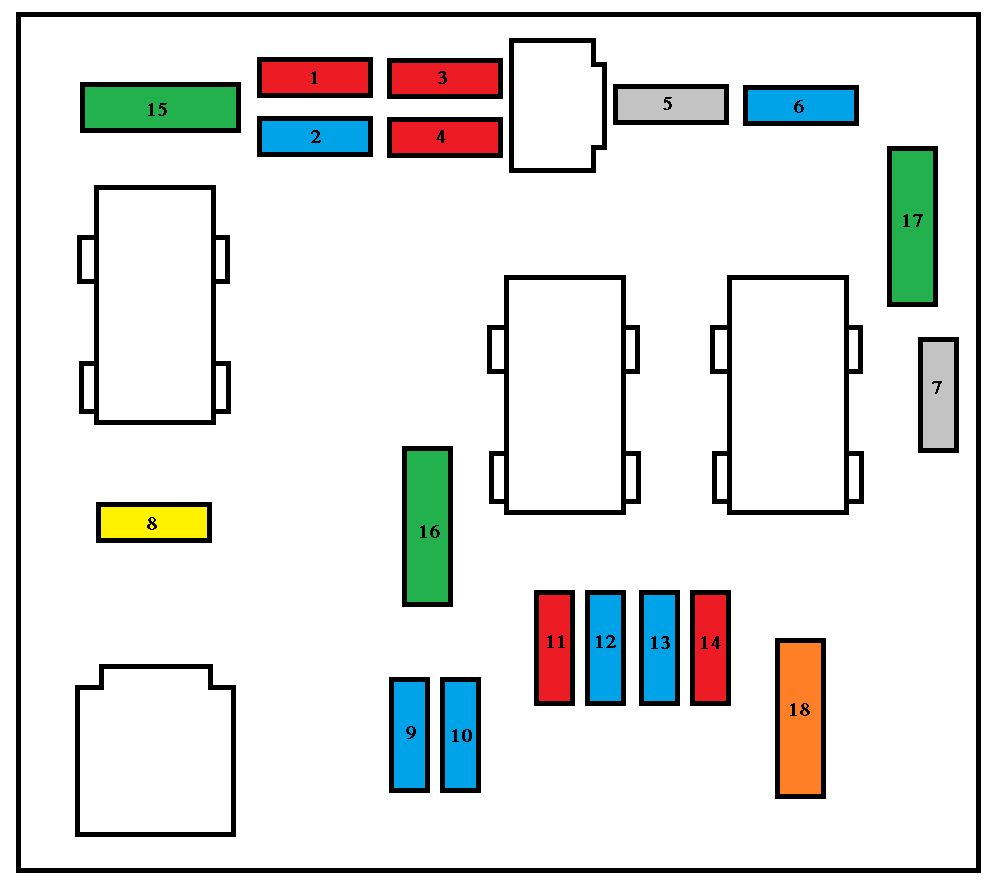
| Pozycja | Amperaż [A] | Chroniony obwód / funkcja |
|---|---|---|
| High-current Maxi fusible links (MF1-MF8) | ||
| MF1 | 20 | Radiator cooling fan motor |
| MF2 | 60 | Main anti-lock braking system (ABS) pump power feed |
| MF3 | 30 | Second anti-lock braking system supply circuit |
| MF4 | 70 | Body Systems Interface (BSI) module, first main power circuit |
| MF5 | 70 | Body Systems Interface (BSI) module, second main power circuit |
| MF6 | – | Unused maxi-fuse socket |
| MF7 | 30 | Ignition switch main feed |
| MF8 | – | Unused maxi-fuse socket |
| Standard engine compartment fuses (F1-F18, no F6 assigned) | ||
| F1 | 10 | On diesels: glow-plug control module, water-in-fuel sensor and mass air-flow sensor; also reversing lamps and vehicle speed sensor |
| F2 | 15 | Fuel tank vapour purge valve (EVAP) and fuel pump |
| F3 | 10 | ABS electronic control module |
| F4 | 10 | Automatic transmission control and engine management module, where fitted |
| F5 | – | Unused fuse socket in this 2002 configuration |
| F7 | 20 | Headlamp washer pump, if installed |
| F8 | 20 | Cooling fan relay, engine control module, diesel injection pump and fuel pressure regulating valve, depending on engine |
| F9 | 15 | Left-hand dipped-beam headlamp |
| F10 | 15 | Right-hand dipped-beam headlamp |
| F11 | 10 | Left-hand main-beam headlamp |
| F12 | 15 | Right-hand main-beam headlamp |
| F13 | 15 | Horn |
| F14 | 10 | Front and rear windscreen washer pumps |
| F15 | 30 | Engine control module, injectors, oxygen sensor, ignition coils or diesel injection pump and fuel heating, depending on engine |
| F16 | 30 | Secondary air injection pump relay on applicable petrol engines |
| F17 | 30 | Front windscreen wipers, low and high speeds |
| F18 | 40 | Heating and air-conditioning blower motor |
Passenger compartment – cabin fuses and PARC S1 shunt
The cabin panel includes rear electric windows, central locking, lighting, radio, front and rear 12 V outlets and the estate tailgate wiper. The layout is not continuously numbered, so the absent numbers have no assigned rating in this owner’s manual. Fuse F9 is the 30 A supply for rear electric windows in this SW; it is not the hydraulic roof pump used on Peugeot 206 CC models. The PARC shunt S1 is a configuration bridge, not an ordinary replaceable fuse.
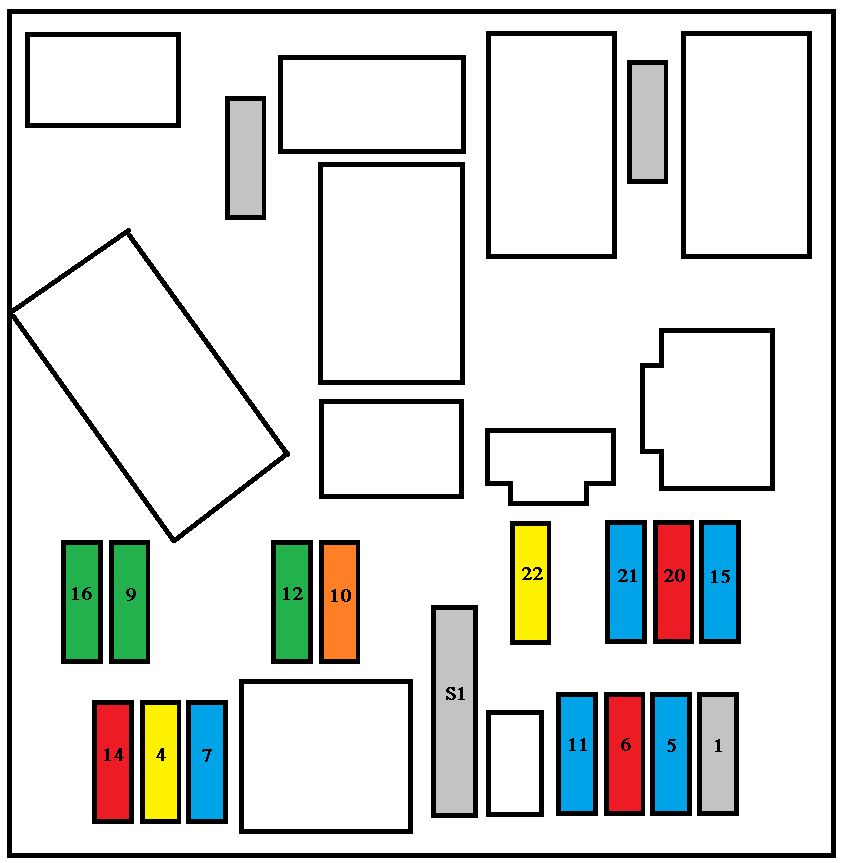
| Pozycja | Amperaż [A] | Chroniony obwód / funkcja |
|---|---|---|
| Dashboard BSI fuse panel and PARC S1 shunt | ||
| F1 | 15 | Heated seats and factory alarm siren, if installed |
| F4 | 20 | Multifunction display, navigation equipment, boot light and audio system |
| F5 | 15 | Automatic gearbox diagnostics |
| F6 | 10 | Engine coolant level warning, automatic gearbox and audio system |
| F7 | 15 | Driving school equipment and optional alarm |
| F9 | 30 | Rear electric window motors of the SW estate, not a 206 CC roof hydraulic pump |
| F10 | 40 | Heated rear window and exterior mirror demisting |
| F11 | 15 | Rear wiper on the SW tailgate |
| F12 | 30 | Front electric windows and optional sunroof |
| F14 | 10 | Supply to BSI, airbag electronics, steering wheel controls and rain sensor |
| F15 | 15 | Instrument cluster, multifunction display, navigation, air conditioning and radio |
| F16 | 30 | Central door locking and boot locking/unlocking |
| F20 | 10 | Right-hand brake light |
| F21 | 15 | Left-hand brake light and third high-mounted brake lamp |
| F22 | 30 | Front and rear courtesy lights, glovebox and map-reading lamps, cigarette lighter and rear 12 V socket in the SW |
| S1 | – | PARC configuration shunt (S1) – not a conventional blade fuse |
Why production year and body style matter
The 206 SW shares the basic 206 architecture with the hatchback, but the five-door estate has its own rear window motor, tailgate wiper and luggage-compartment power outlet circuits. On a Peugeot 206 CC, related electrical positions may instead serve the electro-hydraulic folding roof. Later 2003-2008 SW wiring also changed: BSI specification, optional ABS/ESP and fuse ratings can differ even when the fuse location label remains the same. Always use the actual vehicle cover and corresponding manual before choosing an amperage.
Common faults and fuse positions
No power at the cigarette lighter or rear 12 V outlet: First inspect cabin fuse F22 (30 A on this June 2002 layout), which also serves several interior lamps. If the front socket works but the rear outlet does not, check the contacts and boot-side wiring separately.
Rear electric windows fail: Cabin F9 (30 A) is the correct circuit for the early SW. Rear tailgate wiper stops: Cabin F11 (15 A) protects the rear wiper, but the tailgate hinge wiring and motor must also be checked. Rear demister fails: Cabin F10 (40 A) protects the heated rear glass and exterior mirrors.
No blower operation: The engine-bay F18 (40 A) supplies the heater and A/C blower. Fuel pump fails to run: Engine-bay F2 (15 A) serves the pump and EVAP valve; ignition and relay supplies should also be checked. Front wipers fail: Engine-bay F17 (30 A) provides their main power. Repeatedly blown fuses need a wiring or electrical load diagnosis, not a higher-rated replacement.
Other Peugeot 206 electrical systems
The later Peugeot 206 SW (2003-2008) fuse diagrams show subsequent BSI and Maxi variants. For the original hatchback there is a separate Peugeot 206 2000-2002 guide; for the convertible, consult Peugeot 206 CC 2000-2002 because of its folding-roof electrical circuits.
Technical basis: Peugeot 206 SW owner’s handbook, Practical Information, 17 June 2002, pages 126-130. The ratings and unused fuse locations follow the early 2002 SW specification.