
The Peugeot 4007 is a compact SUV built on the Mitsubishi Outlander-based platform, available with a 2.2 HDi diesel and a market-dependent 2.4-litre petrol engine with CVT. This 2010-2012 reference covers 25 numbered dashboard fuses, 32 engine-bay fuses and the three spare fuses stored in the under-bonnet box cover – all 60 source positions, including empty holders, are preserved. Large original-layout schematics replace the small 300-pixel drawings in the Polish source. The 2010-2012 handbook retains the dashboard accessory fuse 19 and the engine horn at fuse 4. Its longer engine fuse 22 description specifies diesel water detection, injection/EGR, airflow and engine-related sensors; not every listed component is fitted on all petrol or diesel configurations.
Where are the Peugeot 4007 fuse boxes?
Dashboard / passenger compartment: On left-hand-drive cars the cabin fuse carrier is behind a small storage compartment in the lower dashboard on the left. Turn the ignition off, open cover A, pull it gently toward you and inspect the panel behind it. The instrument panel, wipers, power socket, four-wheel-drive controller, seats and electric windows are among the protected systems. On right-hand-drive cars Peugeot instructs owners to open the glovebox, press its two opening guides inward to pass the first stop, release retaining tab B, and support the glovebox cover as it folds down.
Engine compartment: Raise the bonnet and locate the fuse box beside the battery, on the vehicle’s left side. Push catch A to unlock its cover, remove the cover fully and inspect the numbered fuses. Close the cover carefully after checking so the weather seal remains effective. The high-current Maxi positions (marked with an asterisk in the tables) are intended for professional servicing. Spare positions 33, 34 and 35 are carried inside the engine-box cover and are not live protective circuits.
Differences between engines, options and manual editions
The fuse lists combine equipment for different powertrains but do not imply that every 4007 has all the circuits. Engine positions 2 (7 A), 3 (20 A), 5 (7.5 A) and 8 (15 A) refer in the owner’s table to the 2.4-litre petrol engine and CVT-related installation. The unusual 7 A at engine fuse 2 is copied deliberately from the factory handbook and should not be silently changed to 7.5 A. The diesel engine uses position 22 (20 A) for injection, airflow and water-in-fuel monitoring and position 32 (30 A) for its engine ECU supply. Xenon dipped beams use engine fuses 16/17 at 20 A each, while conventional dipped-beam circuits are 18/19 at 10 A. Check the headlamp equipment before selecting the correct fuse.
The 4007 shares a platform with the Mitsubishi Outlander and Citroen C-Crosser, but its manufacturer-issued electrical table is the reference used here. The 2008 and 2010-2012 Peugeot fuse allocations are extremely similar; the two year-specific articles are separate because their original Polish pages and manual editions differ. The 2010-2012 engine listing gives a longer set of engine sensors and solenoids at fuse 22. A separate 2008 article retains the earlier rear DVD listing.
Dashboard fuses 1-25
The dashboard accessory power socket, often used for a cigarette-lighter adapter, uses fuse 19 (15 A). The rear window wiper is on 11 (15 A), front wipers and wash-wipe controls on 4 (30 A), central locking and door mirrors on 6 (20 A), the 4WD system on 17 (10 A), and the sunroof where fitted on 15 (20 A). Heated mirrors use 22 (7.5 A), the rear screen heater is 21* (30 A), and optional heated seats have 25 (30 A). Positions 13 and 23 are unoccupied in the documented version.
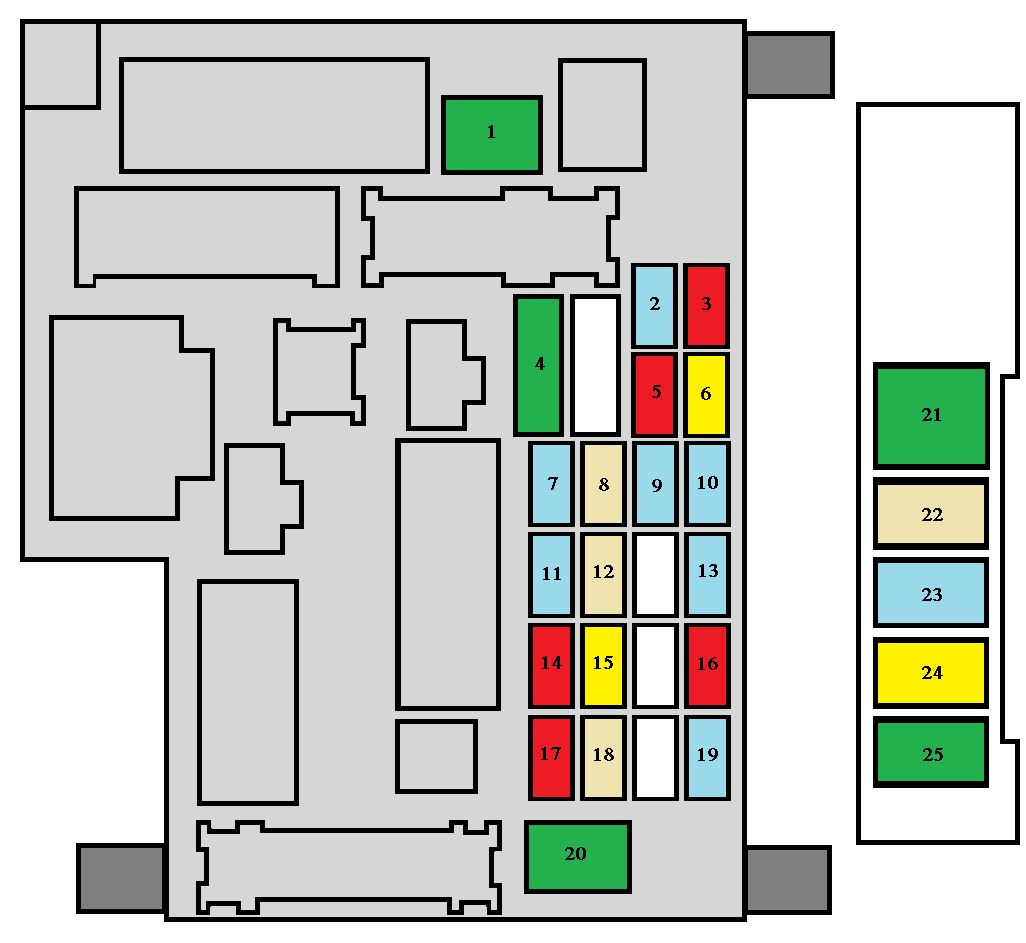
| Pozycja | Amperaż [A] | Chroniony obwód / funkcja |
|---|---|---|
| 1* | 30 | Heater system main supply – Maxi fuse |
| 2 | 15 | Brake lamps, centre high-level stop lamp and built-in systems interface |
| 3 | 10 | Rear fog lamp |
| 4 | 30 | Front windscreen wipers and screenwash equipment |
| 5 | 10 | Diagnostic socket |
| 6 | 20 | Central door locking and exterior mirrors |
| 7 | 15 | Audio, hands-free, telematics and multifunction display; the 2010-2012 owner chart no longer specifically lists the earlier rear-DVD accessory at this position |
| 8 | 7.5 | Remote key receiver, climate controller, instrument panel and steering-wheel switches |
| 9 | 15 | Instrument cluster and multifunction display |
| 10 | 15 | Built-in systems interface (BSI) supply |
| 11 | 15 | Rear windscreen wiper motor |
| 12 | 7.5 | Instrument panel, 4WD, A/C, ABS, display, headlamp aim control, heated seats, SRS airbags, steering sensor, sunroof, rear demister and remote functions (as fitted) |
| 13 | – | Unused fuse position |
| 14 | 10 | Ignition-switch circuit |
| 15 | 20 | Powered sunroof, when fitted |
| 16 | 10 | Exterior mirror controls, audio, telematics and optional rear DVD player |
| 17 | 10 | Four-wheel-drive transfer/control unit |
| 18 | 7.5 | Reversing lamps, parking sensors, rear camera and airbag controller |
| 19 | 15 | 12 V accessory outlet/cigarette lighter |
| 20* | 30 | Electric window motor control main supply – Maxi fuse |
| 21* | 30 | Heated rear windscreen main supply – Maxi fuse |
| 22 | 7.5 | Heated exterior door mirrors |
| 23 | – | Unused fuse position |
| 24 | 25 | Electric driver’s seat, footwell lighting and rear-bench release |
| 25 | 30 | Heated front seats, where equipped |
The starred dashboard positions 1*, 20* and 21* are Maxi fuses. Their professional-service status is preserved from the owner’s handbook, rather than assigning invented relay numbers.
Engine compartment fuse positions 1-32
Engine fuse 4 (10 A) feeds the horn, fuse 6 (20 A) supplies optional headlamp washers, fuse 10 (15 A) demisting and wiper-related controls, 24* (30 A) the starter and 26*/27* the ABS/ASC system. The engine cooling equipment uses condenser fan 28* (30 A) and radiator fan 29* (40 A). Fuse 30 (30 A) feeds the cabin fuse carrier, fuse 31 (30 A) an optional audio amplifier and fuse 32 (30 A) the diesel engine controller. Positions 9, 11, 12, 13, 20 and 25 are unused in this documented allocation.
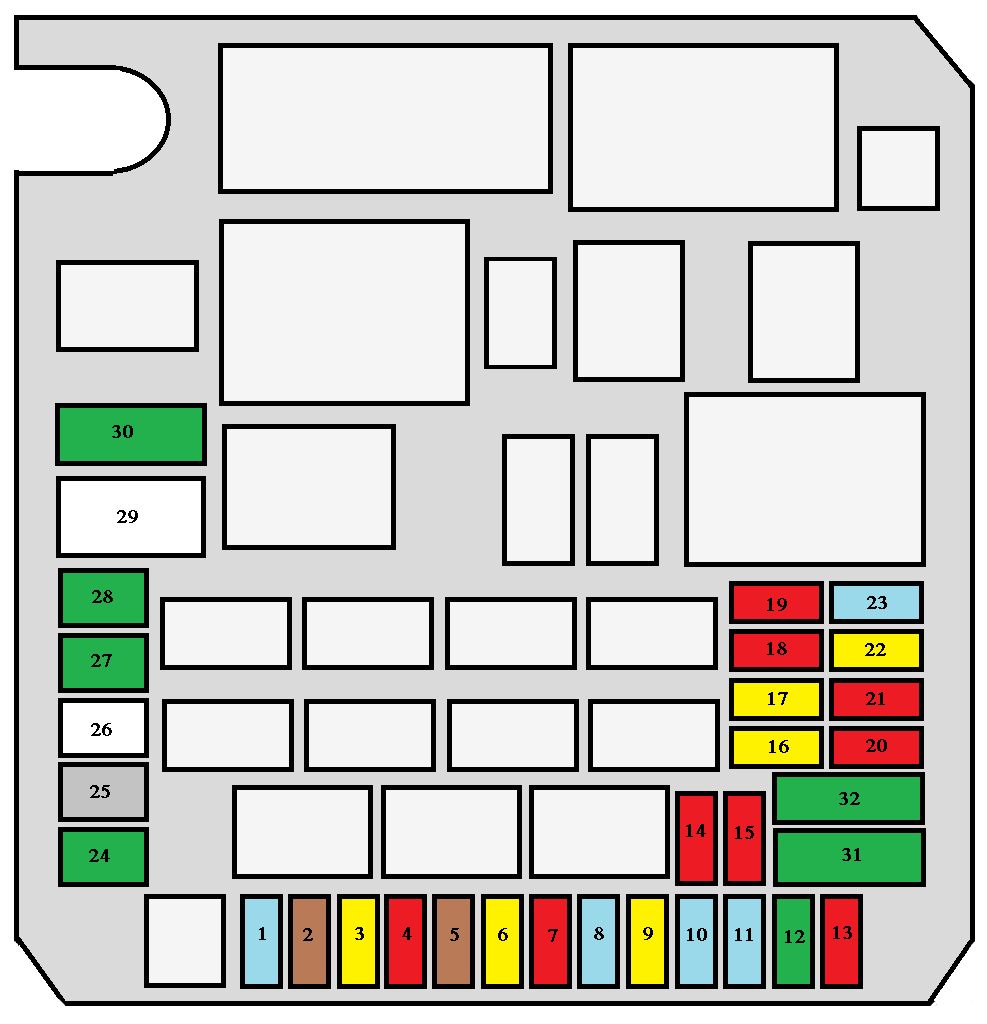
| Pozycja | Amperaż [A] | Chroniony obwód / funkcja |
|---|---|---|
| 1 | 15 | Front fog lamps |
| 2 | 7 | Engine electronic control unit for the 2.4-litre 16V petrol engine |
| 3 | 20 | CVT automatic transmission ECU and CVT control relay on equipped petrol models |
| 4 | 10 | Horn |
| 5 | 7.5 | 2.4-litre 16V alternator circuit in the 2008/2010 English handbook; later regional editions describe a 2.4-litre starter-related feed – check the exact manual |
| 6 | 20 | Headlamp washer system where fitted |
| 7 | 10 | Air conditioning system |
| 8 | 15 | Engine ECU for 2.4-litre 16V petrol engine |
| 9 | – | Unused fuse position |
| 10 | 15 | Demisting and windscreen-wiper control |
| 11 | – | Unused fuse position |
| 12 | – | Unused fuse position |
| 13 | – | Unused fuse position |
| 14 | 10 | Left main-beam headlamp |
| 15 | 10 | Right main-beam headlamp |
| 16 | 20 | Left dipped-beam xenon headlamp |
| 17 | 20 | Right dipped-beam xenon headlamp |
| 18 | 10 | Left standard dipped-beam headlamp and manual/automatic headlamp aim |
| 19 | 10 | Right standard dipped-beam headlamp |
| 20 | – | Unused fuse position |
| 21 | 10 | Ignition coils – petrol engine |
| 22 | 20 | Engine control and fuel-management electronics, water-in-diesel sensor, diesel injection pump, air-flow, oxygen/camshaft and EGR/variable-timing sensors or valves depending on engine; detailed sensor allocation published in the 2010-2012 instructions |
| 23 | 15 | Petrol fuel pump and fuel-level gauge |
| 24* | 30 | Starter motor power supply – Maxi fuse |
| 25 | – | Unused fuse position |
| 26* | 40 | ABS and Active Stability Control (ASC) power supply – Maxi fuse |
| 27* | 30 | Second ABS/ASC power supply – Maxi fuse |
| 28* | 30 | Air-conditioning condenser fan – Maxi fuse |
| 29* | 40 | Radiator cooling fan – Maxi fuse |
| 30 | 30 | Passenger compartment fuse box power supply |
| 31 | 30 | Audio power amplifier main supply |
| 32 | 30 | Diesel engine electronic control unit power feed |
Engine positions 24*, 26*, 27*, 28* and 29* are Maxi fuses. Other high-current relay/control assemblies are equipment dependent and are not assigned unverified numbers.
Spare fuses 33-35 inside the engine box cover
The engine fuse cover stores 33 (10 A), 34 (15 A) and 35 (20 A) as spares. These are not circuits that power separate equipment. Peugeot’s handbook also notes that its spare selection does not include 7.5 A, 25 A or 30 A replacements; do not confuse that emergency-spare guidance with permission to fit higher-rated protection during normal service. Always match the rating required by the actual electrical circuit.
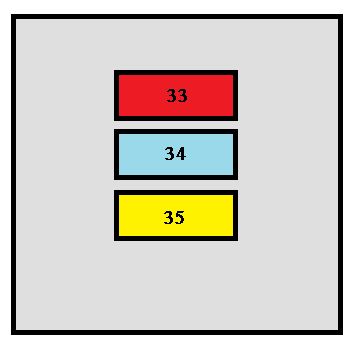
| Pozycja | Amperaż [A] | Chroniony obwód / funkcja |
|---|---|---|
| 33 | 10 | Spare, not connected to a powered circuit; stored beneath the engine fusebox cover |
| 34 | 15 | Spare, not connected to a powered circuit; stored beneath the engine fusebox cover |
| 35 | 20 | Spare, not connected to a powered circuit; stored beneath the engine fusebox cover |
Practical checks for common Peugeot 4007 electrical faults
12 V accessory socket dead: Start with passenger fuse 19 at 15 A, inspect the socket for metal objects, then check its wiring. Horn silent: Engine fuse 4 at 10 A, followed by the sounder, relay and wiring. Rear wiper not moving: Cabin fuse 11 at 15 A and the tailgate wiring loom. Front wipers not working: Cabin fuse 4 at 30 A, plus engine fuse 10 at 15 A for wiper-related control where relevant. If a fuse is intact, a seized linkage or motor can still be responsible.
Four-wheel-drive warning or selector not responding: Cabin fuse 17 (10 A) supplies the 4WD controller, while position 12 (7.5 A) also feeds several control modules including 4WD/ABS; a fault-code scan is needed before replacing an ECU. ABS/ASC warning: Check professional-service engine Maxi fuses 26*/27* using approved high-current procedures; wheel-speed sensors and control modules may be at fault even with good fuses. Starter does not crank: Engine 24* (30 A) is its listed high-current protection, not an ordinary cabin fuse.
Other Peugeot fuse and engine system references
For the adjacent owner-manual edition see Peugeot 4007 (2008). The Peugeot 3008 I is another crossover but uses a separate Peugeot electrical system, and the Peugeot 5008 I has different cabin and high-current fuse positions. Do not transfer ratings or diagrams from those models.
Technical source: Peugeot 4007 2010 and 2011-2012 owner’s handbook, Practical Information, dashboard, engine compartment and spare-fuse tables. Exact equipment, drivetrain and regional versions may vary.