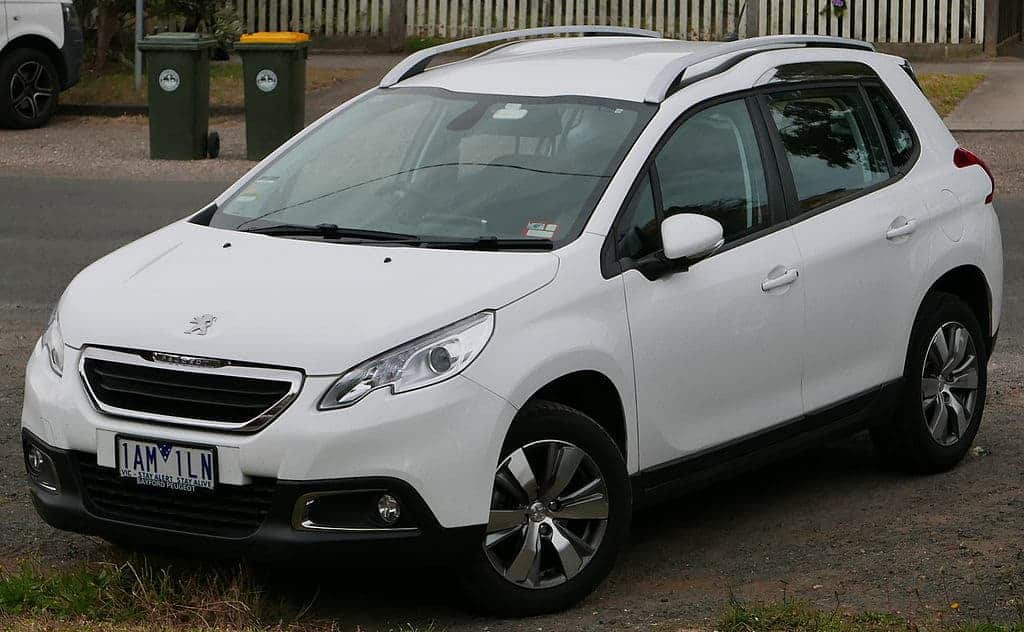
The first-generation Peugeot 2008, launched in 2013 and sold through the transition to the second generation in 2019, has two separate dashboard fuse carriers and an engine-compartment fusebox. This guide preserves all 32 manufacturer-listed technical positions in three complete tables, including unused sockets, optional equipment and the changes made during production. The important engine F16 position is 15 A in both documented versions, but its function changes from fog lamps in earlier manuals to daytime running lights in the 2016 edition. Confirm the vehicle’s original model year and fuse-board variant rather than combining different manuals into one allocation.
Fuse box locations and how to open them
Left dashboard: Turn off ignition and all electrical consumers. On left-hand-drive vehicles the fuse carrier is at the bottom of the dashboard, to the left of the steering column. Remove the lower service cover starting at the upper edge; its exact fasteners vary with dashboard trim. The fuse extraction tweezers are provided with the Peugeot vehicle tools. This carrier supplies the horn, lighter/12 V outlet, radio and touchscreen, washer pump and rear wiper.
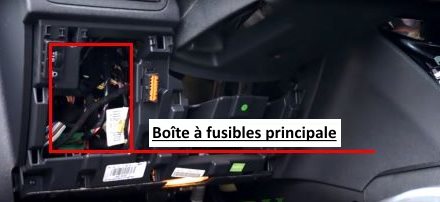
Second dashboard fusebox: A separate carrier is reached behind or alongside the passenger glovebox, depending on steering position and interior trim. Open the glovebox and release the cover indicated in the handbook. This block has an independent set of F01-F12 numbers, with the rear screen heater, power windows, heated seats and folding mirrors. The F09 here is not the F9 5 A alarm fuse in the first cabin board.
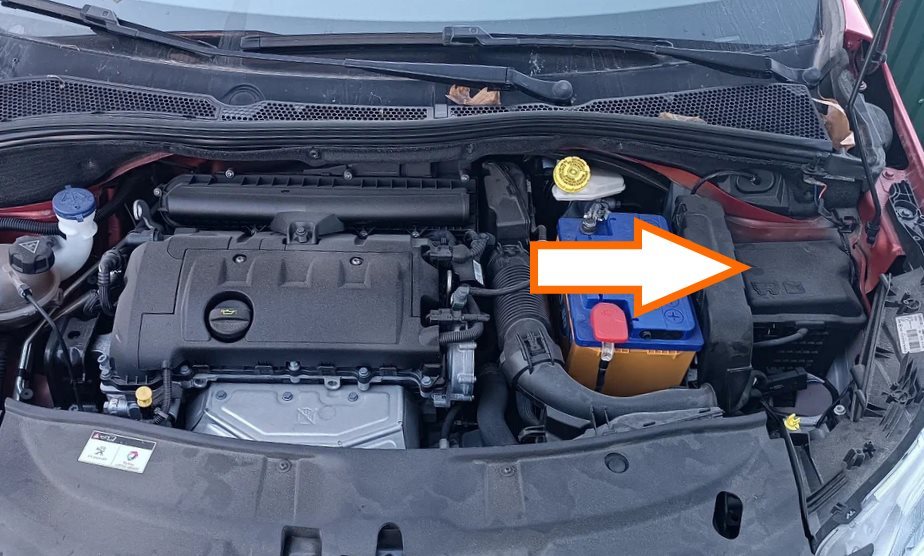
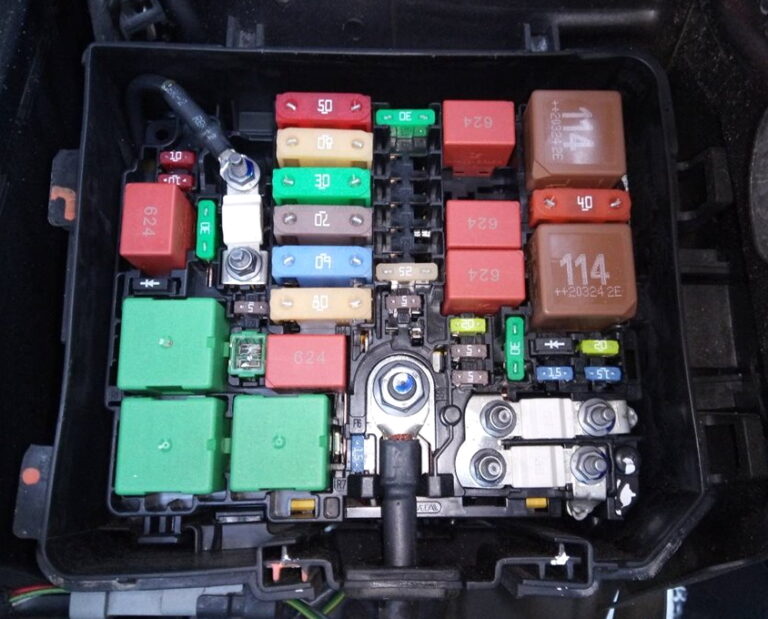
Under the bonnet: Open the bonnet and find the sealed electrical box close to the battery on the left side of the engine bay. Release the plastic lid clips; check the numbered fuses, then refit the cover carefully to restore its water seal. Additional high-current links and integrated BSM relays exist but their functions are not fully included in the short owner-replaceable table and cannot be assigned by fuse number alone.
Important production and equipment differences
The earlier 2013-2015 engine documentation gives F16 15 A for the front fog lamps. The 2016 Peugeot 2008 handbook instead assigns F16 15 A to daytime running lamps. These are alternative installations, not two devices necessarily powered by one fuse. Right dashboard F04 can appear with no rating alongside a heated-seat designation in later handbooks and unused in earlier diagrams, while F09 (15 A) supplies heated seats and may also serve non-one-touch front windows on later cars. A dash in the amperage column must not be interpreted as a recommendation to install an unspecified fuse.
Some Peugeot 2008 cars first registered in 2019 are still the first-generation model, while the new 2008 II uses a different electrical layout. Check the vehicle generation rather than registration date alone. Petrol PureTech, HDi/BlueHDi and market-specific lighting may have different additional BSM protections not itemised in the owner table.
Main left-hand dashboard fuse carrier
The front accessory outlet and cigarette lighter use F16 15 A in this cabin carrier. Radio and audio equipment use F17 15 A, touchscreen displays F18 20 A, the horn F26 15 A, washer pump F27 15 A and rear wiper F30 15 A. F2 5 A feeds mirror/headlamp/diagnostic equipment while F9 5 A is the alarm. These are dashboard positions – engine F16 has a different function.
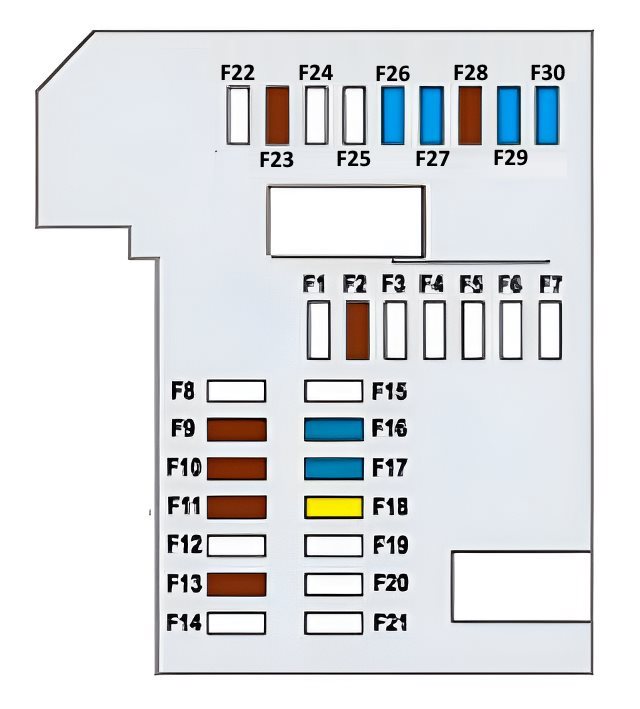
| Pozycja | Amperaż [A] | Chroniony obwód / funkcja |
|---|---|---|
| F2 | 5 | Door mirrors, headlamp controls and diagnostic connector |
| F9 | 5 | Factory alarm system |
| F10 | 5 | Independent telematics unit and, if equipped, trailer module interface |
| F11 | 5 | Electrochromatic interior mirror and additional heating; Active City Brake equipment on some later cars |
| F13 | 5 | Hi-Fi amplifier and rear parking aid; reversing camera on certain later configurations |
| F16 | 15 | Front 12 V accessory socket and cigarette lighter power supply |
| F17 | 15 | Audio system without the factory touchscreen in earlier production and relevant radio equipment |
| F18 | 20 | Touchscreen and integrated multimedia equipment |
| F23 | 5 | Glovebox lighting, vanity mirror lights and cabin reading lamps |
| F26 | 15 | Horn |
| F27 | 15 | Front/rear screen washer pump |
| F28 | 5 | Anti-theft system and steering-column locking, depending on version |
| F29 | 15 | Air-conditioning compressor control |
| F30 | 15 | Rear window wiper motor |
Right-hand dashboard fuse carrier behind the glovebox
F01 40 A protects the heated rear window, F02 10 A the heated door mirrors, F03/F05 30 A the front and rear one-touch windows, F06/F07 10 A the folding mirrors and F10 20 A the optional Hi-Fi amplifier. F09 15 A is the optional heated-seat feed and on later variants can also protect front non-one-touch electric windows. F04, F08, F11 and F12 have no specified conventional amp rating in the listed variant. All twelve source positions are included below.
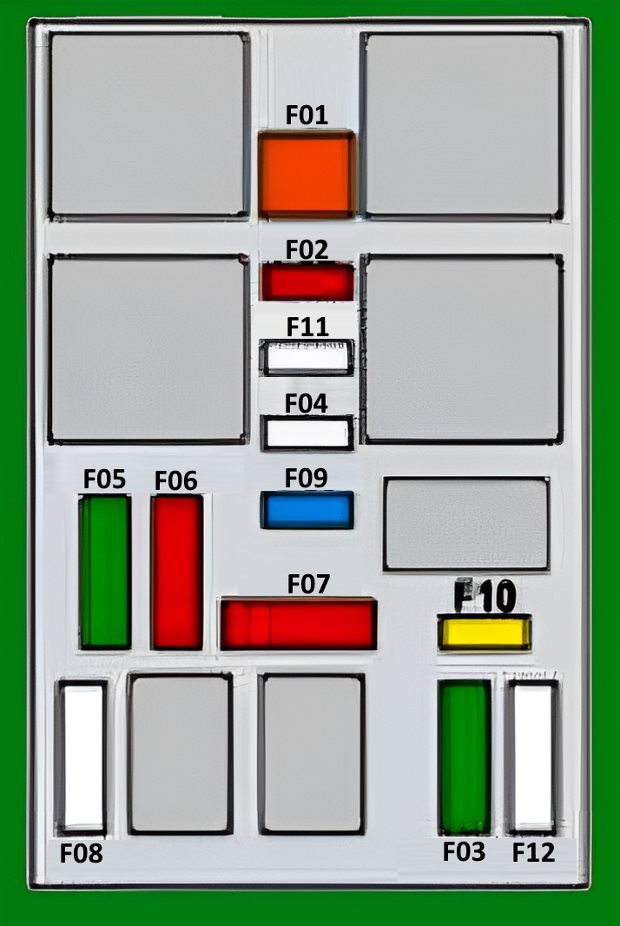
| Pozycja | Amperaż [A] | Chroniony obwód / funkcja |
|---|---|---|
| F01 | 40 | Heated rear window |
| F02 | 10 | Heated exterior mirrors |
| F03 | 30 | Front one-touch electric window motors |
| F04 | – | Heated front seat designation shown without a current rating in some later manuals; earlier configuration lists this socket as unused. Do not install a fuse without vehicle-specific approval |
| F05 | 30 | Rear one-touch electric window motors |
| F06 | 10 | Electric folding exterior door mirrors, first circuit |
| F07 | 10 | Electric folding exterior door mirrors, second circuit |
| F08 | – | Unused fuse position |
| F09 | 15 | Heated front seats where fitted; on later vehicles also front electric windows without one-touch operation |
| F10 | 20 | Optional Hi-Fi sound amplifier |
| F11 | – | Unused fuse position |
| F12 | – | Unused fuse position |
Under-bonnet fusebox and relay carrier
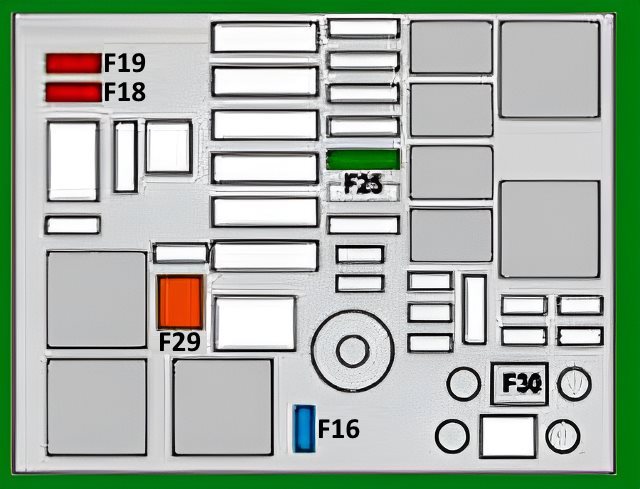
The main engine-bay fuseboard sits beside the battery. The 2013-2015 handbook specifies F16 15 A for front fog lamps while the 2016 edition calls it the daytime running lamp circuit. In both cases F18/F19 10 A protect right/left main-beam headlamps, F25 30 A an optional headlamp wash relay, F29 40 A the front wiper motor and F30 80 A diesel glow plugs. The last position is not a petrol-engine circuit.
| Pozycja | Amperaż [A] | Chroniony obwód / funkcja |
|---|---|---|
| F16 | 15 | 2013-2015: front fog lamps (15 A). 2016-2018 handbook: daytime running lights (15 A). The function changes with the original electrical installation |
| F18 | 10 | Right main-beam headlamp |
| F19 | 10 | Left main-beam headlamp |
| F25 | 30 | Headlamp wash relay on cars equipped with the optional wash system |
| F29 | 40 | Front windscreen wiper motor, low and high speed |
| F30 | 80 | Diesel glow-plug and preheating system, where fitted |
Common electrical symptoms and where to start
Front 12 V socket or cigarette lighter has no power: Check left dashboard F16 (15 A) and inspect the outlet for foreign metal or overheated contacts. Radio fails: F17 (15 A), followed by the radio connectors. Touchscreen stays black: F18 (20 A) and the multimedia power connection. A functioning radio does not guarantee its separate touchscreen feed is sound.
Horn is silent: Left dashboard F26 (15 A), then the horn assembly, switch and wiring. Rear wiper stops: Left dashboard F30 (15 A) and the wiring passing through the tailgate hinge. Front wipers stop: Engine F29 (40 A), wiper motor, mechanical linkage and relevant relay module. Rear window heater fails: Right dashboard F01 (40 A), then the heated glass connectors.
Heated front seats do not work: Check right dashboard F09 (15 A) in a vehicle equipped with the option; a nominally empty F04 cannot be fitted with a guessed fuse. Fog lamps or daytime running lamps fail: The correct function of engine F16 must be established from the original year-specific configuration. Cold diesel starting: Engine F30 (80 A) supplies preheating; glow plugs, voltage, relay and control faults can produce similar symptoms. Never increase a fuse rating to silence repeated failures.
Related Peugeot model fuse diagrams
The Peugeot 208 I A9 (2012-2019) shares elements of this electrical architecture but has its own body and equipment options. The Peugeot 2008 II (2019-2022) belongs to a different generation. For an earlier larger crossover see Peugeot 3008 I; its fuse numbering and ratings must not be applied to the 2008.
Technical basis: Peugeot 2008 owner’s guides for 2013, 2015 and 2016 (Practical Information, fuse tables). Factory options and production-market installations can alter the available consumers.