The Dacia Jogger XJF (2022-2024) is the European family estate / crossover, offered with the 1.0 TCe 110 petrol engine, factory 1.0 ECO-G 100 LPG system and, later, the Hybrid 140 powertrain. It has cabin and engine-compartment fuse protection. The Hybrid 140 also uses a separate high-current distribution unit in the luggage area. These powertrains do not all share the same fuse layout.
Dacia’s owner manual identifies many cabin fuses by symbols without providing universal numerical positions and ratings for every 2022-2024 configuration. No missing numbers have been guessed here. The separate F1-F15 charts show documented ECO-G and Hybrid 140 arrangements, with unused sockets retained. Before using any rating, check the exact engine and actual fuse-carrier layout.
Contents
Where are the Dacia Jogger fuse boxes?
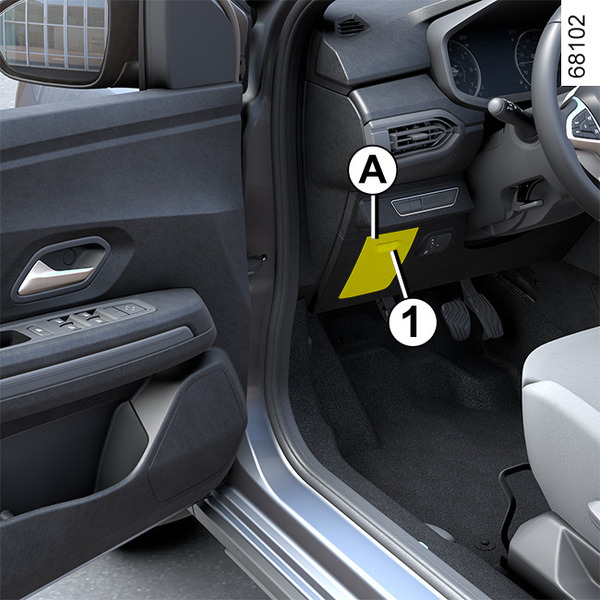
Dashboard: turn off the ignition and open the driver’s door. Find cover A on the left-hand side / lower edge of the dashboard. Press the release recess marked 1 to remove cover A. On some versions, there is a different cover B, released at recess 2. The fuse puller is clipped to the back of the cover. Match the printed fuse symbol to the sticker in your own vehicle.
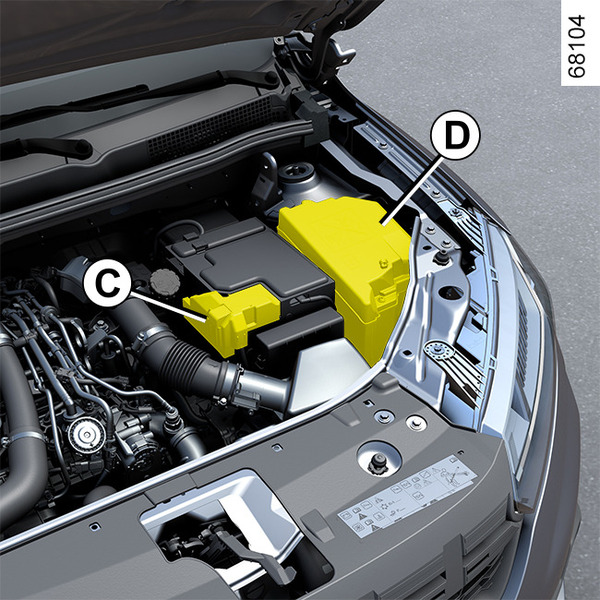
Engine compartment: with the ignition fully off, open the bonnet. In Dacia’s illustration the fuse assemblies marked C and D sit near the battery and forward part of the engine bay. These units are harder to access than the cabin box. Dacia recommends specialist attention for the under-bonnet fuses, especially the high-current links. Refit the covers properly to keep moisture out of the electrical connections.
Hybrid 140 luggage area: the hybrid powertrain also has low-voltage main fuses in the luggage compartment near the electrical supply equipment. The 200 A and 40 A main protection devices are not normal owner-replaceable blade fuses. Never touch orange high-voltage covers or wiring.
Passenger-compartment fuses – Dacia’s factory symbols
The manufacturer labels these functions with icons on the interior fuse-cover legend. A dash in the Position or Amperage column means no common numeric assignment is supplied for all listed Jogger variants; it does not mean the fuse is absent. Use the actual vehicle’s cover sticker to identify and rate the appropriate fuse.
| Pozycja | Amperaż [A] | Chroniony obwód / funkcja |
|---|---|---|
| – | – | Factory horn symbol – horn circuit |
| – | – | Factory front-window symbol – front electric window lifts |
| – | – | Factory rear-window symbol – rear electric window lifts |
| – | – | Factory STOP / UCH symbol – brake lights and central body control unit |
| – | – | Factory lighting symbol – interior roof lamp and luggage area lamp |
| – | – | Factory multimedia symbol – multimedia sockets |
| – | – | Factory trailer symbol – towbar electrical socket |
| – | – | Factory washer symbol – windscreen washer pump and steering-column switch |
| – | – | Factory indicator symbol – turn signals and body control unit |
| – | – | Factory 12 V socket symbol – accessory / cigarette lighter socket |
| – | – | Factory heated-mirror symbol – heated exterior mirrors |
| – | – | Factory mirror-adjustment symbol – electric exterior mirror controls |
| – | – | Factory LPG symbol – LPG fuel supply cut-off, or petrol and LPG cut-off, depending on configuration |
Dacia Jogger 1.0 ECO-G 100 – engine compartment fuses F1-F15
This table describes one documented European 1.0 ECO-G installation with engine H4D-480. The Euro 6d alternative below may protect similar circuits in different numbered sockets. Compare the actual power distribution module before applying the table.
| Pozycja | Amperaż [A] | Chroniony obwód / funkcja |
|---|---|---|
| F1 | 10 | Brake-light switch, gear-selector controller and reversing lights |
| F2 | – | Unoccupied position |
| F3 | 10 | Third ignition-switched power relay |
| F4 | – | Unoccupied position |
| F5 | 10 | Fuel-injection ECU and variable valve timing solenoids for intake and exhaust |
| F6 | 5 | Engine injection ECU and LPG system controller |
| F7 | 30 | Front windscreen wiper motor |
| F8 | – | Unoccupied position |
| F9 | 15 | Vacuum pump relay or cooling-fan assembly; in other variants, cylinder 1-3 injectors |
| F10 | – | Unoccupied position |
| F11 | – | Unoccupied position |
| F12 | 15 | Engine-management control components |
| F13 | 10 | Fuel-injection control unit |
| F14 | 30 | ABS / ESP control unit |
| F15 | 20 | Ignition coils 1-3, or LPG controller, LPG pump cut-off and fuel pump, depending on configuration |
Dacia Jogger ECO-G Euro 6d – alternative F1-F15 arrangement
This separate installation variant places the 30 A windscreen-wiper circuit at F9, instead of F7 in the preceding ECO-G table, while the 30 A ABS / ESP supply moves to F2. This is not a reason to insert a 30 A fuse in F9 on every Jogger. Use this chart only if it matches the fitted engine compartment module.
| Pozycja | Amperaż [A] | Chroniony obwód / funkcja |
|---|---|---|
| F1 | – | Unoccupied position |
| F2 | 30 | ABS / ESP control unit |
| F3 | 20 | Ignition coils 1-3, or LPG controller and gas-pump cut-off relay |
| F4 | 15 | Vacuum pump relay, fan supply or cylinder 1-3 injectors |
| F5 | 15 | Engine-management components |
| F6 | 10 | Fuel-injection ECU and variable valve timing solenoids |
| F7 | 10 | Fuel-injection controller |
| F8 | – | Unoccupied position |
| F9 | 30 | Front windscreen wiper motor |
| F10 | – | Unoccupied position |
| F11 | 10 | Third ignition-switched power relay |
| F12 | – | Unoccupied position |
| F13 | 10 | Reversing lights and brake-light switch |
| F14 | – | Unoccupied position |
| F15 | 5 | Engine ECU and LPG system controller |
Dacia Jogger Hybrid 140 – under-bonnet fuses F1-F15
The 1.6 Hybrid 140, with H4M-632 petrol engine and electric drive equipment, has a different supply arrangement from the 1.0 TCe / ECO-G variants. All 15 positions in the documented European engine-bay block are reproduced, including unused sockets. Do not apply this hybrid chart to an LPG model.
| Pozycja | Amperaż [A] | Chroniony obwód / funkcja |
|---|---|---|
| F1 | 10 | Brake-light switch, gear-selector controller and reversing lights |
| F2 | – | Unoccupied position |
| F3 | – | Unoccupied position |
| F4 | – | Unoccupied position |
| F5 | 10 | Fuel-injection ECU and variable valve timing solenoids |
| F6 | 5 | Fuel-injection controller and electric powertrain control |
| F7 | 30 | Front windscreen wiper motor |
| F8 | – | Unoccupied position |
| F9 | 15 | Cylinder 1-4 fuel injectors |
| F10 | 15 | Fuel-injection controller |
| F11 | – | Unoccupied position |
| F12 | 15 | Engine management, oxygen sensor and evaporative-emissions purge solenoid |
| F13 | 10 | Fuel-injection control unit |
| F14 | 30 | ABS / ESP control unit |
| F15 | 20 | Fuel pump, fuel-level sensor and fuel-temperature sensor |
Dacia Jogger Hybrid 140 – luggage compartment main fuses
The Hybrid 140 service layout also includes positions F1-F3 in a rear main-fuse assembly. The 200 A F2 protects supply to the engine-bay distribution box, while 40 A F3 supplies the cabin fuse and relay panel. These are main protection devices: leave replacement to qualified personnel.
| Pozycja | Amperaż [A] | Chroniony obwód / funkcja |
|---|---|---|
| F1 | – | Unoccupied position |
| F2 | 200 | Main power supply to the engine-compartment fuse box |
| F3 | 40 | Main power supply to the passenger-compartment fuse and relay panel |
Why do Dacia Jogger fuse layouts differ?
1.0 TCe 110: its petrol-only engine wiring is not the same as the ECO-G LPG arrangement. Do not select TCe fuses from the ECO-G list without checking the installed vehicle.
1.0 ECO-G 100: factory LPG equipment adds a dedicated controller and fuel cut-off functions. The cabin may include an LPG cut-off fuse, while some engine-bay protection feeds the LPG ECU and pump shut-off circuit.
Euro 6d: even within 1.0 ECO-G, documented electrical variants move the wiper and injection circuits between F7 and F9; F2, F14 and F15 also differ.
Hybrid 140: the hybrid’s additional drive electronics and rear high-current fuses are not equivalent to the ordinary 12 V accessory fuses. Hybrid-drive faults should be assessed with the correct diagnostic equipment.
Common Dacia Jogger electrical faults – what to check
The 12 V accessory socket has no power: look for the cigarette-lighter / accessory-socket symbol on the dashboard fuse cover. The exact socket and current rating must be read from the installed fuse legend. If the fuse is sound, inspect the outlet for a loose contact or trapped metal object.
The front wipers do not work: the first ECO-G table identifies F7 (30 A), whereas the Euro 6d variant uses F9 (30 A). The Hybrid 140 table shows F7 (30 A). Never treat these separate configurations as interchangeable.
The horn does not work: locate the horn symbol on the dashboard legend. If the specified fuse is intact, inspect the relay supply, horn connector and switch circuit.
An ECO-G model will not start: check the fuel-injection controller, LPG control unit and ignition-coil feeds against the correct variant. Fuse F15 does not have one fixed role in all ECO-G and hybrid models.
An ABS / ESP warning is displayed: one ECO-G variant lists F14 (30 A), another lists F2 (30 A), and the documented Hybrid 140 again lists F14 (30 A). If the correct fuse and supply are good, retrieve fault codes and check wheel sensors.
An electric window has failed: look for the front- or rear-window symbol. If only one door is affected, also inspect the wiring loom in the flexible door-to-body conduit.
Never install a higher-rated fuse or populate an unused socket without a vehicle-specific reason. See the Dacia Sandero II fuse guide and Dacia Logan I fuse guide for related models, but do not transfer their fuse positions to the Jogger.