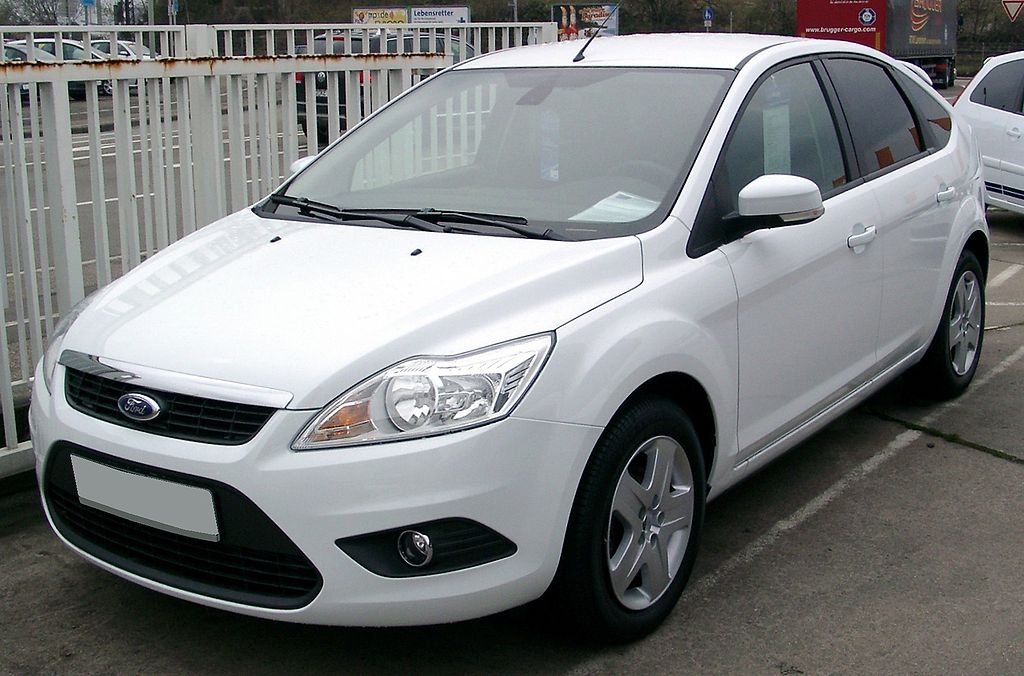
The Ford Focus Mk2 (2004-2011) uses a central passenger-compartment fuse box and an additional engine-compartment fuse box. The exact engine-bay assignments vary by engine and specification, which is why the source article retains two separate engine-box tables instead of forcing them into a single layout.
The complete tables below preserve every source row, including positions marked not used and the separate Focus ST, diesel and convertible variants.
Some electrical architecture from this period is shared across Ford’s C1-platform family, including the Ford C-MAX Mk1 and the later Ford Kuga Mk1, but fuse numbers and equipment assignments should always be checked against the specific model.
Central fuse box

| Fuse | Rating [A] | Protected component / function |
|---|---|---|
| 37 | 10 | Left high beam |
| 38 | 10 | Right high beam |
| 39 | 20 | Cigarette lighter, rear power socket |
| 40 | 20 | Power moonroof |
| 41 | 20 | Front passenger door module |
| 42 | 7.5 | Heated mirrors |
| 43 | 10 | Electronic modules – battery supply (heater controls, steering column, DPF, remote receiver, DVD player, alarm) |
| 44 | 10 | Diagnostic connector |
| 45 | 10 | Daytime running lamps / parking lamps |
| 46 | 10 | Instrument cluster battery supply, central fuse box |
| 47 | 15 | Washer pump, heated washer jets |
| 48 | 20 | Low beam and daytime running lamps |
| 49 | 15 | Lighting-switch battery supply |
| 50 | 20 | Windshield wiper |
| 51 | 15 | Fuel pump |
| 52 | 25 | Heated rear window |
| 53 | 7.5 | Left parking/side/tail lamps |
| 54 | 7.5 | Right parking/side/tail lamps |
| 55 | 20 | Central locking, driver door module |
| 56 | 20 | Keyless system |
| 57 | 10 | Power-folding mirror or battery-backed alarm sounder |
| 58 | 15 | Audio modules – battery supply |
| 59 | 20 | Trailer-tow module |
| 60 | 15 | Right low beam |
| 61 | 15 | Left low beam |
| 62 | 20 | Driver power seat |
| 63 | 25 | Power windows |
| 64 | 20 | Not used |
| 65 | 10 | Airbag module |
| 66 | 7.5 | Lighting-switch ignition supply |
| 67 | 10 | Instrument-cluster ignition supply, engine immobilizer |
| 68 | 7.5 | Instrument-cluster accessories |
| 69 | 20 | Fog lamps |
| 70 | 10 | Electronic modules – ignition supply |
| 71 | 10 | Daytime running lamps |
| 72 | 25 | Not used |
| 73 | 7.5 | License-plate lamps |
| 74 | 15 | Stop lamps |
| 75 | 10 | Powertrain control module / steering-assist module / accelerator pedal / automatic transmission |
| 76 | 7.5 | Electric parking brake |
| 77 | 25 | Central-locking relay |
| 78 | 15 | Rear-window wiper |
| 79 | 15 | Luggage-compartment power socket |
| 80 | 10 | Battery saver, interior lighting |
| 81 | 20 | Right rear door module |
| 82 | 20 | Left rear door module |
| 83 | 10 | Premium audio-system modules |
| 84 | 10 | Reversing lamp, ignition supply to trailer connector |
| 85 | 10 | Cooling |
| 86 | 20 | Heated front seats |
Additional engine-compartment fuse box – version 1

This shorter table follows the Polish owner-manual configuration retained in the source article.
| Fuse | Rating [A] | Protected component / function |
|---|---|---|
| 13 | 20 | Starter solenoid |
| 21 | 20 | Fuel-fired heater |
| 26 | 10 | Automatic transmission |
| 30 | 10 | Engine control module |
| 32 | 10 | Oxygen sensors |
| 33 | 10 | Oxygen sensors |
| 35 | 10 | Engine control module |
| 36 | 10 | Powertrain module |
Engine-compartment fuse box – version 2
The second table follows the English-language European manual configuration and includes the full high-current, gasoline, diesel, Focus ST and convertible variants.
| Fuse | Rating [A] | Protected component / function |
|---|---|---|
| 1 | 50 | Cooling fan |
| 2 | 80 | Power steering |
| 3 | 60 | Central fuse-box supply – circuit 1 |
| 4 | 60 | Central fuse-box supply – circuit 2 |
| 5 | 80 | Air conditioning |
| 6 | 60 | Auxiliary heater – diesel only |
| 7 | 30 | Auxiliary heater – diesel only |
| 8 | 20 | ABS, traction-control valves |
| 9 | 20 | Powertrain control module (PCM) – all versions except Focus ST |
| 9 | 30 | Powertrain control module (PCM) – Focus ST only |
| 10 | 30 | Blower motor |
| 11 | 20 | Ignition switch |
| 12 | 40 | Ignition relay 15I |
| 13 | 20 | Starter solenoid |
| 14 | 40 | Heated windshield – right-hand side |
| 15 | 30 | Cooling-fan relay |
| 16 | 40 | Heated windshield – left-hand side |
| 17 | 30 | Electric parking brake – all versions except convertible |
| 17 | 30 | Roof control module – convertible only |
| 18 | – | Not used |
| 19 | 10 | ABS module |
| 20 | 15 | Horn |
| 21 | 20 | Auxiliary heater |
| 22 | 10 | Power-steering module |
| 23 | 30 | Headlamp washers |
| 24 | 15 | Auxiliary heater – diesel only |
| 25 | 10 | Ignition, relays |
| 26 | 10 | Automatic transmission |
| 27 | 10 | A/C compressor clutch |
| 28 | 10 | Glow-plug monitoring – diesel only |
| 29 | 10 | Dual-zone climate control |
| 30 | 10 | Powertrain control module (PCM), automatic transmission |
| 31 | 10 | Smart-charging battery sensor |
| 32 | 10 | Automatic transmission |
| 32 | 10 | Fuel-injection supply – Focus ST only |
| 33 | 10 | Oxygen sensors – gasoline only |
| 33 | 10 | Intercooler valve – diesel only |
| 33 | 20 | Oxygen sensors – Focus ST only |
| 34 | 10 | Fuel injectors, ignition transformers |
| 35 | 10 | Powertrain control module (PCM), valves and solenoids – all versions except Focus ST |
| 35 | 15 | Powertrain control module (PCM), valves, solenoids, crankcase heating – Focus ST only |
| 36 | 10 | Powertrain control module (PCM) |
Commonly checked fuses
- Cigarette lighter / rear power socket: central fuse 39 – 20 A.
- Diagnostic connector: central fuse 44 – 10 A.
- Fuel pump: central fuse 51 – 15 A.
- Audio modules: central fuse 58 – 15 A; premium audio also uses fuse 83 – 10 A.
- Heated front seats: central fuse 86 – 20 A.
- Heated windshield: engine fuses 14 and 16 – 40 A each in version 2.
- Horn: engine fuse 20 – 15 A in version 2.
FAQ – Ford Focus Mk2 fuses
Where is the cigarette-lighter fuse?
Central fuse 39 – 20 A also protects the rear power socket.
Which fuse protects the diagnostic connector?
Central fuse 44 – 10 A.
Where is the fuel-pump fuse?
Central fuse 51 – 15 A.
Why are there two engine-compartment tables?
The source article preserves two European-manual configurations. Version 1 is a shorter Polish-manual list; version 2 is the fuller English-European list with additional engine and body-style variants. They are intentionally kept separate.
Why do some numbers appear more than once in version 2?
Ford uses different assignments or ratings for specific configurations. Examples include F9 for Focus ST, F17 for convertible models and F33 for gasoline, diesel and Focus ST variants.
Can the Focus Mk2 table be used for the C-MAX Mk1?
No. The vehicles share some platform architecture, but fuse assignments must be checked separately for each model.