
The sixth-generation Honda Accord built for the United States and Canada (1998-2002) is available as a sedan or coupe and has three principal fuse boxes. Two separate fuse and relay panels sit at opposite ends of the dashboard and the main high-current box is in the engine compartment. This is the North American configuration, not the same as every European-market Accord. The original Polish article retained an older URL mentioning 1997, but the diagrams and this guide refer specifically to the 1998-2002 US and Canadian vehicles.
Where are the Honda Accord VI fuse boxes?
Driver-side dashboard: Switch the ignition off and open the front driver’s door. Locate the small fuse access cover on the outside edge of the lower dashboard, release it and pull gently to expose fuse locations 1-13. Three additional relay positions, R1-R3, are shown on the back of this module.
Passenger-side dashboard: Open the front passenger door and release the access cover at the opposite end of the dashboard. This is an independent fuse panel numbered 1-16, with a separate R1-R3 relay set. Fuse 9 in this passenger box, not fuse 9 on the driver’s side, protects the lighter and radio accessory feed.
Engine compartment: With the ignition off, lift the bonnet and find the main covered distribution box toward the back on the passenger side of North American cars. Remove the lid by releasing its retaining clips. Fuses are numbered 41-59, with relays R1-R7. Large 40-100 A fusible links may be bolt-fixed and should be serviced using the proper Honda electrical procedure.
Driver-side cabin fuse box – positions 1-13 and R1-R3
These fuses cover fuel injection, SRS, climate controls, gauges, ignition circuits, indicators and wipers. The front and back of the panel are shown separately to distinguish the relay sockets from the numbered fuses.
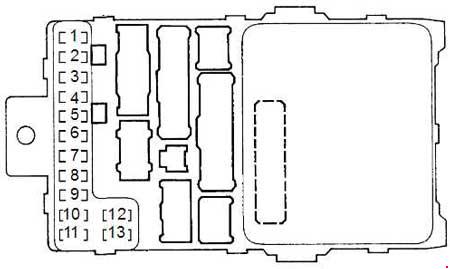
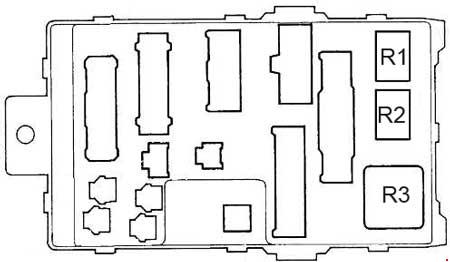
| Pozycja | Amperaż [A] | Chroniony obwód / funkcja |
|---|---|---|
| 1 | 15 | Fuel pump, PGM-FI main injection relay and SRS controller VA supply |
| 2 | 10 | SRS airbag controller VB supply |
| 3 | 7.5 | Heating/A/C controls, compressor clutch and cooling fan relays; also heated seats on Canadian EX |
| 4 | 7.5 | Power mirror adjustment and ABS; ABS/TCS controller on selected 2001-2002 V6 vehicles |
| 5 | 7.5 | Daytime running lights (DRL) on Canadian vehicles only |
| 6 | 15 | ECM/PCM engine controller, cruise control, alternator supply, speed sensor and engine accessories |
| 7 | 7.5 | Sunroof relay, front washer supply and optional SRS side airbags |
| 8 | 7.5 | Accessory (ACC) supply relay |
| 9 | 7.5 | Instrument cluster, reverse lamps, clock, automatic-transmission shift interlock and body electronics |
| 10 | 7.5 | Turn signals and hazard flasher control |
| 11 | 15 | Ignition coil circuit on four-cylinder petrol models |
| 12 | 30 | Front windscreen wipers and washers |
| 13 | 7.5 | Starter signal for ECM/PCM, PGM-FI main relay and starter circuit |
| R1 | – | Starter cut relay |
| R2 | – | Reversing lamp relay |
| R3 | – | Turn signal and hazard warning flasher relay |
Passenger-side cabin fuse box – positions 1-16 and relays
On selected engines meeting ULEV emission requirements, the wide-range oxygen sensor LAF heater has a 20 A alternative at fuse position 6. The two position 14 entries identify alternative ABS and ABS/TCS equipment, not two separate 14-position fuses fitted together.
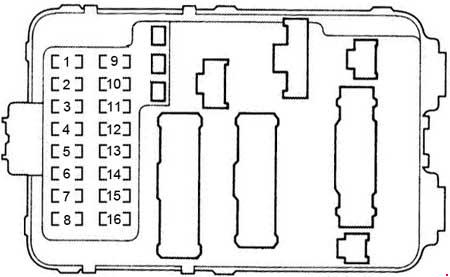
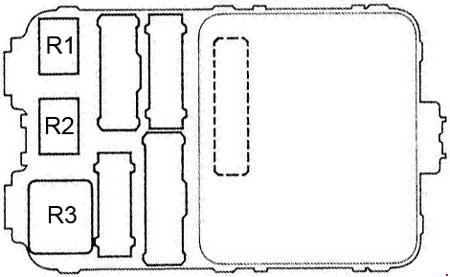
| Pozycja | Amperaż [A] | Chroniony obwód / funkcja |
|---|---|---|
| 1 | 30 | Electric sunroof motor, where fitted |
| 2 | 20 | Power seat height and tilt adjustment, depending on seat design |
| 3 | 20 | Power seat slide motor |
| 4 | 20 | Power passenger seat adjustment, where equipped |
| 5 | 20 | Electric seat recline adjustment |
| 6 | 10 | Daytime running lamps (DRL), Canadian-market models |
| 6 ULEV | 20 | LAF wide-range oxygen sensor heater on ULEV engine specification; alternative position 6 in selected USA models |
| 7 | 20 | Left rear power window and sunroof relays |
| 8 | 20 | Front passenger’s electric window |
| 9 | 20 | Cigarette lighter and radio – primary accessory supply |
| 10 | 10 | Position, licence plate and dashboard illumination |
| 11 | 7.5 | Interior, boot, door and reading lamps |
| 12 | 20 | Door locking and multiplex body control module |
| 13 | 7.5 | Clock and radio memory, A/C and engine controllers and multiplex electronics |
| 14 ABS | 7.5 | ABS controller on non-2001/2002 V6 specifications |
| 14 V6 | 7.5 | ABS/TCS controller on petrol V6 models from 2001-2002; alternative to preceding row |
| 15 | 20 | Driver’s electric window |
| 16 | 20 | Right rear electric window |
| R1 | – | Power window relay |
| R2 | – | 12 V accessory outlet and accessory supply relay |
| R3 | – | Rear-window defogger relay |
Engine compartment fuse box – positions 41-59 and R1-R7
The engine-bay unit supplies the headlights, ABS, windows, powered seats, air conditioning, cooling fans and other high-current circuits. Fuse 44 is unoccupied in the source listing. The R1-R7 relay labels belong specifically to this under-bonnet box.
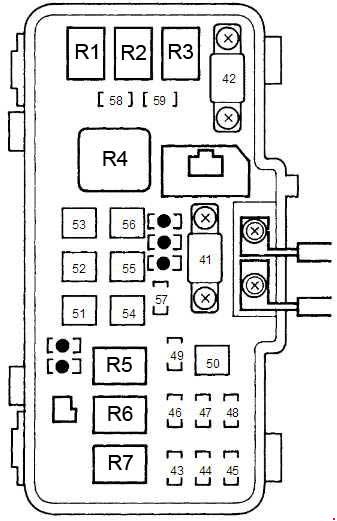
| Pozycja | Amperaż [A] | Chroniony obwód / funkcja |
|---|---|---|
| 41 | 100 | Battery main power distribution |
| 42 | 50 | Ignition switch IG1 primary feed |
| 43 | 20 | Right headlamp; Canadian models also supply DRL control |
| 44 | – | Unused location |
| 45 | 20 | Left headlamp and main-beam warning lamp; DRL control on Canadian models |
| 46 | 15 | PGM-FI injection system control and diagnostic link connector (DLC) |
| 47 | 20 | Brake lamps, cruise control, horn, engine controller and automatic shift/key interlock |
| 48 | 20 | ABS controller or ABS/TCS control on selected V6 specifications |
| 49 | 15 | Hazard warning lights and turn signal flasher |
| 50 | 30 | ABS pump and passenger fuse No. 14 checking supply |
| 51 | 40 | Main power-window supply and relay |
| 52 | 20 | Traction control system (TCS), where fitted |
| 53 | 40 | Rear-window defogger supply |
| 54 | 40 | Passenger fuse board backup and accessory power (ACC) |
| 55 | 40 | Electric seat power supply, where fitted |
| 56 | 40 | Heater / air-conditioning blower motor |
| 57 | 20 | Radiator engine-cooling fan |
| 58 | 20 | Air-conditioning condenser fan and compressor clutch |
| 59 | 20 | Heated front seats on Canadian EX models |
| R1 | – | Air-conditioning condenser fan relay |
| R2 | – | Radiator engine cooling fan relay |
| R3 | – | Air-conditioning compressor clutch relay |
| R4 | – | Heater blower motor relay |
| R5 | – | Horn relay |
| R6 | – | Second headlamp control relay |
| R7 | – | First headlamp control relay |
V6, ULEV, Canadian and body-style differences
Canadian versions may have daytime running lights (DRL) and heated seats, which alter the occupation of several positions. Selected 2001-2002 V6 cars use ABS combined with traction control (TCS): this affects the description of passenger fuse 14 and under-bonnet fuse 48. A ULEV-specification engine may use the additional 20 A LAF heater listing at passenger position 6. Electric seats, sunroofs and power windows also depend on trim and whether the car is a sedan or coupe.
Checking the cigarette lighter, wipers and starting circuits
Radio and 12 V lighter: Passenger-side fuse 9 is rated 20 A and supplies these accessories. The driver’s fuse 9 (7.5 A) protects a different circuit.
Front wipers: Driver-side fuse 12 (30 A) protects the wiper and washer supply. Heated rear window: Under-bonnet fuse 53 (40 A) and the passenger-side R3 relay control the rear demister.
Fuel pump and engine starting: Driver-side fuse 1 (15 A) is associated with the fuel pump and PGM-FI main relay. Under-bonnet engine and starter circuits should be diagnosed alongside the appropriate relays. ABS faults can involve fuses 48 and 50 under the bonnet and passenger-side fuse 14. An illuminated SRS warning lamp calls for diagnostic checks rather than disconnecting airbag connectors indiscriminately.
Accord and Odyssey from a similar production period
The Honda Odyssey II RL1 (1999-2003) also has dashboard fuse boxes on both sides, but the fuse numbering and power sliding door system are different. Never substitute Odyssey assignments for those of an Accord.
Technical basis: Honda Accord Electrical Troubleshooting Manual for 1998-2002, including “Fuse-to-Components Index” and “Power Distribution” for US and Canadian vehicles.