
The North American Honda Odyssey II RL1 (1999-2003) is a large minivan with two separate dashboard fuse boards, a main under-bonnet distribution box and additional high-current circuits for power sliding doors, rear air conditioning and EX-L options. This is not the same installation as the Japanese Odyssey RA6-RA9. The tables distinguish the 1999-2001, 2002 and 2003 layouts, including the separate 11-position secondary engine-bay box on 2003 variants.
Where are the Honda Odyssey RL1 fuse panels?
Main engine compartment box: Turn off the ignition and raise the bonnet. Find the large plastic fuse carrier at the back of the engine bay on the passenger side of US-market models. Release its retaining clips and read positions 1-24. The box includes a 120 A battery fusible link and several spare fuses.
Auxiliary under-bonnet boxes: Near the battery are additional protection blocks serving the automatic sliding doors, rear climate control, heated seats and optional rear entertainment system. On 2002 versions these are represented by two separate two-position panels. Some 2003 vehicles instead use a larger 11-position auxiliary box; do not mix the two layouts.
Driver-side interior box: Open the left front door and find the panel under the dashboard beside the driver’s left leg. It contains fuses 1-13, including fuel pump and wiper protection.
Passenger-side interior box: Open the right front door and pull the right edge of the fuse access cover under the passenger dashboard. Fuse 9 is the 12 V accessory outlet protection on this side. Different right-hand-drive or non-North-American vehicles require their own layouts.
Primary engine compartment fuse box – positions 1-24
All standard and spare positions are shown. The 120 A main battery link is a high-current component and requires the manufacturer’s servicing procedure. The sliding door and powered seat circuits are installed on appropriate EX and EX-L trims.
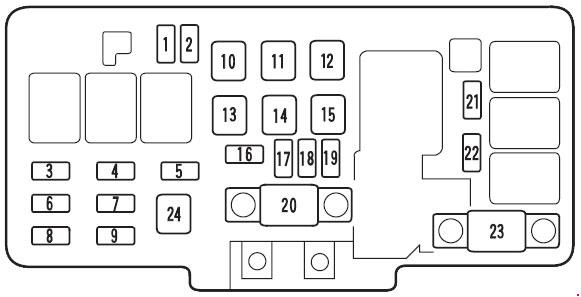
| Pozycja | Amperaż [A] | Chroniony obwód / funkcja |
|---|---|---|
| 1 | 20 | Spare 20 A fuse stored in the engine-bay carrier |
| 2 | 30 | Spare 30 A fuse stored in the engine-bay carrier |
| 3 | 15 | Right-hand front headlamp |
| 4 | 15 | ACGS – Alternator and engine management supply |
| 5 | 15 | Hazard warning lights and indicators |
| 6 | – | Unused position |
| 7 | 20 | Stop / brake lamps |
| 8 | 15 | Left-hand front headlamp |
| 9 | 20 | ABS controller, fail-safe (F/S) circuit |
| 10 | 40 | Main electric window motor supply |
| 11 | 30 | Automatic power sliding doors on EX and EX-L variants |
| 12 | 30 | Heated rear window |
| 13 | 40 | Back-up and accessory (ACC) main supply |
| 14 | 40 | Power-adjustable seats on EX and EX-L vehicles |
| 15 | 40 | Heater and ventilation blower motor |
| 16 | 30 | Engine radiator cooling fan |
| 17 | 7.5 | Spare 7.5 A fuse |
| 18 | 10 | Spare 10 A fuse |
| 19 | 15 | Spare 15 A fuse |
| 20 | 120 | 120 A main battery power fusible link |
| 21 | 30 | Air-conditioning condenser fan |
| 22 | 7.5 | Magnetic clutch (MG) air-conditioning relay |
| 23 | 50 | Ignition switch IG1 main power supply |
| 24 | 30 | ABS pump motor |
2002 secondary block – sliding doors and rear air conditioning
On equipped 2002 versions this additional two-position carrier protects the electric sliding door supply and the rear cabin air-conditioning blower. It is separate from the main 24-position fuse box and the alternative 2003 module.

| Pozycja | Amperaż [A] | Chroniony obwód / funkcja |
|---|---|---|
| 1 | 30 | Power sliding doors, EX and EX-L trim |
| 2 | 40 | Rear air-conditioning and blower circuit |
2002 secondary EX-L block – heated seats and entertainment
Another two-position supplementary panel is used for optional EX-L heated front seats and rear-seat entertainment equipment.

| Pozycja | Amperaż [A] | Chroniony obwód / funkcja |
|---|---|---|
| 1 | 20 | Front heated seats on EX-L versions |
| 2 | 20 | Factory rear-seat entertainment system on EX-L versions |
Driver-side dashboard – fuses 1-13
The key year-dependent change is at positions 7 and 11: on 1999-2001 vehicles the rear wiper uses 7 (10 A) and ignition coils use 11 (15 A); on 2002-2003 vehicles the functions reverse. The original fuse values cannot be swapped without confirming the build year.
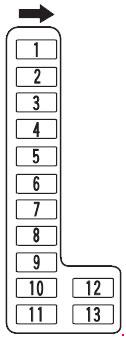
| Pozycja | Amperaż [A] | Chroniony obwód / funkcja |
|---|---|---|
| 1 | 15 | Fuel pump and PGM-FI main relay |
| 2 | 10 | SRS airbag controller |
| 3 | 7.5 | Heater controls, air-conditioning clutch and cooling fan relays |
| 4 | 7.5 | Electric exterior mirror adjustment |
| 5 | 7.5 | Daytime running light circuit on Canadian-market vehicles |
| 6 | 15 | PCM engine control and cruise control |
| 7 | 10 / 15 | 1999-2001: rear wiper 10 A; 2002-2003: ignition coils 15 A |
| 8 | 7.5 | Accessory (ACC) power relay |
| 9 | 10 | Reversing lamps and instrument cluster |
| 10 | 7.5 | Turn signal and hazard flasher |
| 11 | 15 / 10 | 1999-2001: ignition coils 15 A; 2002-2003: rear wiper 10 A |
| 12 | 30 | Front windscreen wipers |
| 13 | 7.5 | Starter signal to engine control module |
Passenger-side dashboard – fuses 1-16
Fuses 1 and 5 cover the left and right automatic sliding doors. Cabin position 9 (15 A) serves the accessory power socket. Fuse 11 supplies cabin lights and radio, at 15 A in many 1999-2001 vehicles or 10 A on 2002-2003 examples.

| Pozycja | Amperaż [A] | Chroniony obwód / funkcja |
|---|---|---|
| 1 | 20 | Driver-side automatic sliding door |
| 2 | 20 | Power seat reclining on EX / EX-L |
| 3 | 10 | BSC electronic module on EX / EX-L |
| 4 | 20 | Power seat fore-and-aft slide on EX / EX-L |
| 5 | 20 | Passenger-side automatic sliding door |
| 6 | 10 | Daytime running lights on Canadian-market models |
| 7 | 7.5 | Left rear power vent/window, function varies by model year |
| 8 | 20 | Front passenger’s electric window |
| 9 | 15 | 12 V accessory power outlet (ACC SOCKET) |
| 10 | 15 | Instrument panel, position and licence plate lighting |
| 11 | 15 / 10 | Interior lamps and radio; 15 A in 1999-2001, 10 A on 2002-2003 models |
| 12 | 20 | Central door locking |
| 13 | 7.5 | Clock and electronic memory backup |
| 14 | 7.5 | ABS pump motor check circuit |
| 15 | 20 | Driver’s electric window |
| 16 | 7.5 | Right rear power vent/window, according to model year |
2003 secondary engine compartment box – positions 1-11
On some 2003 North American RL1 configurations a separate secondary box has eleven numbered positions, including unused slots 2-7. This is not the same physical layout as the 2002 two-position auxiliary panels. Match the exact box before using these fuse locations.
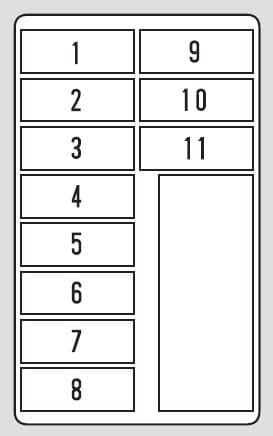
| Pozycja | Amperaż [A] | Chroniony obwód / funkcja |
|---|---|---|
| 1 | 20 | Factory rear-seat entertainment system, EX-L |
| 2 | – | Unused location |
| 3 | – | Unused location |
| 4 | – | Unused location |
| 5 | – | Unused location |
| 6 | – | Unused location |
| 7 | – | Unused location |
| 8 | 20 | Front heated seats, EX-L |
| 9 | 30 | Driver’s electric window |
| 10 | 40 | Rear air-conditioning system |
| 11 | 20 | Power sliding doors, EX / EX-L |
Differences between 1999-2001, 2002 and 2003
The 1999-2001 rear wiper and ignition-coil fuses use different dashboard locations from the 2002-2003 arrangement. Canadian models may have daytime running lights (DRL), while EX / EX-L specifications can include powered sliding doors, motorised seats, seat heating and a rear entertainment system. The rear window ventilation circuits also vary across model years. The alternative 2003 auxiliary panel should be treated as a separate vehicle configuration.
Which fuse should you check first?
12 V accessory socket: On the passenger-side fuse board inspect position 9 (15 A), rather than the number 9 on the driver-side panel.
Power sliding doors: On EX / EX-L models, main engine fuse 11 (30 A), the passenger-side fuses 1 and 5 (20 A each) and the correct auxiliary high-current circuit may all be relevant. Vehicles without powered doors need not have these fuse positions occupied.
Rear air conditioning: The 2002 auxiliary panel uses position 2 (40 A), whereas the 2003 11-position panel uses position 10 (40 A). Wipers: Confirm whether the rear wiper belongs to driver-side position 7 or 11 by build year. ABS warning lamps can require checking main engine positions 9 and 24 as well as sensor and wiring faults.
North American Honda Accord from the same period
The Honda Accord VI USA (1998-2002) has similarly placed driver and passenger fuse panels but its circuit ratings and the optional electrical equipment differ. Use the correct RL1 diagrams for the Odyssey’s power sliding doors.
Technical basis: Honda Odyssey 2002 owner’s handbook, “Fuses” section, pages 362-364, together with the RL1 1999-2001 and 2003 configuration listings. The guide applies to North American Odyssey RL1 vehicles.