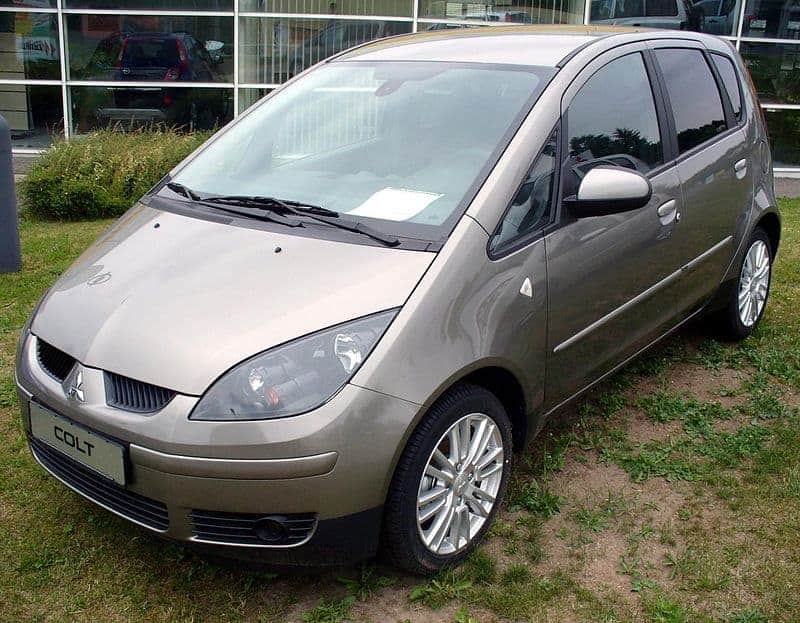
The facelifted Mitsubishi Colt Z30 introduced at the end of 2008 uses a main fuse box inside the passenger compartment together with a group of high-current fusible links next to the battery. The facelift was presented in autumn 2008 as the 2009 model, which is why technical documentation most often describes this arrangement as Colt 2009-2012. On a car built late in 2008, compare the physical layout of the fuse box with the diagram before replacing a fuse.
If you have an earlier Colt, do not automatically use the table below. Older generations are covered separately in the Mitsubishi Colt 1996-2004 fuse guide.
Mitsubishi’s owner’s manual also notes that some positions may be unused depending on the vehicle version and equipment. When replacing a fuse, always use exactly the same fuse rating.
Contents
- Fuse box locations
- Passenger compartment fuse box
- Passenger compartment relays
- High-current fusible links by the battery
- Important equipment-version notes
- FAQ
Fuse box locations
On European left-hand-drive cars, the main fuse box is located in the lower dashboard in front of the driver’s seat. To access it, turn the cover fasteners to the left and remove the panel.
On right-hand-drive versions, the fuse box is located behind the passenger glove box.
In the engine compartment, next to the battery, there are high-current fusible links protecting, among other circuits, the alternator, electric power steering, ABS/ESP and the main supply to the passenger-compartment fuse box.
A similar split between passenger-compartment circuits and main power-supply protection is used on many Mitsubishi models from this period, but the numbering is different. For example, the Mitsubishi Lancer X, whose styling also influenced the Colt facelift, has its own fuse-box layout and separate table.
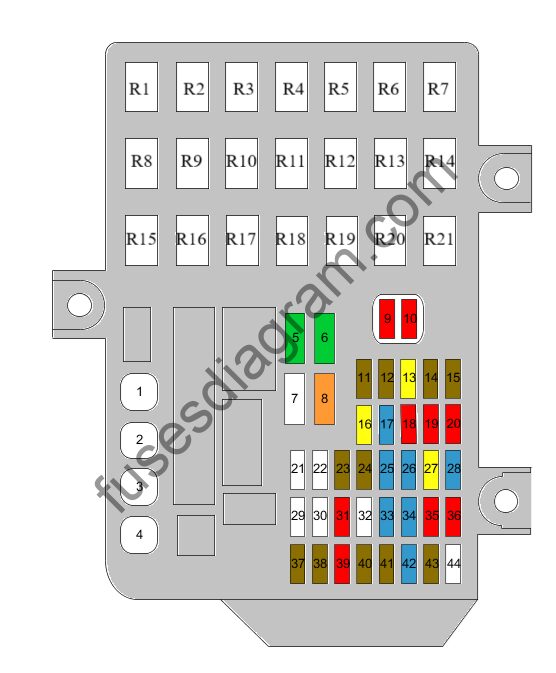
Mitsubishi Colt Z30 passenger compartment fuse box
The large technical diagram below shows the F1-F44 panel clearly and replaces the old illustration, which was only about 200 px wide.
| Fuse | Rating [A] | Function |
|---|---|---|
| 1 | 40 | Ignition switch / main ignition-switched power supply |
| 2 | 40 | Power windows |
| 3 | 40 | Radiator fan |
| 4 | 40 | Automated manual transmission – if equipped |
| 5 | 30 | Heated rear window |
| 6 | 30 | Heated seats – if equipped |
| 7 | – | Unused in the owner’s manual table for this configuration |
| 8 | 40 | Heater / blower motor |
| 9 | 10 | Radio |
| 10 | 10 | Interior lighting |
| 11 | 7.5 | Heated exterior mirrors |
| 12 | 7.5 | Electronic control module |
| 13 | 20 | Windshield wipers |
| 14 | 7.5 | Right rear / parking lights |
| 15 | 7.5 | Left rear / parking lights |
| 16 | 20 | Engine management system |
| 17 | 15 | Fuel pump |
| 18 | 10 | Horn |
| 19 | 10 | Left high-beam headlight |
| 20 | 10 | Right high-beam headlight |
| 21 | – | Unused |
| 22 | – | Unused |
| 23 | 7.5 | Power-adjustable exterior mirrors |
| 24 | 7.5 | Rear fog light |
| 25 | 15 | Accessory socket / 12 V outlet |
| 26 | 15 | Rear window wiper |
| 27 | – | Unused in the owner’s manual table |
| 28 | – | Unused in the owner’s manual table |
| 29 | – | Unused |
| 30 | – | Unused |
| 31 | 10 | Hazard warning lights |
| 32 | – | Unused |
| 33 | 15 | Central locking |
| 34 | 15 | Front fog lights |
| 35 | 10 | Left low-beam headlight |
| 36 | 10 | Right low-beam headlight |
| 37 | 7.5 | Reverse light |
| 38 | 7.5 | Engine control |
| 39 | 10 | Ignition system / ignition coils |
| 40 | 7.5 | Instrument cluster |
| 41 | 7.5 | Relay circuit power supply |
| 42 | 15 | Brake lights |
| 43 | 7.5 | Air conditioning |
| 44 | – | Unused |
The F1-F44 ratings above match the Colt owner’s manual. The manual clearly states that not every position has to be fitted in every vehicle, because this depends on version and equipment.
Some extended service diagrams assign positions 7, 21, 22, 27 and 28 to equipment including diesel-engine circuits, a sunroof or an additional power socket. Because the owner’s manual for the facelifted Colt marks these positions as unused, those alternative descriptions should not be treated as universal for every car.
This is especially important when comparing the Colt with larger Mitsubishi models. In the Mitsubishi Lancer 2000-2008 and the later Lancer X, the same fuse numbers refer to completely different circuits.
Passenger compartment relays
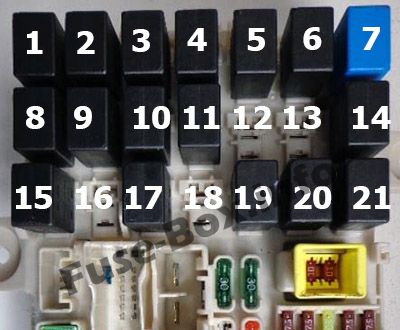
The relays are integrated into the passenger-compartment fuse-box assembly. Their fitment depends on equipment and market, so the table below lists the positions that are clearly identified in documentation for the Colt Z30.
| Relay | Function |
|---|---|
| R1 | Power windows |
| R2 | Horn |
| R4 | Rear fog light |
| R5 | Starter |
| R6 | Engine control |
| R9 | Front fog lights |
| R10 | Heater blower |
| R12 | Transmission control – if equipped |
| R13 | Accessory power outlet |
| R16 | Washer system |
| R17 | Heated rear window |
| R18 | Heated seats |
| R19 | Low-beam headlights |
| R20 | High-beam headlights |
Extended service information also shows additional fuel-pump and radiator-fan relays, but their fitment depends on the engine version. We therefore do not assign one universal function to them for every 2008-2012 Colt.
High-current fusible links by the battery
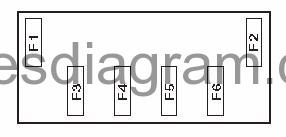
Under the hood, near the positive battery terminal, are the main protection devices for the electrical system. Mitsubishi refers to these components as fusible links. They are not the same as the small F1-F44 blade fuses in the passenger compartment.
| Fuse | Rating [A] | Circuit |
|---|---|---|
| F1 | 120 | Main supply to the dashboard fuse and relay box |
| F2 | 120 / 175 | Alternator – rating depends on charging-system version |
| F3 | 40 | ABS / ASC / ESP |
| F4 | 60 | Electric power steering |
| F5 | 30 | ABS / ASC / ESP |
| F6 | 80 | Additional main supply to the passenger-compartment fuse box |
F2 may be rated at 120 A or 175 A, depending on the alternator and vehicle configuration. Do not install the higher value simply because it appears in another Colt.
Mitsubishi’s manual treats a failed high-current fusible link differently from a blown standard passenger-compartment fuse and recommends having the vehicle checked if one of these links melts.
The newer Mitsubishi ASX I also uses separate high-current protection, but its ratings and locations are different. The same applies to the Mitsubishi Outlander from 2012.
Important equipment-version notes
The Colt Z30 was offered as both a three- and five-door hatchback, with several petrol engines and, in some markets, a diesel engine. Not every fuse box therefore has every position populated in exactly the same way.
- F4 40 A is fitted to cars with the relevant automated manual transmission version.
- F6 30 A is used when the vehicle has heated seats.
- F21, F22, F27 and F28 may be empty even though the physical fuse slots are present.
- F2 by the battery may be rated at either 120 A or 175 A.
- The fitment of some relays changes with engine and equipment.
If the physical fuse-box layout differs from the diagram above, check the module number and documentation for the specific vehicle. This is particularly important for cars built late in 2008, when the facelifted version was entering the market.
If you also work on larger Mitsubishi models from the same period, separate diagrams are available for the Mitsubishi Pajero 2006-2015 and the Mitsubishi L200 2005-2015. Both use completely different fuse boxes, so their tables should not be applied to the Colt.
FAQ – Mitsubishi Colt Z30 2008-2012
Where is the main fuse box?
On a left-hand-drive car, the fuse box is in the lower dashboard in front of the driver, behind a removable cover.
Which fuse protects the 12 V outlet?
The accessory outlet is protected by fuse No. 25 – 15 A in the passenger-compartment fuse box. Some descriptions also refer to it as the cigarette-lighter fuse.
Which fuse is for the radio?
The main radio fuse is No. 9 – 10 A.
Which fuse is for the fuel pump?
The fuel pump is protected by No. 17 – 15 A.
Which fuse is for the horn?
The horn is protected by No. 18 – 10 A. Relay R2 is also part of the horn circuit.
Which fuse is for the rear wiper?
The rear wiper is assigned to No. 26 – 15 A.
Which fuses are for the low-beam headlights?
The left low-beam headlight is protected by No. 35 – 10 A, and the right one by No. 36 – 10 A.
Which fuses are for the high-beam headlights?
The left high-beam headlight uses No. 19 – 10 A, while the right uses No. 20 – 10 A.
Which fuse is for the brake lights?
The brake lights are protected by No. 42 – 15 A.
Which fuse is for the central locking?
The central locking system is assigned to No. 33 – 15 A.
Which fuse is for the front wipers?
The main windshield-wiper circuit is protected by No. 13 – 20 A.
Should position 7 contain a 30 A fuse?
Not in every version. The owner’s manual for the facelifted Colt marks position 7 as unused. Some extended diagrams assign it to diesel-engine equipment, so do not add a fuse based only on a diagram for another vehicle version.
Does a 2008 Colt use this same layout?
The facelift was introduced in 2008 as the 2009 model. A late-2008 vehicle may already use the configuration shown here, but compare the physical panel with the diagram to be sure. Do not mix the earlier layout with the facelifted version.