
The 2020 Ford Escape IV is the first model year of the fourth-generation compact SUV. The range included the 1.5-liter EcoBoost, 2.0-liter EcoBoost, 2.5-liter Hybrid and plug-in hybrid powertrains. EcoBoost versions used an 8-speed automatic transmission, while the hybrids used an eCVT.
The 2020 Escape has two main fuse panels: the Power Distribution Box in the engine compartment and the passenger-compartment panel below the glove box. Ford’s factory documentation covers gasoline, Hybrid and PHEV variants together, so the tables retain all drivetrain-specific assignments rather than merging or omitting them.
The Escape shares Ford’s C2 vehicle architecture with the 2022 Ford Maverick, but the fuse numbering is not interchangeable between the two models.
Fuse box locations
Power Distribution Box: located in the engine compartment. Ford recommends disconnecting the 12 V battery before servicing high-current fuses. The cover is released at the lever near its rear edge.
Passenger-compartment fuse panel: located below the glove box. It protects much of the cabin electronics, including central locking, door modules, SYNC, audio, climate control, the instrument cluster and wireless charging.
Engine-compartment Power Distribution Box
The factory layout uses positions 1-88. Positions listed as “Not used” are retained exactly because they are part of the factory numbering.
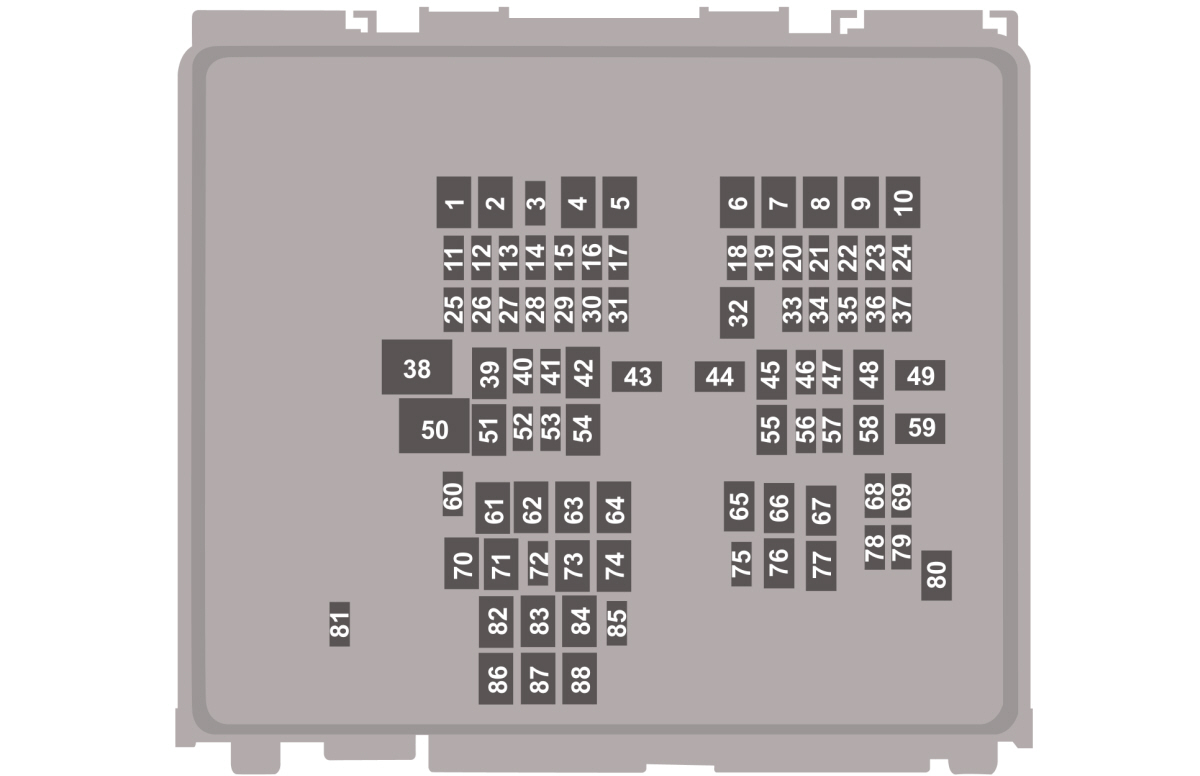
| Fuse | Rating [A] | Protected component / function |
|---|---|---|
| 1 | – | Not used |
| 2 | – | Not used |
| 3 | – | Not used |
| 4 | 60 | Supplemental heater – gasoline |
| 5 | 40 | Supplemental heater – gasoline |
| 6 | 40 | Supplemental heater – gasoline |
| 7 | – | Not used |
| 8 | – | Not used |
| 9 | – | Not used |
| 10 | 30 | Starter |
| 11 | 15 | Powertrain control module (PCM) |
| 12 | 15 | Powertrain control module (PCM) |
| 13 | 15 | Powertrain control module (PCM) |
| 14 | 15 | Powertrain control module (PCM) |
| 15 | – | Not used |
| 16 | – | Not used |
| 17 | – | Not used |
| 18 | 10 | Powertrain control module (PCM) |
| 19 | 10 | ABS module |
| 20 | – | Not used |
| 21 | 5 | Adaptive cruise control |
| 22 | 5 | Battery energy control module – Hybrid |
| 23 | 5 | Charge-port illumination – Hybrid/PHEV |
| 24 | 20 | Audio amplifier |
| 25 | – | Not used |
| 26 | – | Not used |
| 27 | – | Not used |
| 28 | 10 | Brake pedal switch |
| 29 | 5 | Powertrain control module – Hybrid |
| 30 | 10 | Electronic stability control – gasoline; transmission oil pump – Hybrid |
| 31 | 5 | Electronic power-assist steering |
| 32 | 30 | Body control module (BCM) |
| 33 | 10 | Front parking camera, rear-view camera, BLIS, gear-selector actuator |
| 34 | 10 | Headlamp leveling |
| 35 | 15 | Heated steering wheel |
| 36 | 10 | Powertrain control module – Hybrid |
| 37 | 20 | Horn |
| 38 | 40 | Blower motor |
| 39 | – | Not used |
| 40 | 15 | Heated wiper park area |
| 41 | 20 | Audio amplifier |
| 42 | 30 | Driver power seat |
| 43 | 50 | Electric coolant pump – Hybrid |
| 44 | 40 | Trailer module |
| 45 | 30 | Passenger power seat |
| 46 | 20 | Transmission oil pump |
| 47 | 20 | Heated seats |
| 48 | 40 | ABS valves |
| 49 | 60 | ABS pump |
| 50 | 60 | Cooling fan |
| 51 | 30 | Moonroof |
| 52 | 5 | DC/DC converter – Hybrid |
| 53 | 10 | Battery charging control module – Hybrid |
| 54 | – | Not used |
| 55 | – | Not used |
| 56 | – | Not used |
| 57 | 10 | OBD-II / DLC diagnostic connector |
| 58 | 40 | Auxiliary power distribution box – Hybrid |
| 59 | 40 | Body control module (BCM) |
| 60 | – | Not used |
| 61 | 20 | 12 V power point in luggage compartment |
| 62 | – | Not used |
| 63 | – | Not used |
| 64 | 30 | Power liftgate |
| 65 | – | Not used |
| 66 | – | Not used |
| 67 | – | Not used |
| 68 | 5 | Mass air flow and intake air temperature sensor – gasoline |
| 69 | 15 | Port fuel injectors |
| 70 | 20 | 12 V power point in rear console |
| 71 | 20 | 12 V power point in media bin |
| 72 | 20 | Rear wiper |
| 73 | – | Not used |
| 74 | 30 | Front wiper motor |
| 75 | 10 | Heated exterior mirrors |
| 76 | 30 | Heated rear window |
| 77 | – | Not used |
| 78 | 10 | A/C clutch |
| 79 | 10 | Headlamp washers |
| 80 | 20 | Fuel pump |
| 81 | 10 | Rear-window washer pump |
| 82 | 40 | Power inverter |
| 83 | – | Not used |
| 84 | 40 | Powertrain / AWD control module |
| 85 | 5 | Rain sensor |
| 86 | – | Not used |
| 87 | – | Not used |
| 88 | – | Not used |
Passenger-compartment fuse panel
The cabin panel uses positions 1-25:
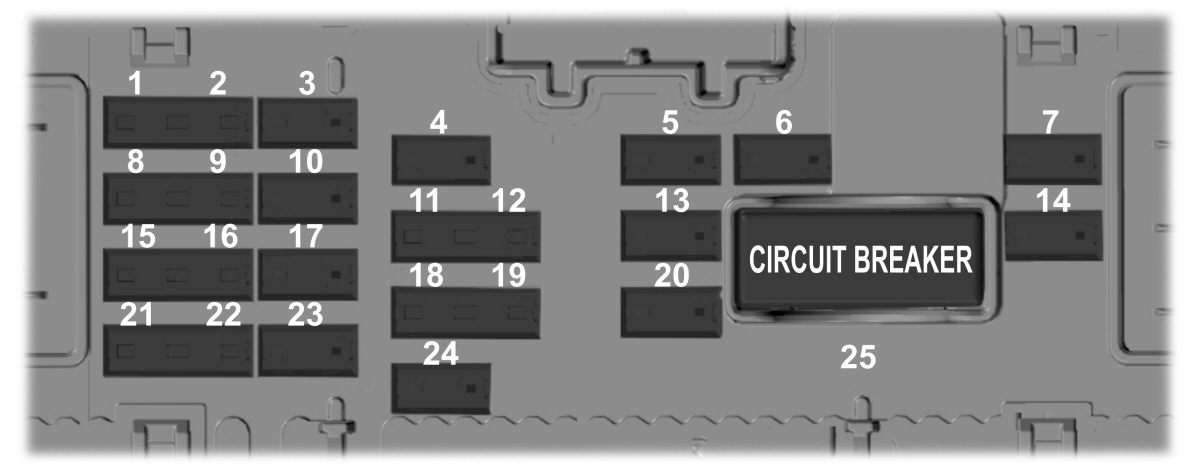
| Fuse | Rating [A] | Protected component / function |
|---|---|---|
| 1 | 5 | Spare / not used |
| 2 | 5 | Spare / not used |
| 3 | 10 | Spare / not used |
| 4 | 10 | Ignition switch |
| 5 | 20 | Central locking – lock and unlock |
| 6 | 10 | Moonroof; DC converter |
| 7 | 30 | Passenger door module |
| 8 | 5 | Parking system control module |
| 9 | 5 | Electrochromic mirror; image processing module A |
| 10 | 10 | Extended power module |
| 11 | 5 | Power liftgate; hands-free liftgate module; telematics module |
| 12 | 5 | Head-up display module; keyless-entry keypad |
| 13 | 15 | Driver door lock |
| 14 | 30 | Driver door module |
| 15 | 15 | Extended power module |
| 16 | 15 | Spare / not used |
| 17 | 15 | SYNC; transceiver module; integrated control panel |
| 18 | 7.5 | Wireless charging module |
| 19 | 7.5 | Lighting switch panel |
| 20 | 10 | Spare / not used |
| 21 | 7.5 | Climate control; electronic gear-selector module |
| 22 | 7.5 | Instrument cluster; Gateway module; steering column control module |
| 23 | 20 | Audio unit |
| 24 | 20 | Spare / not used |
| 25 | 30 | Power windows; exterior mirrors |
Commonly checked fuses
- Fuel pump: under-hood fuse 80 – 20 A.
- OBD-II / DLC: fuse 57 – 10 A.
- Audio unit: cabin fuse 23 – 20 A.
- SYNC: cabin fuse 17 – 15 A.
- Audio amplifiers: under-hood fuses 24 and 41 – 20 A each.
- ABS: fuse 19 – 10 A for the module, fuse 48 – 40 A for the valves and fuse 49 – 60 A for the pump.
- 12 V luggage-compartment outlet: fuse 61 – 20 A.
- 12 V rear-console outlet: fuse 70 – 20 A.
- 12 V media-bin outlet: fuse 71 – 20 A.
- Front wipers: fuse 74 – 30 A.
- Heated steering wheel: fuse 35 – 15 A.
- Starter: fuse 10 – 30 A.
On Hybrid and PHEV models, several additional positions protect the electric coolant pump, DC/DC converter, battery control and charging-related systems. These circuits are marked explicitly in the table and are not used in every gasoline version.
FAQ – 2020 Ford Escape fuses
Where is the passenger-compartment fuse box?
Below the glove box on the passenger side. The panel uses positions 1-25.
Where is the fuel-pump fuse?
Under-hood fuse 80 – 20 A.
The radio powers up but there is no sound. What should I check?
In addition to cabin fuse 23 – 20 A for the audio unit and fuse 17 – 15 A for SYNC, check under-hood amplifier fuses 24 and 41 – 20 A each when the installed audio system uses them.
Where is the OBD-II fuse?
Under-hood fuse 57 – 10 A.
Does the Hybrid use exactly the same assignments as the 1.5 EcoBoost?
No. The physical fuse-box locations are shared, but some positions are Hybrid/PHEV-only, including circuits for the electric coolant pump, DC/DC converter and battery control module.
Does this 2020 diagram apply to later Escape model years?
Do not assume full compatibility. Ford revised equipment and fuse assignments in later model years, so this table is specific to the 2020 configuration.