
The facelift-era Peugeot 5008 I (2014-2016) retains the first-generation T87 fuse layout but the manufacturer’s later owner manuals deliberately list fewer owner-serviceable engine and battery fuses than earlier editions. This guide follows the 2014-2016 factory allocation: 27 dashboard positions, 15 under-bonnet positions and four battery-mounted positions, plus eight useful cross references. It does not add unverified high-current Maxi or engine positions from an older 5008.
Where are the Peugeot 5008 fuse boxes?
Cabin: Switch the ignition and all electrical accessories off. On left-hand-drive 5008 cars the service cover is below the dashboard on the driver’s side. Release the access flap from its fasteners, take the fuse extractor from the service equipment and compare the fuse numbers with the printed layout. In right-hand-drive cars the trim access may differ; use the handbook for the particular market. The F1-F17 main positions and F30-F39 accessory circuits are in the passenger-compartment distribution area.
Engine bay: Open the bonnet. Find the black fuse carrier alongside the battery, release the two cover catches and lift the lid. Confirm the actual occupied sockets, replace only a correctly rated fuse and fully secure the two catches to reseal the housing. Above the battery: A second carrier supplies the high-current electrical distribution. The later owner handbook only provides a four-fuse user chart for that carrier; the other power links require qualified workshop diagnosis.
Do not mix 2009-2013 ratings with 2014-2016
Compared with the earlier 5008, the later handbook still places the luggage-compartment 12 V socket at dashboard F31 (30 A) and the panoramic roof blind at F39 (20 A). However, the 2014-2016 owner’s manual lists only F2, F3, F4 and F6 as owner-serviceable positions on the battery carrier. Other Midi and Maxi links may physically exist but their ratings are not proven by this four-row table. The older 2009-2013 reference must not be taken as a replacement catalogue for the facelift car’s high-current wiring.
Commonly searched 5008 I fuses
These eight lines repeat positions from the three technical tables, clearly distinguishing engine F2 horn and F8 starter from same-numbered dashboard circuits.
| Pozycja | Amperaż [A] | Chroniony obwód / funkcja |
|---|---|---|
| F9 | 30 | Front cigarette lighter and front/rear passenger 12 V sockets – DASHBOARD F9 |
| F31 | 30 | Luggage compartment 12 V outlet – supplemental DASHBOARD F31 |
| F8 | 20 | Radio, audio and multimedia – DASHBOARD F8 |
| F1 | 15 | Tailgate rear window wiper – DASHBOARD F1 |
| F12 | 30 | Front windscreen wiper motor – ENGINE F12 |
| F2 | 15 | Horn – ENGINE F2, not dashboard F2 |
| F8 | 20 | Starter motor control – ENGINE F8, not dashboard F8 |
| F39 | 20 | Electric panoramic roof sunblind – supplemental DASHBOARD F39 |
Passenger-compartment main and supplemental fuse positions
F1 (15 A) is the rear wiper, F3 (5 A) the airbag unit, F5/F6 (30 A each) the front and rear electric windows, F8 (20 A) audio and multimedia, and F9 (30 A) the front lighter and passenger accessory outlets. The boot socket has a separate F31 (30 A); F39 (20 A) controls the panoramic roof blind. F17 (40 A) protects the rear heated glass. F2 remains unused and SH is the PARC transport-mode shunt rather than a replaceable blade fuse.
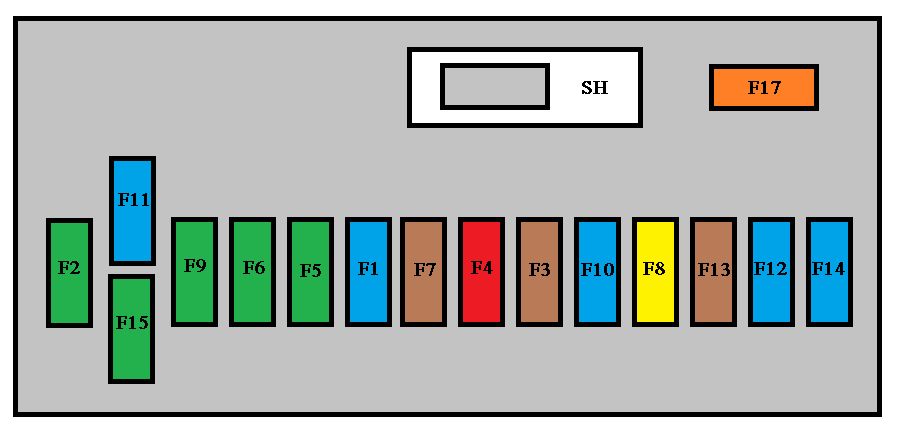
| Pozycja | Amperaż [A] | Chroniony obwód / funkcja |
|---|---|---|
| F1 | 15 | Rear windscreen wiper motor |
| F2 | – | Unused fuse position |
| F3 | 5 | Airbag and pyrotechnic seat-belt pretensioner ECU |
| F4 | 10 | Electrochromatic interior mirror, air-conditioning controls, protection/switching module and rear multimedia equipment |
| F5 | 30 | Front one-touch electric windows |
| F6 | 30 | Rear one-touch electric windows |
| F7 | 5 | Courtesy and reading lights, glovebox and armrest illumination and the boot 12 V socket relay control |
| F8 | 20 | Radio, telephone, CD changer, multifunction screen, tyre-pressure monitoring, alarm and telematics where equipped |
| F9 | 30 | Front 12 V accessory outlet and cigarette lighter, plus rear cabin 12 V outlet |
| F10 | 15 | Steering-wheel mounted controls |
| F11 | 15 | Low-current ignition and anti-theft switch feed |
| F12 | 15 | Trailer-presence sensor, rain/light sensor, and the supplies to F32, F34 and F35 |
| F13 | 5 | Engine electrical fuse carrier and airbag ECU |
| F14 | 15 | Instrument cluster, its screen and F33 supply |
| F15 | 30 | Central locking and deadlocking |
| F17 | 40 | Heated rear screen and supply to F30 |
| SH | Shunt | PARC parking/transport-mode electrical shunt, not a conventional blade fuse |
| F30 | 5 | Heated exterior door mirrors |
| F31 | 30 | 12 V luggage-compartment accessory socket |
| F32 | 5 | Electronically operated gearbox selector lever |
| F33 | 10 | Head-up display, Bluetooth hands-free system and air-conditioning control |
| F34 | 5 | Seat-belt warning lamp display |
| F35 | 10 | Parking sensors and Hi-Fi amplifier authorisation |
| F36 | 10 | Trailer fuse-box control and driver-door switch module |
| F37 | 20 | Hi-Fi amplifier where fitted |
| F38 | 30 | Electrically adjustable driver seat |
| F39 | 20 | Panoramic glass roof blind motor |
Engine-compartment fuses F2-F18
The 2014-2016 Peugeot manual identifies F2 (15 A) for the horn, F3 (10 A) for both screenwash circuits, F4 (10 A) for daytime running lamps, F8 (20 A) for the starter solenoid, F11 (40 A) for the cabin blower and F12 (30 A) for the front wipers. F15-F18 protect the two main and two dipped headlamps. Turbo pressure regulation and diesel heating circuits at F5 differ between the 1.6 THP petrol and 1.6 HDi diesel engines. Positions not shown in this limited handbook table are not assigned an amperage by guesswork.
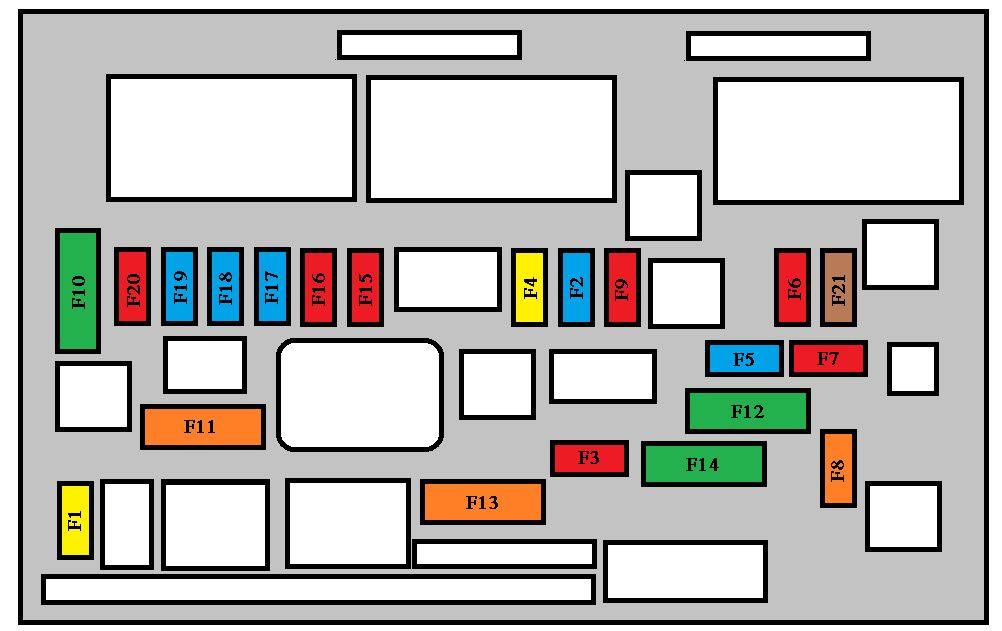
| Pozycja | Amperaż [A] | Chroniony obwód / funkcja |
|---|---|---|
| F2 | 15 | Horn |
| F3 | 10 | Front and rear screenwash pumps |
| F4 | 10 | Daytime running lamps |
| F5 | 15 | Canister-purge and turbo-pressure/wastegate solenoids and oil-vapour heater on 1.6 THP, or diesel fuel heater on HDi as equipped |
| F6 | 10 | Diagnostic connector, directional headlamp controls, diesel particulate-filter additive pump, Distance Alert and exterior mirror adjustment |
| F7 | 10 | Power-steering controller, automatic gearbox and directional-headlamp height adjustment |
| F8 | 20 | Starter motor solenoid control |
| F9 | 10 | Clutch and brake pedal switches |
| F11 | 40 | Air-conditioning and heating blower |
| F12 | 30 | Front windscreen wipers, slow and high speed |
| F14 | 30 | Air pump on applicable engine versions |
| F15 | 10 | Right main-beam headlamp |
| F16 | 10 | Left main-beam headlamp |
| F17 | 15 | Left dipped-beam headlamp |
| F18 | 15 | Right dipped-beam headlamp |
Battery-mounted mini and midi fuse protection
In the 2014-2016 official owner’s manual, the listed user-accessible locations are F2 5 A for the dual brake switch, F3 5 A for the battery charging unit, F4 25 A for ABS/ESP solenoid valves and F6 15 A for the piloted/automatic gearbox. This does not mean other power links have been removed, only that this handbook does not give their replacement ratings. Professional service is needed for additional high-current links.
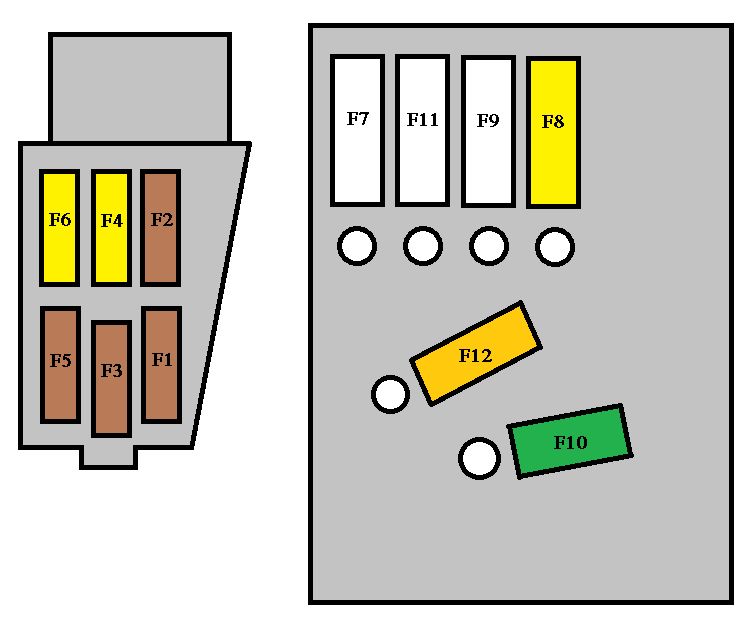
| Pozycja | Amperaż [A] | Chroniony obwód / funkcja |
|---|---|---|
| F2 | 5 | Dual-function brake pedal switch |
| F3 | 5 | Battery charging module |
| F4 | 25 | ABS/ESP solenoid valves |
| F6 | 15 | Electronically controlled manual gearbox or automatic gearbox, where equipped |
Common electrical symptoms in the facelift 5008
Front lighter or 12 V outlet dead: Check dashboard F9 (30 A) and the socket contacts. Boot 12 V outlet: The later version uses supplemental dashboard F31 (30 A); check the socket at the load area before assuming an upstream fault. Panoramic glass roof shade stuck: Supplemental F39 (20 A), then the sunblind guides, drive motor and switches. Rear wiper stops: F1 (15 A) and the tailgate hinge harness.
Horn not sounding: Engine F2 (15 A). Wipers stop: Engine F12 (30 A), motor and linkage. Blower is silent: Engine F11 (40 A) and the fan speed controller. ABS/ESP warning: The battery carrier F4 (25 A) is the listed valve supply, but wheel sensors, battery voltage and pump electronics need diagnosis too. Never increase a fuse amperage to match a different production year.
Related Peugeot first-generation diagrams
The Peugeot 5008 I (2009-2012) explains older F29/F31 socket differences and a fuller battery distribution; the Peugeot 5008 I (2013) covers the immediately preceding production specification. The related Peugeot 3008 I (2009-2016) has some shared PSA electrical architecture but different body equipment and must be checked separately.
Technical basis: Peugeot 5008 official owner manuals for 2014 and 2015-2016, Practical Information, dashboard, engine and above-battery tables. Ratings depend on engine, gearbox, equipment and market.