
The 2003 Peugeot 307 SW has two main fuse boxes, one beneath the driver’s side of the dashboard and another in the engine compartment next to the battery. These assignments correspond to the pre-facelift T5 installation documented in the Peugeot 307 SW owner’s handbook dated 14 April 2003. The listed positions, including high-current Maxi fuses and the special PARC shunt, have been retained. Check your vehicle’s build date and equipment before relying on a different handbook edition.
How to access the Peugeot 307 SW fuse boxes
Inside the cabin: Switch off the ignition and open the driver’s door. Locate the cover under the dashboard to the left. Turn its retaining fastener approximately a quarter turn with a coin, pull the handle and lower the cover. Spare fuses and a fuse extraction tool are stored on the inside. The illustration numbers positions F1-F26, but the handbook does not assign a function to every marked slot.
Engine compartment: Open the bonnet and locate the fuse box beside the battery. Unclip the lid and compare the positions with the F1-F18 diagram. High-current Maxi fuses MF1-MF8 are part of this assembly. Peugeot advises against changing these large fusible links without workshop assistance. Reseat the cover securely after inspection.
Dashboard fuses – 2003 Peugeot 307 SW
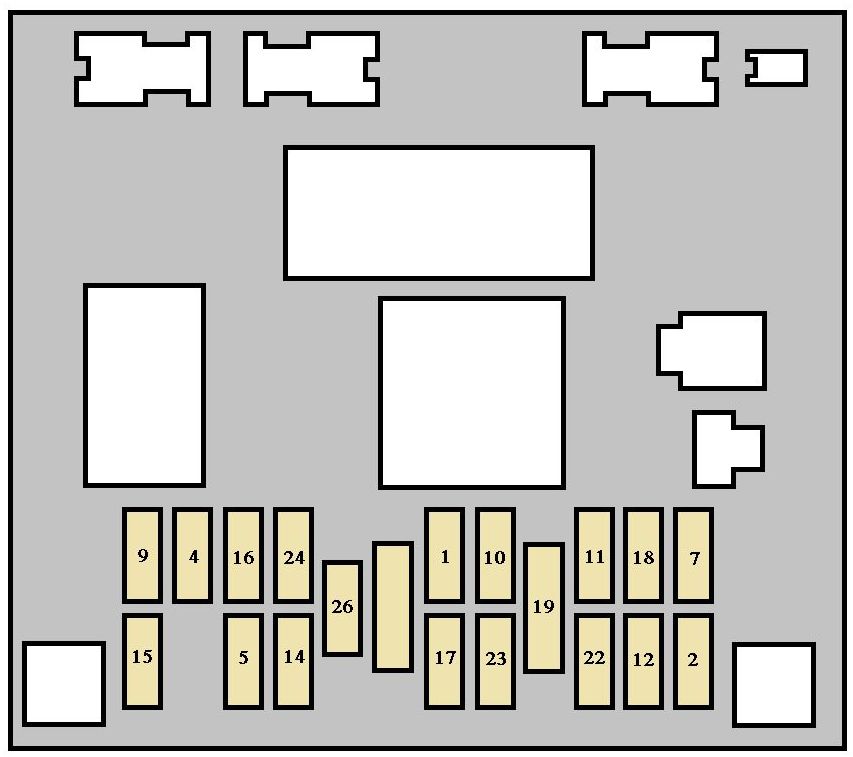
| Pozycja | Amperaż [A] | Chroniony obwód / funkcja |
|---|---|---|
| Cabin fuses and PARC configuration shunt | ||
| F1 | 10 | Rear fog lamp |
| F2 | 15 | Rear window wiper |
| F4 | 15 | Front electric windows; also roof controls on some variants, not the washer pump |
| F5 | 15 | Left brake lamp and trailer circuit, where fitted |
| F7 | 30 | Cabin and luggage-compartment lighting, reading lamps, front 12 V socket, glovebox lamp and panoramic roof blind |
| F9 | 30 | Front electric window mechanisms and panoramic roof blind control, depending on variant |
| F10 | 15 | OBD diagnostic socket, rear 12 V power outlet and towbar wiring |
| F11 | 20 | Audio unit, multifunction display, steering-column controls and automatic transmission |
| F12 | 10 | Right-hand position lamps, number plate lights and illumination for central locking, climate controls and cigarette lighter |
| F14 | 30 | Central door locking and deadlocking system |
| F15 | 30 | Rear electric windows with one-touch operation, where fitted |
| F16 | 10 | Supply for engine-bay fuse box and BSI, alarm, particulate filter controller, steering controls and SRS |
| F17 | 10 | Right brake lamp and high-mounted third brake lamp |
| F18 | 10 | OBD diagnostics, steering-column switches, electrochromic mirror and brake, clutch and coolant sensors |
| F19 | 30 | PARC configuration shunt – not a conventional protective fuse |
| F22 | 10 | Left-hand position lamps and number-plate / trailer lighting |
| F23 | 15 | Alarm siren and interior motion sensors, depending on equipment |
| F24 | 15 | Instrument cluster, radio, display, air conditioning and rear parking sensors |
| F26 | 30 | Heated rear window |
Engine compartment fuses F1-F18 and Maxi fuses MF1-MF8
The standard F1-F18 fuses share this housing with the Maxi protection links. F7 has no assigned function in the April 2003 handbook – it must not be mistaken for the windscreen washer pump fuse. Later handbook editions can differ in the allocation of some Maxi positions, particularly MF6.
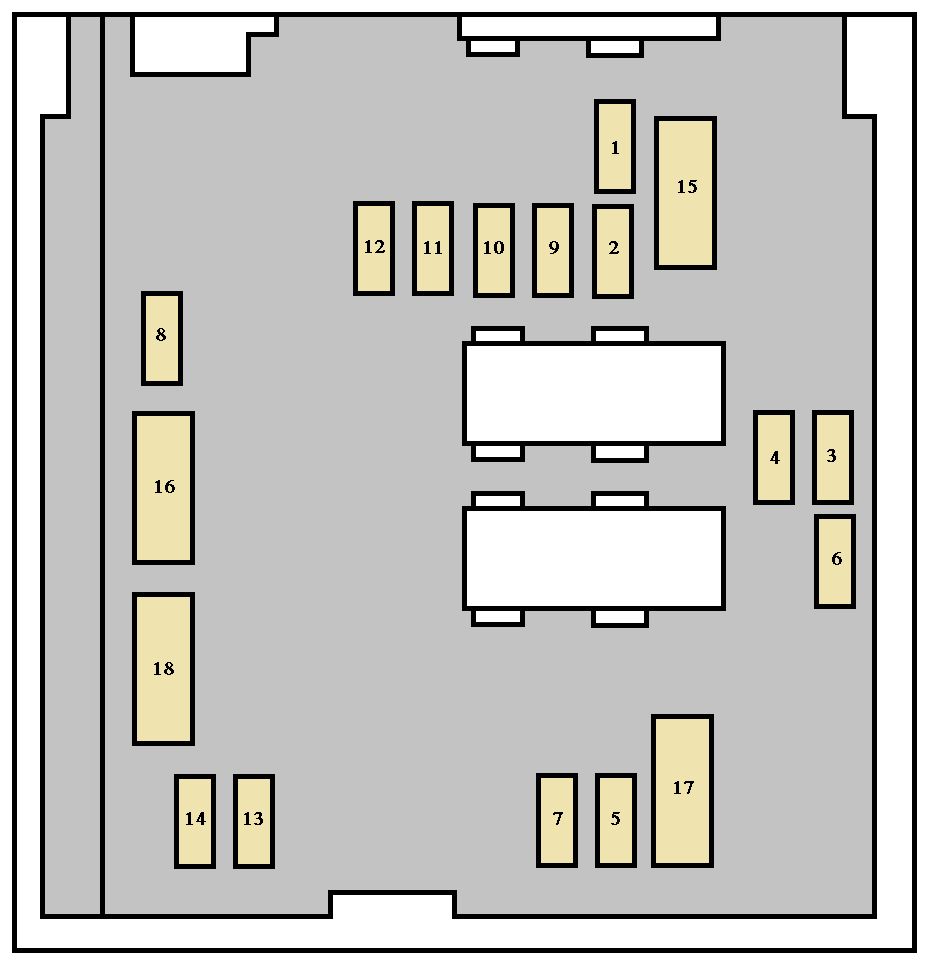
| Pozycja | Amperaż [A] | Chroniony obwód / funkcja |
|---|---|---|
| Standard engine-bay fuses F1-F18 | ||
| F1 | 10 | Reversing-light switch for manual or automatic gearbox, automatic start-inhibit control, vehicle speed sensor and diesel fuel-water sensor |
| F2 | 15 | EVAP fuel vapour canister valve and fuel pump |
| F3 | 10 | Electric power steering control unit and ABS/ESP controller |
| F4 | 10 | Injection control unit, cooling-fan or auxiliary-heating relays, automatic transmission control and shift interlock |
| F5 | 15 | Diesel particulate filter control unit, where fitted |
| F6 | 15 | Front fog lamps |
| F7 | – | Unassigned in the 2003 Peugeot 307 SW handbook; the washer pump was previously incorrectly attributed to this position |
| F8 | 20 | Engine control unit and cooling-fan relay supply; diesel injection pump on relevant versions |
| F9 | 15 | Left-hand dipped-beam headlamp |
| F10 | 15 | Right-hand dipped-beam headlamp |
| F11 | 10 | Right-hand main-beam headlamp |
| F12 | 10 | Left-hand main-beam headlamp |
| F13 | 15 | Horn |
| F14 | 10 | Front and rear window washer pumps |
| F15 | 30 | Petrol: oxygen sensors, EGR, ignition coils and injectors; diesel: high-pressure regulator, glow plugs, airflow meter, injection controller and fuel heater |
| F16 | 30 | Secondary air injection pump on petrol models with automatic transmission |
| F17 | 30 | Front windscreen wiper, low and high speed |
| F18 | 40 | Heating and air-conditioning blower |
| Maxi fuses MF1-MF8 – main power feeds | ||
| MF1 | 50 | Main cooling fan assembly supply |
| MF2 | 30 | ABS/ESP hydraulic pump motor |
| MF3 | 30 | ABS/ESP solenoid valves |
| MF4 | 70 | Primary BSI control module supply, first circuit |
| MF5 | 70 | Primary BSI control module supply, second circuit |
| MF6 | 20 | Heated seats in the 14 April 2003 handbook; this position can be unoccupied on certain later variants |
| MF7 | 30 | Main ignition switch supply |
| MF8 | 70 | Electro-hydraulic power steering pump |
Which fuse should you check for a specific fault?
12 V outlets: In the April 2003 layout, the front socket receives power through cabin fuse F7 (30 A), which also feeds interior lighting and the panoramic roof blind. The rear 12 V outlet has a separate cabin fuse, F10 (15 A).
Wipers and windows: The tailgate wiper uses cabin F2 (15 A); front wipers use engine-bay F17 (30 A). Front electric windows depend on cabin F4 (15 A) or F9 (30 A), according to the fitted window-control system. The heated rear window uses cabin F26 (30 A).
Fuel pump and horn: Check engine-bay F2 (15 A) for the fuel pump and F13 (15 A) for the horn. When the ABS/ESP warning remains illuminated, a wheel sensor, wiring defect or control module can be responsible even if its power fuses are intact.
Why the 14 April 2003 handbook edition matters
Peugeot updated electrical equipment through the 2003 production period. In the owner’s handbook dated 14 April 2003, Maxi fuse MF6 is listed as the heated-seat supply (20 A). Some later configurations do not populate this position in the same way. The year of first registration is not sufficient: check the vehicle’s production configuration before changing a fuse rating.
Other Peugeot electrical layouts of the period
The Peugeot 307 Break estate uses similar first-generation 307 electrical architecture, although its body equipment differs from the SW. For a contemporary smaller Peugeot model, the Peugeot 206 (2000-2002) fuse box guide documents its own dashboard and engine fuse circuits.
Primary technical source: Peugeot 307 SW Owner’s Manual, 14 April 2003, chapter “Practical Information”, pages 148-151. Maxi fuse functions refer to that edition.