
The European-market Ford Ranger Mk2 from 2006-2011 uses a central passenger-compartment fuse box, an additional high-current fuse box in the engine compartment and, on vehicles equipped with the inclinometer/compass display, a separate 2 A fuse behind the glove box. Ford’s European documentation covers the 2.5 Duratorq-TDCi and 3.0 Duratorq-TDCi engines.
The Ranger was facelifted during this generation. The earlier PJ and later PK versions use almost identical fuse-box hardware, but several central-panel positions differ in both function and rating. The most important changes involve F1, F2, F12 and F15, so the two configurations are listed separately below.
From 2011 Ford introduced the completely new T6/PX generation. If your Ranger has the later body style and different fuse boxes, use the Ford Ranger Mk3 fuse guide.
Fuse box locations – Ford Ranger Mk2 2006-2011
Ford identifies three locations for electrical protection:
- Central fuse box: in the lower dashboard area behind a removable trim panel. It contains positions 1-22.
- Additional fuse box: in the engine compartment. It contains high-current fuses 1-9.
- Inclinometer and compass fuse: behind the passenger glove box on vehicles equipped with the dashboard inclinometer/compass unit.
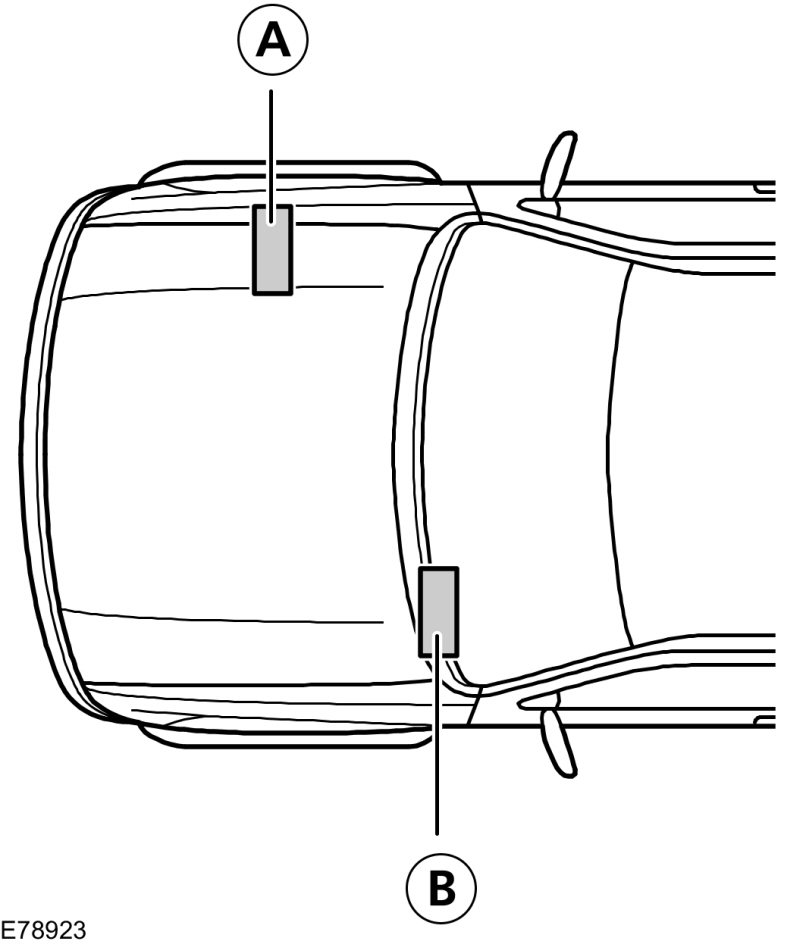
In Ford’s factory illustration, the additional fuse box is marked A and the central fuse box B. The exact position of the cabin panel also depends on whether the vehicle is left- or right-hand drive.
Central fuse box – earlier Ranger PJ
This layout corresponds to the earlier European Ranger documentation and is used on the pre-facelift PJ version. The panel has 22 positions.
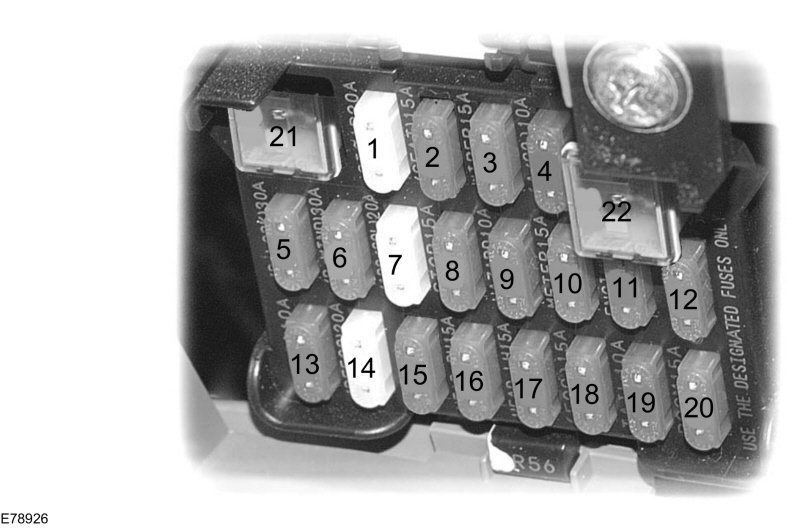
| Fuse | Rating | Color | Protected component / function |
|---|---|---|---|
| 1 | 20 A | yellow | Cigarette lighter, audio system, power exterior mirrors, auxiliary power point |
| 2 | 15 A | blue | Heated seat |
| 3 | 15 A | blue | Windshield wipers and washers |
| 4 | 10 A | red | Air conditioning, ABS relay |
| 5 | 30 A | pink | Central locking |
| 6 | 30 A | pink | Power windows |
| 7 | 20 A | yellow | ABS solenoid valve |
| 8 | 15 A | blue | Stop lamps, horn |
| 9 | 10 A | red | Hazard warning lamps |
| 10 | 15 A | blue | Instrument cluster, reversing lamps, turn signals, Remote Free-Wheel (RFW) system |
| 11 | 15 A | blue | Engine management systems |
| 12 | – | – | Not used |
| 13 | 10 A | red | A/C electromagnetic clutch |
| 14 | 20 A | yellow | Heated rear window |
| 15 | 10 A | red | Rear fog lamp |
| 16 | 15 A | blue | Right-hand headlamp |
| 17 | 15 A | blue | Left-hand headlamp |
| 18 | 15 A | blue | Front fog lamps |
| 19 | 10 A | red | Tail lamps, parking lamps, license-plate lamps |
| 20 | 15 A | blue | Interior lighting, warning system |
| 21 | – | – | Not used |
| 22 | 30 A | pink | Power windows |
Useful identifiers for this earlier layout are F2 15 A for the heated seat, unused F12 and F15 10 A for the rear fog lamp. These positions make it easier to distinguish the PJ layout from the later PK panel.
Central fuse box – facelifted Ranger PK
After the facelift, Ford retained the same physical panel layout but changed several assignments. The later PK documentation adds, among other things, cruise-control circuits. F1, F2 and F12 are particularly important when identifying the correct table.
| Fuse | Rating | Color | Protected component / function |
|---|---|---|---|
| 1 | 20 A | yellow | Cigarette lighter, audio system, power exterior mirrors, auxiliary power point, cruise control if equipped |
| 2 | 20 A | yellow | Cigarette lighter, audio system, power exterior mirrors, auxiliary power point. Ford documentation lists this position as unused on vehicles without cruise control |
| 3 | 15 A | blue | Windshield wipers and washers |
| 4 | 10 A | red | Air conditioning, ABS relay |
| 5 | 30 A | green | Central locking |
| 6 | 30 A | green | Power windows |
| 7 | 20 A | yellow | ABS solenoid valve |
| 8 | 15 A | blue | Stop lamps, horn |
| 9 | 10 A | red | Hazard warning lamps |
| 10 | 15 A | blue | Instrument cluster, reversing lamps, turn signals, Remote Free-Wheel (RFW) system |
| 11 | 15 A | blue | Engine management systems |
| 12 | 5 A | orange | Cruise control if equipped; unused on vehicles without cruise control |
| 13 | 10 A | red | A/C electromagnetic clutch |
| 14 | 20 A | yellow | Heated rear window |
| 15 | – | – | Not used |
| 16 | 15 A | blue | Right-hand headlamp |
| 17 | 15 A | blue | Left-hand headlamp |
| 18 | 15 A | blue | Front fog lamps |
| 19 | 10 A | red | Tail lamps, parking lamps, license-plate lamps |
| 20 | 15 A | blue | Interior lighting, warning system |
| 21 | – | – | Not used |
| 22 | 30 A | pink | Power windows |
The easiest way to distinguish the two central-panel tables is to inspect F12 and F15. In the earlier PJ layout, F12 is unused and F15 powers the rear fog lamp. In the later PK documentation, F12 is a 5 A cruise-control fuse while F15 is unused.
Do not confuse this European PJ/PK Ranger with the North American 2004-2012 Ford Ranger. The vehicles overlap in model years but use different electrical systems, engines, fuse panels and numbering.
Additional engine-compartment fuse box
The additional fuse box is under the hood. It contains nine high-current fuses that protect the main electrical supply, glow plugs, headlamps, injection system, ABS, fuel heater, air conditioning and wipers.
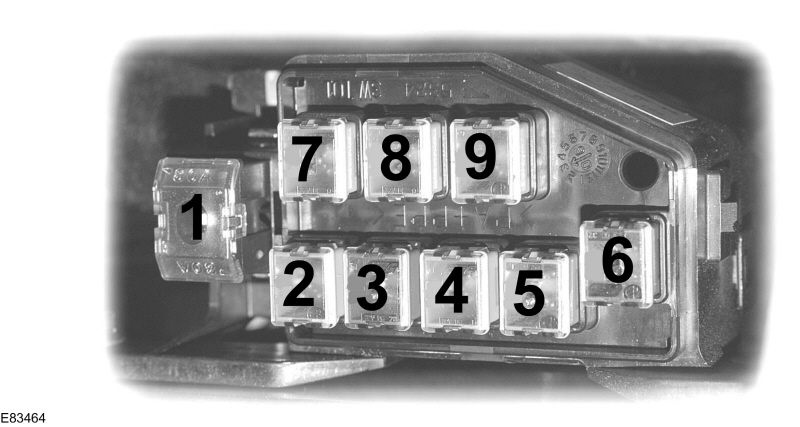
| Fuse | Rating [A] | Protected component / function |
|---|---|---|
| 1 | 80 | Main electrical-system protection – supply to all circuits |
| 2 | 60 | Glow plugs |
| 3 | 40 | Engine management, instrument cluster and, on selected versions, cigarette lighter and power windows |
| 4 | 60 | Headlamps |
| 5 | 20 | Injectors / fuel-injection system |
| 6 | 40 | ABS pump motor, hazard warning lamps, stop lamps |
| 7 | 30 | Fuel heater |
| 8 | 60 | Air conditioning, windshield wipers and washers |
| 9 | 60 | Air conditioning, tail lamps and, depending on equipment, heated rear window, central locking, ABS solenoid valve, power windows and front fog lamps |
Ford notes that some F3 and F9 functions apply only to certain equipment versions. An absent component therefore does not mean the fuse table is incorrect.
Inclinometer and compass fuse
Higher-specification Rangers can have a dashboard unit containing a compass and longitudinal/lateral inclinometer. This module has a separate fuse behind the passenger glove box.
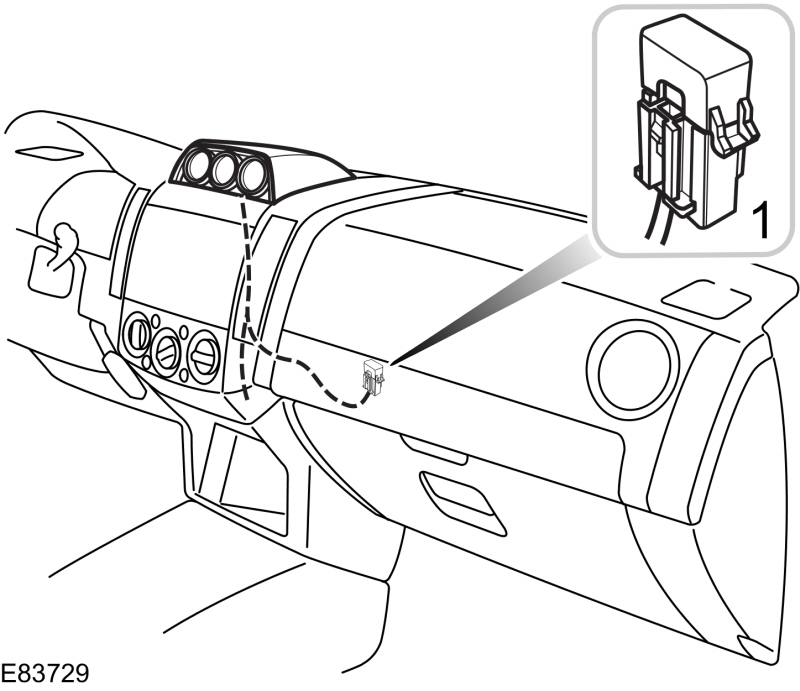
| Fuse | Rating [A] | Protected component / function |
|---|---|---|
| 1 | 2 | All inclinometer and compass circuits |
To access it, fully open the glove box and squeeze its sides inward to release the stops. The fuse holder is behind the glove box.
Ford Ranger 2.5 TDCi and 3.0 TDCi
Ford’s European documentation for this generation covers both the 2.5 Duratorq-TDCi and 3.0 Duratorq-TDCi. The main fuse tables are shared between the engines, while the actual use of some circuits depends on equipment, transmission and market specification.
Important high-current protection common to both engines includes F2 60 A for the glow plugs, F5 20 A for the injection system and F7 30 A for the fuel heater.
Remote Free-Wheel (RFW) system and 4×4
Central-panel F10 15 A supplies the Remote Free-Wheel system together with the instrument cluster, turn signals and reversing lamps. RFW controls the mechanism that disconnects and engages the front axle on 4×4 versions.
If the RFW indication, turn signals and reversing lamps fail together, F10 is a useful common power-supply point to check. A 4×4 engagement problem on its own does not automatically mean that F10 has failed because the RFW system also uses vacuum components, solenoids and PCM control.
European Ranger vs North American Ranger
The vehicle covered here is the European PJ/PK Ranger, built alongside the Mazda BT-50. It is not the same truck as the North American Ranger sold during overlapping years. The 2004-2012 Ford Ranger USA has a different passenger fuse panel, different under-hood box and different engine range.
The T6/PX successor introduced in 2011 also uses a different arrangement. The Ford Ranger Mk3 has a much larger engine-compartment panel and separate passenger-compartment numbering.
FAQ – Ford Ranger Mk2 2006-2011 fuses
Why can two 2006-2011 Rangers have different F2, F12 and F15 assignments?
The model changed from the earlier PJ to the facelifted PK specification. In the earlier layout F2 is 15 A for the heated seat, F12 is unused and F15 10 A protects the rear fog lamp. In the later PK panel F2 is 20 A, F12 is 5 A for cruise control and F15 is unused.
What does RFW mean at fuse F10?
RFW means Remote Free-Wheel, the system that controls front-axle disengagement and engagement on 4×4 versions. F10 also supplies the instrument cluster, turn signals and reversing lamps.
Where is the factory inclinometer fuse?
It is not in either main fuse box. A separate 2 A fuse is located behind the passenger glove box and supplies the inclinometer/compass unit.
Do the 2.5 TDCi and 3.0 TDCi use different main fuse boxes?
Ford’s European manual covers both engines with the same main fuse-box diagrams. Equipment, transmission and market specification can still affect how some circuits are used.
Can I use the North American 2004-2012 Ranger diagram for this European Ranger Mk2?
No. They are different vehicles with different fuse boxes, numbering and electrical systems despite overlapping model years.
How can I tell whether to use the PJ or PK table?
Compare the actual fuse-panel population. F12 is particularly useful: it is unused in the earlier layout but is a 5 A cruise-control fuse in the later PK documentation. F2 and F15 provide additional clues. On vehicles built around the facelift transition, use the production date and the actual panel layout rather than the first-registration year alone.