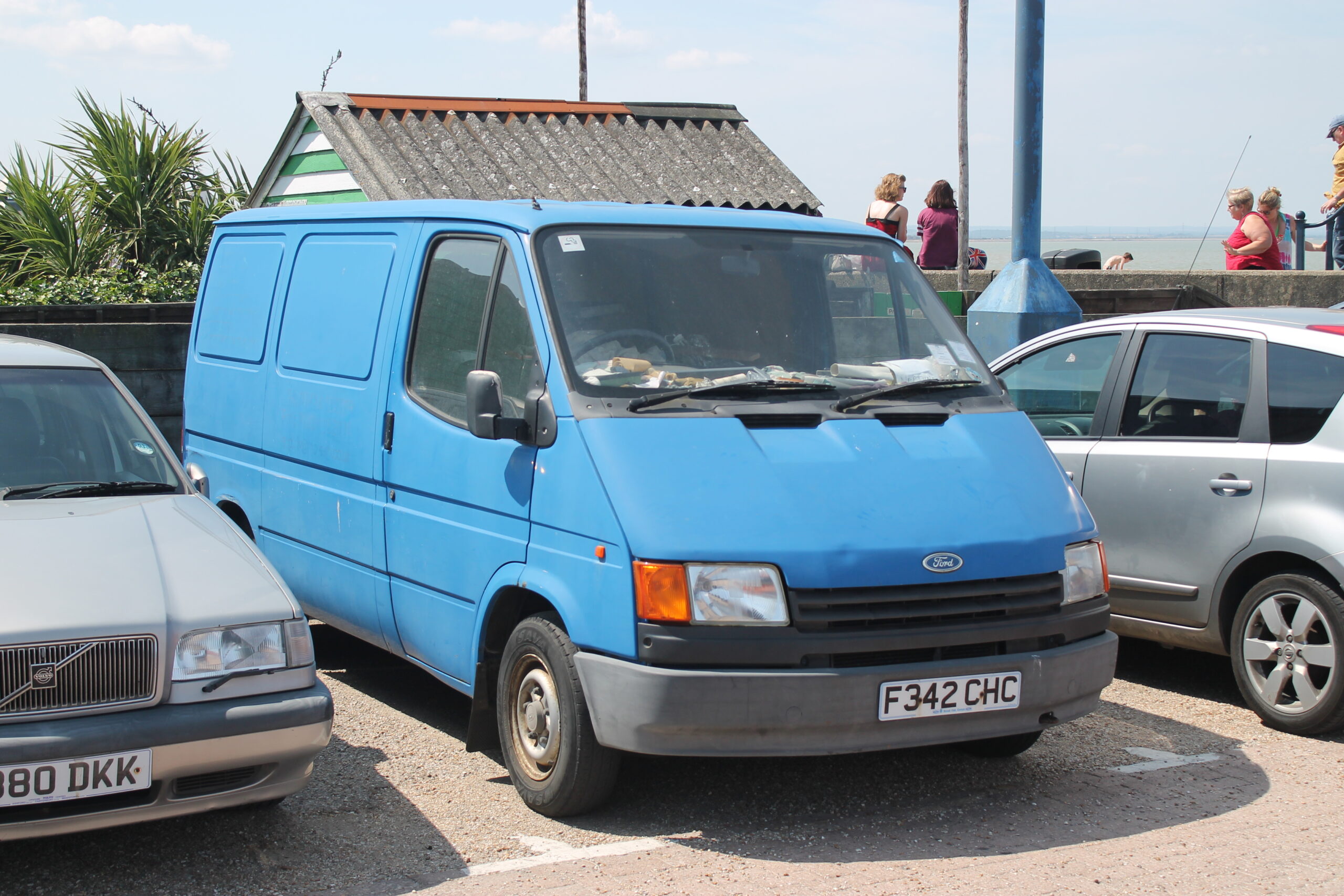
The Ford Transit (1986-1992) was offered as a panel van, minibus, chassis cab and camper base with petrol and diesel engines. Early models used a central passenger-compartment fuse and relay board containing positions 1-23 and relay sockets A-K. The wiring differs from the revised fuseboard introduced around 1992, even though vehicles from both periods may have similar bodywork.
This guide reproduces all 34 original entries without dropping the empty sockets, five-spare-fuse holder, trailer flasher, dim-dip system, rear wiper, gearbox overdrive and optional equipment. Verify the board shape and markings on your Transit rather than using the registration date alone.
Cigarette lighter and factory 12 V outlet: fuse 20 (25 A) in the early 1-23 board. On a Transit with the later 1992-1995 1-24 fuseboard, the cigarette lighter instead uses fuse 9 (20 A).
Where are the Ford Transit 1986-1992 fuses?
Central fuse and relay panel: in a left-hand-drive European Transit it sits under the driver’s dashboard close to the steering column. Park, switch off ignition and accessories, open the driver’s door and move the seat backward. Reach under the lower dashboard, locate the plastic fuseboard cover and release its clips gently. Older covers can become brittle. Compare the numbered positions with the legend on the cover; some vehicles also have a plastic fuse puller stored nearby.
One board houses the 1-23 main fuse positions and relays A-K. Fuse location 23 holds spare replacement fuses, not five independent live electrical circuits. Sockets 8, 9 and 15 are unused in the illustrated configuration. Added camper, emergency-services or trailer equipment may carry its own inline or auxiliary fuse near the battery or accessory wiring.
Right-hand-drive and converted vans: panel access may be mirrored, and vehicles repaired with replacement looms can differ from factory delivery. If the panel contains 24 numbered main fuses plus Roman-numeral relay labels, use the revised 1992-1995 diagram instead.
Ford Transit early fusebox – full 34-row reference
The following original diagram illustrates 23 numbered positions and 11 lettered relay sockets. Separate fuses protect the right and left dipped beams, high beams and side lights. Optional dim-dip headlight circuitry is covered by fuse 7 (15 A) and relays C/D. Rear wiper and heated rear glass depend on body and market equipment, while the tachograph or overdrive is principally seen on selected commercial versions.
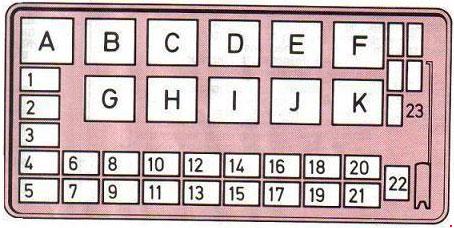
| Position | Amperage [A] | Protected circuit / function |
|---|---|---|
| 1 | 25 | Cabin heater blower motor and headlamp flash-to-pass supply |
| 2 | 10 | Left and right direction indicators |
| 3 | 15 | Front windscreen wiper motor and washer pump on vehicles without headlamp washer equipment |
| 4 | 10 | Reversing lights, brake lights and heated rear window relay control |
| 5 | 10 | Fuel and coolant temperature gauges, alternator and oil pressure warning lights, brake fluid warning and Thermostart diesel starting indicator |
| 6 | 15 | Rear window wiper motor and rear screenwash pump, if installed |
| 7 | 15 | Reduced-intensity dipped headlights (dim-dip), only on markets with this system |
| 8 | – | Unused fuse position in the documented early panel |
| 9 | – | Unused fuse position in the documented early panel |
| 10 | 10 | Right front/rear position lamps and dashboard illumination |
| 11 | 10 | Left front/rear position lamps and number plate lights |
| 12 | 10 | Right dipped-beam headlamp |
| 13 | 10 | Left dipped-beam headlamp |
| 14 | 10 | Rear fog lamps and headlamp washer timer |
| 15 | – | Unused fuse position |
| 16 | 10 | Right main-beam headlamp and its instrument-cluster indicator |
| 17 | 10 | Left main-beam headlamp |
| 18 | 10 | Cabin lights, radio, clock and optional tachograph; also front washer pump on vehicles equipped with headlamp washers |
| 19 | 20 | Hazard warning flashers and, on some installations, horn |
| 20 | 25 | Cigarette lighter and headlamp washer pump when equipped |
| 21 | 20 | Rear-window electric defogger on vehicles with heated glazing |
| 22 | 10 | Gearbox overdrive circuit, when fitted |
| 23 | – | Storage holder for five replacement fuses, not five active protected circuits |
| A | – | Relay A: automatic gearbox starter interlock / neutral safety control, automatic versions only |
| B | – | Relay B: unused socket |
| C | – | Relay C: reduced-intensity dipped headlamp control (dim-dip) |
| D | – | Relay D: second dim-dip headlamp relay |
| E | – | Relay E: unused relay socket |
| F | – | Relay F: heated rear window relay |
| G | – | Relay G: direction indicator flasher, trailer heavy-duty alternative on equipped vans |
| H | – | Relay H: headlamp washer relay |
| I | – | Relay I: front intermittent windscreen wiper relay |
| J | – | Relay J: rear intermittent wiper relay on vehicles with rear glazing |
| K | – | Relay K: unused relay socket |
How to identify a pre-1992 fuseboard
The old fuseboard has fuses 1-23 and relays A through K. Its cigarette lighter is position 20 (25 A). The later 1992-1995 board has fuses 1-24, spare and ABS positions F1-F4 and relay labels including Roman numerals I-XII. These are separate layouts: a fuse identified as 20 in one board need not protect the same device in the other.
Relay I is for the front intermittent windscreen wipers and relay J for the optional rear intermittent wiper. Relays C/D are used for reduced-intensity dipped-beam lighting on selected markets, not for adjusting dashboard illumination.
Typical Ford Transit electrical problems
Cigarette lighter or 12 V charger does not work: check 20 (25 A). Where headlamp washers are fitted, the same fuse can also supply that equipment. Disconnect chargers and check the socket for a short before fitting an identical replacement.
Direction indicators fail: inspect 2 (10 A) and flasher relay G. If only hazard lights fail, also inspect 19 (20 A) and the hazard switch. Towing vehicles may use a heavy-duty indicator flasher with a different load capacity.
Front wipers or washer pump stop: inspect 3 (15 A) and relay I. The washer pump is fed differently on vehicles equipped with headlamp washers, where 18 (10 A) may also serve it. Look for seized wiper linkage, corroded wiring and damaged pump connectors.
One dipped beam is out: check 12 (10 A) for the right and 13 (10 A) for the left. For main beam use 16 and 17 (10 A each). If both lamps are off, check the stalk switch and any dim-dip equipment.
Heated rear window fails: if installed, check 21 (20 A) and relay F, plus the associated control feed on fuse 4. On tailgates with movable glass or rear doors, wiring at hinges and defogger contact tabs can fail.
Clock, radio memory or interior lighting fail: check 18 (10 A). A separately installed tachograph may also have its own inline protection, so check body-builder documentation before disturbing the base-vehicle fuseboard.
Petrol and diesel variants, 1986-1992
Early Transits had different petrol and diesel engines, but the principal cabin fuseboard is not identified by engine type alone. Options such as Thermostart on diesel models, headlamp washers, heated rear glass, rear wiper, overdrive, automatic transmission and trailer electrics affect which sockets are used. Vans with solid rear doors may not have rear-screen equipment at all.
At the start of the 1990s Ford revised the electrical distribution. If the actual fuseboard does not match this drawing, do not force the reference to fit: check the next generation’s diagram and the original fuse-cover legend.
Other Transit fuse and relay diagrams
The later Ford Transit (1992-1995) uses a revised main panel. Another change followed in the Ford Transit (1995-2000). For much newer commercial electrical systems, see Ford Transit Mk6 (2000-2006). None of those fuse numbers can be copied to this early board.
Technical references: Ford Transit 1986-1992 workshop fuse and relay allocations, as documented in the Ford Transit electrical equipment technical data. The original matching diagram is retained, including all spare and unoccupied sockets.
Featured vehicle photo: Charlie, “1989 Ford Transit 100 (15191474225).jpg”, Wikimedia Commons, CC BY 2.0, unmodified. The image’s author and licence information are retained in the media record.