
The first-generation Mazda CX-7 before the facelift (2006-2009) uses two main fuse panels. The larger under-bonnet box protects engine management, cooling fans, headlamps and major body electrical feeds. A smaller driver’s side cabin panel contains the circuits for the radio, accessory power outlets, windscreen wipers and interior lighting. The complete 34-position engine-bay and 15-position passenger fuse listings below are based on the 2008 CX-7 owner’s handbook.
Where are the Mazda CX-7 fuse boxes?
Engine compartment: Turn the ignition off, open the bonnet and find the large black plastic fuse box close to the battery. Release the lid catches, raise the cover and use its printed legend to identify the position on the diagram. A large fusible link protects high-current circuits and should be replaced only using the manufacturer’s service procedure.
Passenger compartment: On left-hand-drive cars, look below the dashboard by the driver’s feet. Open the small access cover using its intended latch point, rather than forcing the trim. Right-hand-drive access may differ. Both panels should be checked against the actual vehicle, especially on cars built during the 2009 changeover.
Main engine compartment fuse box – positions 1-34
This box includes the engine and cooling circuits, ABS, ignition and high-current accessory supplies. The identification codes in the third column match those used on the Mazda fuse legend.

| Pozycja | Amperaż [A] | Chroniony obwód / funkcja |
|---|---|---|
| 1 | 40 | IGN 2 – Main ignition system power supply |
| 2 | 40 | BLOWER – Interior ventilation blower motor |
| 3 | 60 | BTN – Main supply for multiple electrical circuits |
| 4 | 40 | FAN 2 – Second radiator cooling fan circuit |
| 5 | 40 | IGN 1 – Main ignition power supply |
| 6 | 40 | FAN 1 – First engine cooling fan circuit |
| 7 | 40 | P.SEAT – Electrically adjustable seat, where equipped |
| 8 | 30 | INJ – Fuel injector power supply |
| 9 | 20 | ROOF – Electric sunroof, where equipped |
| 10 | 30 | BOSE – Factory Bose sound system, where equipped |
| 11 | 30 | ENGINE – Engine management power supply |
| 12 | 20 | D.LOCK – Central door locking |
| 13 | 30 | P.WIND – Power windows |
| 14 | 30 | FUEL – Fuel pump |
| 15 | 40 | ABS 1 – Anti-lock braking system, first circuit |
| 16 | 20 | ABS 2 – Anti-lock braking system, second circuit |
| 17 | 7.5 | DSC – Dynamic Stability Control |
| 18 | 20 | FOG – Front fog lamps, depending on equipment |
| 19 | 30 | DEF – Heated rear window |
| 20 | 15 | TNS – Position lamps, number plate lighting and entry illumination |
| 21 | 10 | A/C – Air-conditioning system, where equipped |
| 22 | 20 | ETC – Electronic throttle control and accelerator pedal position sensor |
| 23 | 15 | H/L HI – Headlamp levelling system, depending on equipment |
| 24 | 15 | DRL – Daytime running lights, where fitted |
| 25 | 15 | H/L LO RH – Right-hand dipped-beam headlamp |
| 26 | 15 | H/L LO LH – Left-hand dipped-beam headlamp |
| 27 | 7.5 | ENG BAR 2 – Powertrain control module (PCM) supply |
| 28 | 10 | ECM – Engine management system |
| 29 | 15 | ENG BAR 1 – Airflow meter and EGR control valve |
| 30 | 20 | P.WIND 2 – Additional electric window circuit |
| 31 | 10 | STOP – Brake lamps |
| 32 | 20 | HORN – Horn |
| 33 | 25 | ENG B+ – Constant PCM power supply |
| 34 | 10 | HAZARD – Hazard warning lights and turn indicators |
Passenger compartment fuse box – positions 1-15
The interior fuse panel protects accessories, lighting, mirror adjustment, audio and wiper circuits. OUTLET 1 and OUTLET 2 are independent 15 A power-outlet fuses.
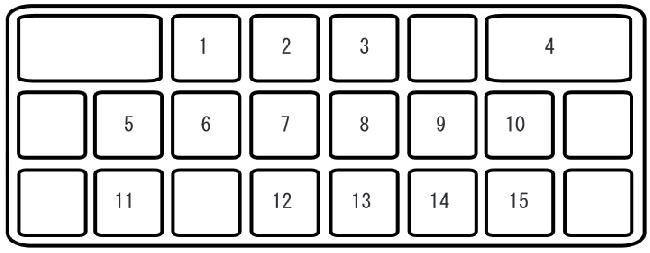
| Pozycja | Amperaż [A] | Chroniony obwód / funkcja |
|---|---|---|
| 1 | 15 | OUTLET 1 – First 12 V accessory power outlet |
| 2 | 15 | OUTLET 2 – Second 12 V accessory power outlet |
| 3 | 7.5 | P.MIR – Electrically adjustable exterior mirrors |
| 4 | 30 | WIPER – Front windscreen wipers and washers |
| 5 | 7.5 | M.DEF – Heated exterior mirrors, where fitted |
| 6 | 7.5 | ENG BAR 3 – Airflow meter and EGR control |
| 7 | 15 | P.WIND – Electric window controls |
| 8 | 7.5 | A/B – Advanced airbag and restraint system |
| 9 | 15 | ENGINE – Engine management supply |
| 10 | 10 | METER – Instrument cluster |
| 11 | 15 | ROOM – Radio and overhead interior lighting |
| 12 | 10 | ILLUMI – Instrument panel illumination |
| 13 | 20 | SEAT – Heated seats, where fitted |
| 14 | 10 | A/C – Air conditioning, where fitted |
| 15 | 10 | R.WIP – Rear window wiper and washer |
Differences in equipment and production date
Optional Bose audio, a sunroof, power-adjustable seats, seat heating and daytime running lights can affect the number of fitted fuses. P.SEAT refers to electric seat adjustment, not an accessory power outlet. The original Mazda 2008 fuse descriptions have been retained in the circuit labels, while the functions are explained in English. A late-2009 car may already use the facelift electrical layout, so verify the handbook edition and cover label.
Diagnosing power outlets, wipers and engine-related faults
12 V outlets: If one outlet stops working, start with passenger-compartment OUTLET 1 or OUTLET 2 (both 15 A), according to the affected socket. A working outlet does not establish that the other fuse is sound.
Wipers and horns: Passenger WIPER (30 A) covers the front wiper and washer circuit, while R.WIP (10 A) is for the rear. Check HORN (20 A) in the engine bay for a silent horn.
Fuel supply and engine controls: Engine-bay FUEL (30 A) protects the fuel pump. A cluster of engine management faults may involve ENGINE, ECM, ENG BAR 1/2/3 or ENG B+, but a diagnostic trouble-code scan is needed to identify the underlying circuit. Never fit a fuse with a higher amperage than specified.
Mazda CX-7 after the facelift
For a later build, see the separate Mazda CX-7 (2009-2012) fuse box diagrams. That version uses 36 engine-bay positions and 19 cabin positions, with several reassigned circuits. The illustrations and fuse numbers are not interchangeable across the facelift.
Technical reference: Mazda CX-7 owner’s manual, 2008 model year, “Fuse Panel Description”, pages 8-47 to 8-49. Equipment and market specifications can alter fuse occupancy.