
Peugeot built the 205 in several engine and trim versions between 1983 and 1998. This guide covers the late 14-position passenger-compartment fuse panel found on many 1995-1998 cars. It must not be treated as a universal map for the earliest 205 models or for every GTI and CTI: these may have different fuse arrangements and extra engine-bay protection.
Where is the Peugeot 205 fuse box?
Switch the ignition off. The main fuse board sits beneath the left-hand side of the dashboard. Open the access flap, press the retaining catch or release lever and lower the fuse carrier to inspect its positions. On some cars, a hinged lower cover near the storage area provides access. Avoid forcing brittle plastic fixings on older vehicles. Check the original panel labels before removing or installing a fuse.
On equipped vehicles there are also additional individual protections in the engine bay, particularly for ABS, the radiator cooling fan, the oxygen sensor and the fuel pump. Their exact wiring and physical positions depend on engine and equipment, and must not be inferred from the 14-slot cabin drawing.
Passenger-compartment fuse panel – positions 1-14
The diagram shows the late 205 fuse arrangement. An empty position 6 is deliberately retained in the table. Position 4 is listed as 15 A for optional auxiliary driving lamps in the corresponding reference configuration, but its use can vary by equipment and market.
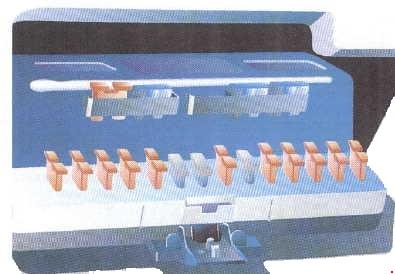
| Pozycja | Amperaż [A] | Chroniony obwód / funkcja |
|---|---|---|
| 1 | 10 | Reversing lights, rev counter, optional daytime running lights, fuel gauge, water-in-fuel sensor on diesel variants and warning lamps for charging, temperature, oil pressure, coolant and brakes |
| 2 | 25 | Direction indicators, fuel gauge, optional heated seats, auxiliary ventilation pump, temperature and oil pressure gauges, heater blower, air-conditioning equipment and dashboard warning lamps |
| 3 | 25 | Reading lamp, brake lamps, front and rear wipers and washers, ignition-switched radio, glovebox lighting, optional headlamp washers and power-window/rear-demister relays |
| 4 | 15 | Auxiliary driving or spot lamps on selected variants; the function can differ by model year and destination market |
| 5 | 10 | Hazard warning lights |
| 6 | – | Unused position on this fuse panel |
| 7 | 25 | Clock, passenger and boot lamps, central locking, radio permanent memory feed, trailer socket and electric-window power relay, where fitted |
| 8 | 30 | Horn, heated rear window and 12 V cigarette lighter |
| 9 | 25 | Front electrically operated windows, where fitted |
| 10 | 5 | Rear fog lamp |
| 11 | 5 | Left rear position/tail lamp and registration-plate lighting |
| 12 | 5 | Right rear position/tail lamp |
| 13 | 5 | Dashboard illumination and front position lamps |
| 14 | 15 | Electric fuel pump on selected petrol variants |
Additional under-bonnet circuits
The late Peugeot owner’s manual separately mentions engine-compartment protection for ABS (30 A), engine cooling fan (30 A) and, on applicable petrol versions, the lambda/oxygen sensor (10 A). Some detailed fuse lists also distinguish a separate ABS electronic-control supply of 15 A. These are optional or installation-dependent circuits: the 14-position dashboard diagram above does not show their physical location. Consult the correct engine-bay fuse holder and original service information before identifying or replacing one of these links.
Why earlier Peugeot 205 and GTI/CTI models can differ
The earliest 1983-1985 Peugeot 205 installations can use a 12-fuse main panel with additional separate protection. Sports models, including the 205 GTI and CTI, can have revised fuel-pump and auxiliary equipment wiring. A fuse that is 15 A in the late-model table should not be transferred automatically to a different generation of the panel simply because the car is a Peugeot 205.
Fault diagnosis using the right 205 fuse
Wipers, brake lamps or ignition-switched radio: Check fuse 3 (25 A), which supplies multiple components of this group. Cigarette lighter and rear-window heating: Fuse 8 (30 A) also protects the horn; multiple failures together can narrow down a supply issue.
Electric front windows: On models equipped with them, fuse 9 (25 A) protects the window supply; also check the switches and window motor wiring. Fuel pump: Fuse 14 (15 A) is used on the relevant petrol injection versions. A fuse that fails again immediately after replacement indicates a wiring or component fault, not a reason to fit a higher amperage.
Later Peugeot 206 fuse layouts
For the successor-era range, consult the Peugeot 206 (2000-2002) fuse box diagrams. The 206 uses a different distribution architecture, so its position numbers are not applicable to the 205.
Technical reference: Peugeot 205 owner’s handbook, “Fuses” section, including the 14-position passenger-compartment listing and separate engine-bay circuit descriptions. Check exact build year, market, engine and installed cover legend.