
The first-generation Peugeot 308 (chassis T7, 2007-2013) has several electrical distribution areas, unlike the newer T9. The European hatchback can have a dashboard fuse board F1-F17, supplementary accessory positions F29-F40, an engine-bay F1-F21 unit, a high-current block above the battery and eight listed Maxi links. The 2009-2012 Peugeot handbook circuit lists are the main reference; specific early and late cars can differ. All 77 original source entries are retained in six complete tables, including seven quick-reference rows and vacant positions.
Peugeot 308 I fuse box locations and access
Passenger compartment: Switch off the ignition and locate the access panel at the lower left-hand dashboard. On a left-hand-drive car, turn its securing screw a quarter-turn to the left, unclip the cover starting at the upper-right corner and pull the cover free. The fuse extractor and spares are mounted on its reverse side. Right-hand-drive owners should open the glovebox and release its guide as described in the original handbook before reaching the lower dashboard panel. The supplementary F29-F40 circuits are associated with accessories and should not be confused with the engine box.
Under the bonnet: Open the bonnet and locate the main engine fuse box alongside the battery. Release the retaining catches, identify the F1-F21 positions and refit the lid tightly against moisture. A separate block above the battery carries the large Midi/mini circuits that protect the electric steering pump, fan and ABS/ESP. Other Maxi links protect cabin and body functions. High-current links require a manufacturer-approved servicing procedure.
Which 308 T7 fuse assignment applies?
Do not choose solely from first registration. A 2009-2010 configuration uses supplementary F29 30 A for the boot 12 V socket, whereas the 2011-2013 reference uses F31 30 A for that outlet and leaves F29 unused. F31 can be only 15 A in an earlier car, serving a refrigerated storage compartment instead. There are also engine variants with F4 headlamp washer protection and F8 25 A starter protection, rather than the F4 10 A daytime-running-light and F8 20 A allocations in the displayed engine table. Compare the physical carrier, fuse label and engine specification.
Popular fuse positions
This index repeats commonly requested circuits from the full tables. Engine F2 for the horn is a different physical socket from dashboard F2. The 20/25 A starter alternatives must never be treated as permission to fit a larger fuse.
| Pozycja | Amperaż [A] | Chroniony obwód / funkcja |
|---|---|---|
| F9 | 30 | Front cigarette lighter and 12 V socket. Many specifications also feed the rear 12 V outlet from this dashboard fuse |
| F29/31 | 30 | Luggage-compartment 12 V outlet. Some 2009-2010 cars use F29 30 A, while 2011-2013 cars use F31 30 A |
| F1 | 15 | Rear windscreen wiper in the passenger compartment |
| F2 | 15 | Horn, ENGINE compartment (not the cabin F2) |
| F8 | 20 / 25 | Starter control in the engine box. 20 A in this 2009-2012 reference, with 25 A in another original configuration |
| F12 | 30 | Front windscreen wiper motor, ENGINE compartment |
| F39 | 20 | Panoramic roof sunblind motor, only where equipped |
Dashboard fuse box F1-F17 and PARC shunt
This is the typical 2009-2012 passenger panel. F9 at 30 A powers the cigarette lighter and front accessory socket, and sometimes the rear outlet. F1 at 15 A protects the rear wiper, F5/F6 supply the front/rear electric windows, and F17 at 40 A protects the heated rear window. The SH slot is a PARC shunt used for transport/parking mode, not a standard blade fuse; unused positions remain explicitly listed.
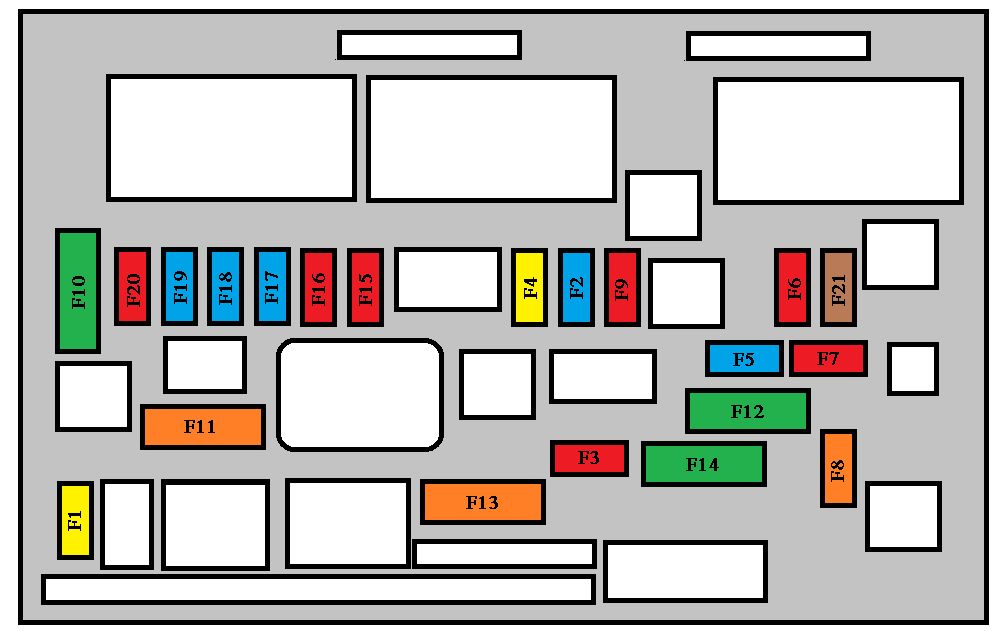
| Pozycja | Amperaż [A] | Chroniony obwód / funkcja |
|---|---|---|
| F1 | 15 | Rear windscreen wiper |
| F2 | – | Unused cabin fuse slot |
| F3 | 5 | Airbag and SRS control module |
| F4 | 10 | Electrochromic interior mirror, air conditioning, body protection/switching module and rear multimedia equipment |
| F5 | 30 | Front one-touch electric windows |
| F6 | 30 | Rear one-touch electric windows |
| F7 | 5 | Front/rear courtesy lamps, map lights, vanity and glovebox lights, armrest lamp and boot 12 V socket relay control |
| F8 | 20 | Radio, phone, CD changer, multifunction display, alarm, telematics and tyre pressure monitoring as equipped |
| F9 | 30 | Front 12 V socket and cigarette lighter; rear 12 V supply on some versions |
| F10 | 15 | Steering-wheel mounted controls |
| F11 | 15 | Low-current ignition-switch electrical feed |
| F12 | 15 | Trailer interface, automatic rain/light sensor and other accessory supplies |
| F13 | 5 | Engine fuse box and airbag controller |
| F14 | 15 | Instrument cluster and its display |
| F15 | 30 | Central door locking and deadlocking |
| F17 | 40 | Heated rear window, plus supply for supplementary F30 |
| SH | Shunt | PARC transport/parking-mode configuration shunt, not a standard replaceable fuse |
Additional accessory fuses F29-F40
Peugeot’s 2009-2010 and 2011-2013 handbook allocations differ most noticeably for F29 and F31. The remaining positions cover heated mirrors, electronic gearbox controls, Bluetooth, parking assistance, Hi-Fi audio, powered driver seat and the optional panoramic roof blind. The table retains both factory year-range ratings in its middle column, using a dash for an unused position. Do not install a fuse in a location listed as unused for your vehicle.
| Pozycja | Amperaż [A] | Chroniony obwód / funkcja |
|---|---|---|
| F29 | 30 / – | Luggage-compartment 12 V power socket in early 2009-2010: F29 30 A. Unused in the later 2011-2013 allocation. Earlier 2009-2010: 30 A; later 2011-2013: -. |
| F30 | 5 / 5 | Heated exterior door mirrors. Earlier 2009-2010: 5 A; later 2011-2013: 5 A. |
| F31 | 15 / 30 | 2009-2010: F31 15 A for refrigerated glovebox/coolbox equipment; 2011-2013: F31 30 A for luggage 12 V outlet. Earlier 2009-2010: 15 A; later 2011-2013: 30 A. |
| F32 | 5 / 5 | Gear selector lever of electronically controlled automatic/manual gearbox. Earlier 2009-2010: 5 A; later 2011-2013: 5 A. |
| F33 | 10 / 10 | Head-up display, Bluetooth hands-free and climate control. Earlier 2009-2010: 10 A; later 2011-2013: 10 A. |
| F34 | 5 / 5 | Seat-belt warning display. Earlier 2009-2010: 5 A; later 2011-2013: 5 A. |
| F35 | 10 / 10 | Parking sensors and Hi-Fi amplifier authorisation. Earlier 2009-2010: 10 A; later 2011-2013: 10 A. |
| F36 | 10 / 10 | Trailer control module and driver door switches. Earlier 2009-2010: 10 A; later 2011-2013: 10 A. |
| F37 | 20 / 20 | Hi-Fi amplifier. Earlier 2009-2010: 20 A; later 2011-2013: 20 A. |
| F38 | 30 / 30 | Driver electrically adjustable seat. Earlier 2009-2010: 30 A; later 2011-2013: 30 A. |
| F39 | 20 / 20 | Panoramic roof blind. Earlier 2009-2010: 20 A; later 2011-2013: 20 A. |
| F40 | – / – | Unused position. Earlier 2009-2010: -; later 2011-2013: -. |
Engine compartment fuse box F1-F21
Engine F2 (15 A) protects the horn, F3 (10 A) washer pumps, F8 (20 A) the starter control, F11 (40 A) the cabin ventilation blower and F12 (30 A) the front wipers in this reference. Petrol THP engines have turbo, EVAP and variable valve-timing equipment, while HDi engines add injection, EGR and particulate-filter controls. F4 at 10 A is the daytime-light circuit in this exact version; other 308 engine carriers may assign that position to 20 A headlamp washing. The original matching engine diagram is shown immediately below.
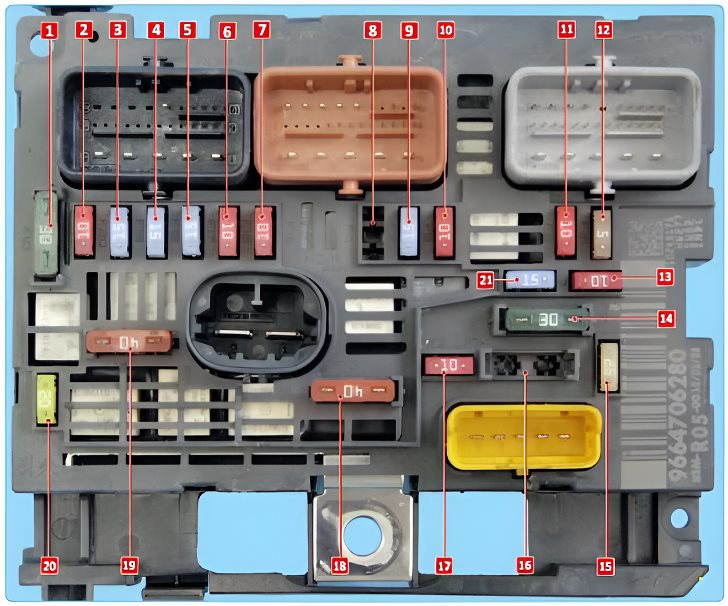
| Pozycja | Amperaż [A] | Chroniony obwód / funkcja |
|---|---|---|
| F1 | 20 | Engine ECU supply; on 2.0 HDi includes injection pump, EGR and injector circuits |
| F2 | 15 | Horn |
| F3 | 10 | Front and rear windscreen washer pumps |
| F4 | 10 | Daytime running lights in this documented engine carrier |
| F5 | 15 | Fuel vapour purge, turbo boost regulation, oil vapour heater or diesel heating depending on engine |
| F6 | 10 | Diagnostic connector, directional headlamps, diesel particulate additive pump and other equipment-dependent controls |
| F7 | 10 | Power steering controller, automatic gearbox and adaptive headlamp height adjustment |
| F8 | 20 | Starter motor solenoid control |
| F9 | 10 | Brake and clutch pedal switches |
| F10 | 30 | Engine ECU actuators including ignition coils, valves, lambda probes, injectors, heaters and fuel pump depending on petrol or diesel engine |
| F11 | 40 | Heater and A/C blower motor |
| F12 | 30 | Front windscreen wiper motor, low and high speeds |
| F13 | 40 | BSI body electronics power after ignition |
| F14 | 30 | Secondary air pump when fitted |
| F15 | 10 | Right main-beam headlamp |
| F16 | 10 | Left main-beam headlamp |
| F17 | 15 | Left dipped-beam headlamp |
| F18 | 15 | Right dipped-beam headlamp |
| F19 | 15 | Oil vapour heating, EVAP, oxygen sensor heaters and solenoid controls depending on engine |
| F20 | 10 | Controlled thermostat, variable valve timing, turbo regulation and coolant sensor |
| F21 | 5 | Cooling fan relay power, Valvetronic, turbo cooling or air flow meter depending on engine |
Battery-mounted Mini/Midi fuses F1-F12
The additional block above the battery is particularly important for power steering, ABS/ESP and engine cooling faults. F7 (80 A) supplies the electric power-steering pump, F8 (60 A) the radiator fan, F10 (40 A) the ABS hydraulic pump and F11 (100 A) the switching and protection module. F9 is explicitly engine dependent: 80 A for some diesel heating or 30 A for 1.6 THP Valvetronic. These ratings should be selected only from the vehicle-specific electrical configuration.
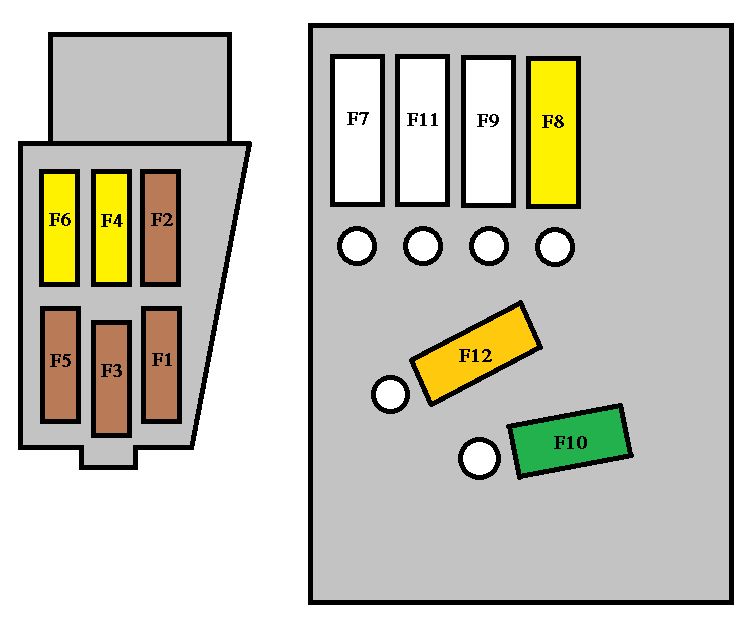
| Pozycja | Amperaż [A] | Chroniony obwód / funkcja |
|---|---|---|
| F1 | – | Unused position in the 2011 battery-mounted panel |
| F2 | 5 | Dual-function brake pedal sensor |
| F3 | 5 | Battery charging module |
| F4 | 25 | ABS/ESP solenoid valves |
| F5 | 5 | ABS/ESP ECU |
| F6 | 15 | Automatic or electronically controlled manual gearbox |
| F7 | 80 | Electric power-steering pump |
| F8 | 60 | Radiator cooling fan |
| F9 | 80/30 | Diesel heating 80 A / 1.6 THP Valvetronic 30 A, depending on engine |
| F10 | 40 | ABS/ESP hydraulic pump |
| F11 | 100 | Switching and protection module high-current supply |
| F12 | 30 | Electric pump for automated gearbox |
Maxi fuses MF1-MF8
These supplementary links feed the trailer distribution box, passenger fuse carrier, BSI body electronics, electric parking brake where fitted, heated front seats and headlamp washers. MF1 is not used in the chart and must remain empty if the vehicle has that specification. The number alone does not identify the correct replacement on a car with different optional equipment.
| Pozycja | Amperaż [A] | Chroniony obwód / funkcja |
|---|---|---|
| MF1 | – | Unused high-current position in this variant |
| MF2 | 30 | Trailer fuse box |
| MF3 | 50 | Passenger-compartment main fuse carrier |
| MF4 | 80 | First BSI power supply |
| MF5 | 80 | Second BSI power supply |
| MF6 | 30 | Electric parking brake supply if equipped |
| MF7 | 30 | Heated front seats if equipped |
| MF8 | 20 | Headlamp washer pump |
Common electrical failures and their fuses
Front lighter or 12 V socket dead: Check cabin F9 (30 A), then inspect the socket for a foreign metallic object. Boot 12 V outlet not working: Confirm whether the car uses early supplementary F29 (30 A) or later F31 (30 A), rather than changing both. Rear wiper: Cabin F1 (15 A) and the tailgate harness. Panoramic roof shade: Supplementary F39 (20 A) on equipped cars.
No horn: Engine F2 (15 A). Windscreen wiper motor stopped: Engine F12 (30 A). Heater blower inoperative: Engine F11 (40 A), followed by the controller and blower connectors. Hard steering with a warning: Check the battery block F7 (80 A) using qualified electrical service procedures; low voltage, wiring and pump faults can produce similar symptoms. ABS warning: Battery protection at F4/F5/F10 and module fault codes are relevant.
Other Peugeot generations
Do not confuse this first-generation T7 with the newer Peugeot 308 II T9 (2014-2018), which has Full and Eco fuse carriers. Related earlier electrical architecture is described in the Peugeot 307 (2001-2004) and Peugeot 407 (2007-2011) articles; their numbering and amperages are not interchangeable.
Technical references: Peugeot 308 T7 2009-2012 owner handbooks, including the main cabin, supplementary F29-F40 and engine distributions. Individual body, engine and market equipment affect fuse occupation and available slots.