
The first-phase Peugeot 307 (T5, 2001-2004) uses a dashboard fuse carrier and a second distribution box beside the battery in the engine compartment. Although the housing can look similar across these early production years, the 2001-2003 and 2004 fuse allocations differ. The full tables below retain every occupied and unused location, the high-current Maxi links, the 2004-only F27 airbag fuse and a seven-row quick reference. The 2001-2003 fuse values have also been checked against the period wiring diagram documentation.
Where are the Peugeot 307 fuse boxes?
Passenger compartment: With the ignition off, open the lower dashboard fuse flap on the driver’s side of a left-hand-drive 307. Release its catches and gently pull the cover down. On right-hand-drive vehicles the position and access can be different; follow the fitted trim and handbook. The fuse puller and spares are usually carried on the back of the cover. The 2004 panel includes an additional F27 location above the usual row of dashboard fuses.
Under the bonnet: Open the bonnet and locate the protected electrical distribution box close to the battery. Release the cover clips, locate the smaller F1-F18 positions and identify the larger Maxi links in the main power distribution carrier. Refit and seal the lid before driving to prevent water reaching the contacts. A Maxi link is a service component protecting a high-current circuit, not a replacement for an ordinary blade fuse.
Most frequently searched Peugeot 307 fuse positions
This seven-row index repeats positions explained in the detailed tables below; it is not another physical fuse box. F11 is 15 A on the earlier dashboard and 20 A on the 2004 panel. Engine F2 and F13 are separate from dashboard fuse numbers.
| Pozycja | Amperaż [A] | Chroniony obwód / funkcja |
|---|---|---|
| F7 | 20 | Front cigarette lighter and 12 V socket. 2001-2003: F7 – 20 A; 2004: F7 – 20 A. |
| F10 | 15 | Rear 12 V outlet. 2001-2003: F10 – 15 A; 2004: F10 – 15 A. |
| F11 | 15 / 20 | Radio and multifunction display. 2001-2003: F11 – 15 A; 2004: F11 – 20 A. |
| F2 | 15 | Fuel pump (engine fuse box). 2001-2003: F2 w komorze silnika – 15 A; 2004: F2 w komorze silnika – 15 A. |
| F13 | 15 | Horn (engine fuse box). 2001-2003: F13 w komorze silnika – 15 A; 2004: F13 w komorze silnika – 15 A. |
| F17 | 30 | Front wipers (engine fuse box). 2001-2003: F17 w komorze silnika – 30 A; 2004: F17 w komorze silnika – 30 A. |
| F26 | 30 | Heated rear window. 2001-2003: F26 – 30 A; 2004: F26 – 30 A. |
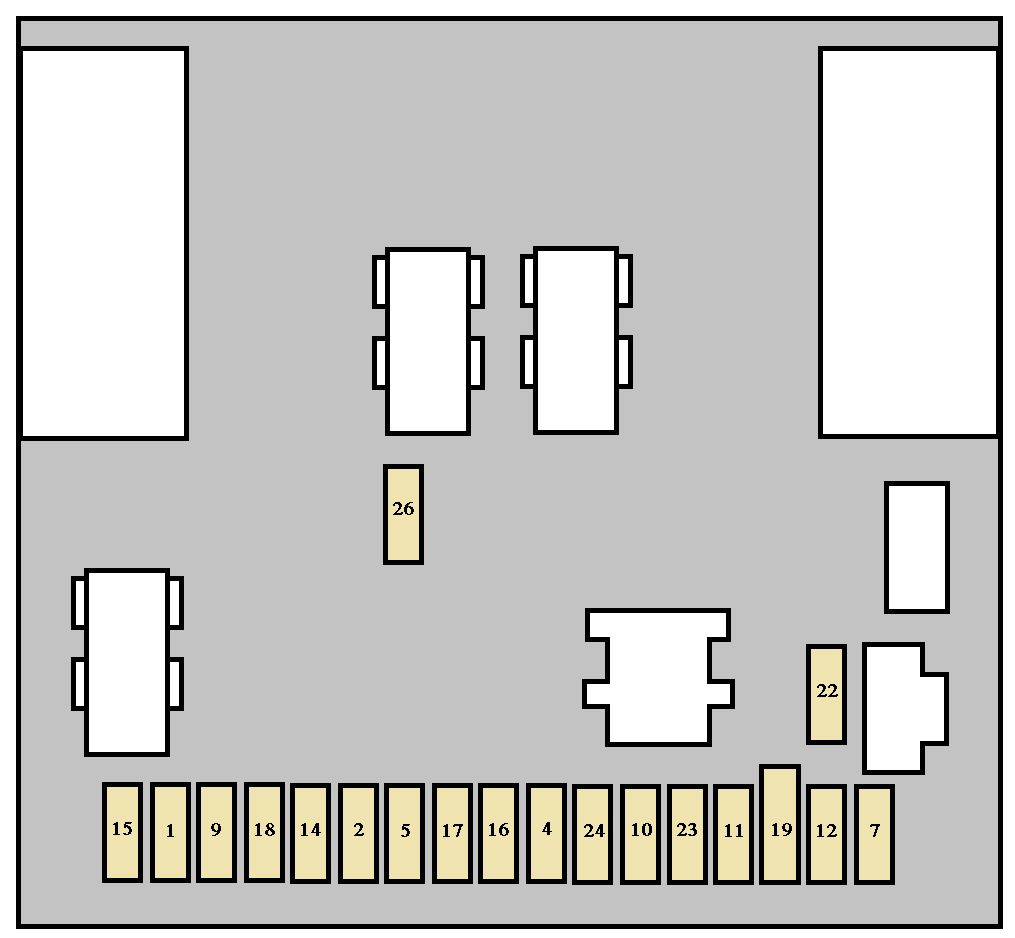
Dashboard fuse box – Peugeot 307 (2001-2003)
This early fascia arrangement lists 26 fuse and shunt positions. In particular, cabin F7 (20 A) supplies the lighter and front interior lighting, F10 (15 A) supplies the rear 12 V socket and diagnostic connector, F11 (15 A) protects radio and display equipment, and F16 (5 A) serves engine fuse-box and SRS-related control. The F19 position is a PARC configuration shunt in a nominal 30 A holder; it is not a normal fuse that should be replaced by amperage alone.
| Pozycja | Amperaż [A] | Chroniony obwód / funkcja |
|---|---|---|
| F1 | 10 | Rear fog lamp |
| F2 | 15 | Rear windscreen wiper motor |
| F3 | – | Unused fuse position |
| F4 | 15 | Front power windows and electric sunroof |
| F5 | 15 | Left brake lamp and trailer stop-lamp supply |
| F6 | – | Unused fuse position |
| F7 | 20 | Front and rear courtesy lights, map-reading and glovebox lamps, cigarette lighter and front 12 V socket |
| F8 | – | Unused fuse position |
| F9 | 30 | Power windows, one-touch window operation and sunroof on equipped cars |
| F10 | 15 | Rear 12 V accessory socket and OBD diagnostic connector |
| F11 | 15 | Radio, multifunction display, steering-wheel controls and automatic gearbox where fitted |
| F12 | 10 | Right-hand front and rear position lamps, number-plate lights, switch illumination, lighter illumination and headlamp-height adjuster |
| F13 | – | Unused fuse position |
| F14 | 30 | Door central locking and deadlocking |
| F15 | 30 | Electric rear windows |
| F16 | 5 | Engine fuse-box control, factory alarm, airbag controller, steering-wheel controls and diesel particulate-filter electronics |
| F17 | 10 | Right brake lamp and high-mounted third brake light |
| F18 | 10 | OBD diagnostic connector, steering-wheel switches, brake and clutch switches and coolant-level sensor |
| F19 | 30 / shunt | PARC transport / parking-mode shunt. Source lists a 30 A holder but this is a configuration bridge, not a conventional blade fuse |
| F20 | – | Unused fuse position |
| F21 | – | Unused fuse position |
| F22 | 10 | Left-hand parking / position lamps, licence-plate illumination and trailer lighting |
| F23 | 15 | Factory alarm siren and cabin alarm controller |
| F24 | 15 | Radio, instrument cluster, automatic A/C, multifunction display and optional parking assistance |
| F25 | – | Unused fuse position |
| F26 | 30 | Heated rear window / demister |
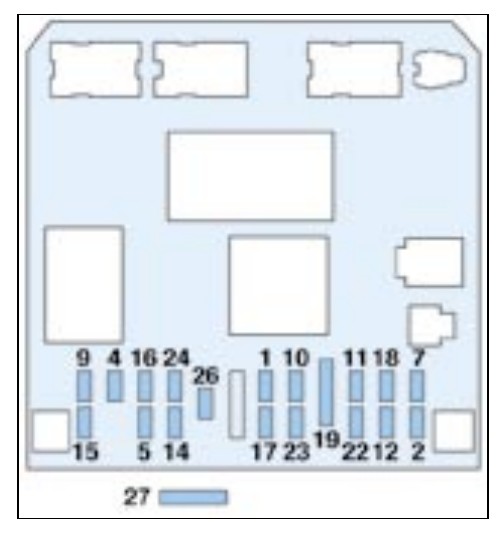
Dashboard fuse box – Peugeot 307 (2004)
In the 2004 handbook the cabin panel has 27 listed positions, with F27 (10 A) located towards the upper part of the panel and dedicated to airbags. F11 (radio, display and steering controls) rises from 15 to 20 A; F16 rises from 5 to 10 A. The drawing below is the exact 2004 27-position board rather than a misleading reproduction of the preceding year’s carrier.
| Pozycja | Amperaż [A] | Chroniony obwód / funkcja |
|---|---|---|
| F1 | 10 | Rear fog lamp |
| F2 | 15 | Rear windscreen wiper motor |
| F3 | – | Unused fuse position |
| F4 | 15 | Front electrically operated windows and optional sunroof |
| F5 | 15 | Left brake lamp and trailer stop-lamp supply |
| F6 | – | Unused fuse position |
| F7 | 20 | Front and rear courtesy lights, glovebox lights, front lighter and 12 V socket |
| F8 | – | Unused fuse position |
| F9 | 30 | Front electric windows, one-touch operation and optional sunroof |
| F10 | 15 | Rear 12 V accessory socket, OBD connector and trailer wiring on equipped vehicles |
| F11 | 20 | Audio system, multifunction display, steering-wheel controls and optional automatic gearbox – 20 A in the 2004 list |
| F12 | 10 | Right-hand position lamps, licence-plate and trailer lights, lighting for dashboard switches and cigarette lighter |
| F13 | – | Unused fuse position |
| F14 | 30 | Central door locking and deadlocking |
| F15 | 30 | Rear power windows |
| F16 | 10 | Engine fuse-box controls, alarm, diesel particulate-filter controller, steering-wheel controls and SRS airbags – 10 A in 2004 |
| F17 | 10 | Right brake lamp and third high-mounted stop light |
| F18 | 10 | Diagnostic connector, auto-dimming mirror, brake/clutch switches and coolant level circuit |
| F19 | 30 / shunt | PARC mode configuration shunt at a nominal 30 A holder, not a replaceable standard fuse |
| F20 | – | Unused fuse position |
| F21 | – | Unused fuse position |
| F22 | 10 | Left-side front/rear position lights, licence-plate and trailer lighting |
| F23 | 15 | Factory alarm siren and alarm ECU |
| F24 | 15 | Instrument cluster, audio, multifunction display, climate control, parking assistance and rain/light sensor |
| F25 | – | Unused fuse position |
| F26 | 30 | Heated rear windscreen |
| F27 | 10 | Airbag electrical control supply at the top of the fuse carrier, 10 A; additional position on the 2004 panel |
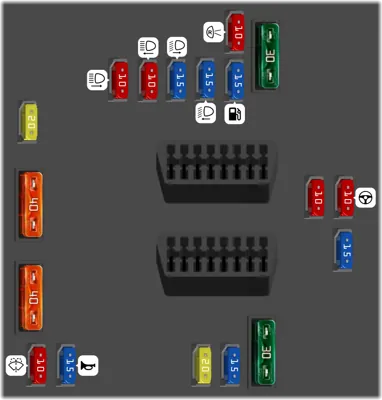
Under-bonnet standard fuses – 2001-2003 and 2004
The engine box protects lights, injection, fuel pump, ABS/ESP, front wipers and climate blower. Positions F9 and F10 have 15 A for the separate left/right dipped beams; F17 has 30 A for the front wipers, and F18 has 40 A for the blower. The 2004 service chart gives F16 at 30 A instead of the earlier 40 A for the secondary air pump on equipped petrol engines. F7 may be unoccupied or protect a 20 A headlamp washer, depending on the fitted configuration.
| Pozycja | Amperaż [A] | Chroniony obwód / funkcja |
|---|---|---|
| F1 | 10 | Manual/automatic gearbox reversing-lamp switch, speed signal, diesel preheating and water-in-fuel sensing depending on engine |
| F2 | 15 | Fuel pump and petrol fuel-vapour canister purge solenoid |
| F3 | 10 | ABS/ESP electronics and electric power steering control |
| F4 | 10 | Engine injection ECU and fan or auxiliary heater relays; automatic gearbox control on equipped cars |
| F5 | 15 | Diesel particulate-filter emission-control ECU where fitted |
| F6 | 15 | Front fog lights |
| F7 | 20 / unused | Headlamp washer pump at 20 A on equipped cars; this location is unused in some later installations |
| F8 | 20 | Cooling fan relay control, engine injection ECU supply and associated pump equipment |
| F9 | 15 | Left dipped-beam headlamp |
| F10 | 15 | Right dipped-beam headlamp |
| F11 | 10 | High-beam headlamp (one side; compare the installed cover because early and 2004 descriptions can reverse left/right) |
| F12 | 10 | Second high-beam headlamp (opposite side; consult the vehicle cover for exact orientation) |
| F13 | 15 | Horn |
| F14 | 10 | Front/rear screen washer pumps according to body and equipment |
| F15 | 30 | Engine control actuators including coils, injectors, EGR, oxygen sensors and diesel pressure equipment |
| F16 | 40 / 30 | Secondary-air pump on appropriate petrol engines: 40 A in 2001-2003, 30 A in 2004 |
| F17 | 30 | Front windscreen wiper motor, low/high speed |
| F18 | 40 | Heating and air-conditioning blower motor |
Main high-current Maxi fuses MF1-MF8
These protect the cooling fan, ABS/ESP, BSI, ignition and electric power steering. The 2001-2003 chart gives MF4 as 60 A for BSI; the 2004 chart gives 70 A. The MF1 cooling fan power link may be 30 or 50 A depending on fan power and production version. MF6 is unused in the 2004 reference but can be a 20 A heated-seat supply on some earlier cars. MF7 remains 30 A for the ignition switch, and MF8 70 A for the electric power steering pump.
| Pozycja | Amperaż [A] | Chroniony obwód / funkcja |
|---|---|---|
| MF1 | 30 / 50 | Engine radiator cooling fan main circuit: 30 A on early systems, and 30/50 A on applicable 2004 fan motors |
| MF2 | 30 | ABS/ESP hydraulic pump motor |
| MF3 | 30 | ABS/ESP solenoid valves |
| MF4 | 60 / 70 | BSI (body systems interface) main power: 60 A on the early list, 70 A on the 2004 list |
| MF5 | 70 | Second BSI main 70 A power feed |
| MF6 | 20 / unused | Optional heated front seats on certain early installations at 20 A; empty in the 2004 list |
| MF7 | 30 | Ignition switch high-current power feed |
| MF8 | 70 | Electric power steering pump main 70 A supply |
Which year and engine-specific fuse diagram is correct?
The registration date does not necessarily establish the production electrical specification. Look at the physical board: an F27 airbag position above the dashboard panel is a useful indication of the 2004 version. Compare F11, F16, MF4 and engine F16 ratings before replacing a fuse. Petrol engines may have the secondary air injection pump circuit, while the diesel HDi can use particulate-filter and preheat circuits. Automatic gearbox, air conditioning, electric sunroof, trailer wiring and alarm equipment also affect actual circuit occupancy.
Peugeot 307 Break, SW and CC have different rear-body and roof equipment. A fuse number documented for a hatchback must not automatically be applied to a station wagon’s roof blind or to the electro-hydraulic folding roof of a 307 CC.
Cigarette lighter, horn, window and other common faults
Front 12 V socket: Cabin F7 (20 A). Rear socket: Cabin F10 (15 A). Audio/display: Check cabin F11 (15 A for 2001-2003 or 20 A for 2004) and F24 (15 A) according to the circuit concerned. Rear window demister: F26 (30 A) on the cabin board.
Horn does not sound: Engine F13 (15 A), followed by the horn relay and wiring. Front wipers stop: Engine F17 (30 A) protects the motor; inspect the mechanism and relay if the fuse remains intact. Fuel pump fails: Engine F2 (15 A) supplies pump and purge equipment, although the fuel pump relay and connections must also be checked.
Central locking stops: Cabin F14 (30 A) supplies locking and deadlocking. Airbag warning: On the 2004 board cabin F27 (10 A) is the extra SRS supply; diagnostic fault codes are needed if fuses are intact. Never replace an airbag-related fuse with a higher rating.
Other Peugeot fuse-box generations
The later Peugeot 307 CC (2006-2008) has its own power feeds for the folding metal roof. The Peugeot 307 SW (2003) has estate-specific equipment. Earlier architecture is described for the Peugeot 306, and the related Peugeot 206 does not share the same fuse numbering.
Technical sources: Peugeot 307 2001-2003 electrical wiring charts, 2004 owner’s handbook fuse layout and the original model-specific source tables. Engine, region and production specification take precedence over generic diagrams.