
The Peugeot 207 CC (2006-2014) is a coupé-cabriolet with an electric-hydraulic folding metal roof. Its fuse allocation is not interchangeable with either the regular hatchback or 207 SW, even where the engine fuse box looks similar. In addition to standard dashboard and engine fuses, the CC includes G37 30 A for the retractable roof unit, G38 for optional Hi-Fi and equipment-dependent G39 heated seats. All 50 physical positions from the original Polish article are retained, with different CC handbook editions distinguished rather than merged into a false universal wiring diagram.
Where are the 207 CC fuse boxes?
Dashboard: Switch the ignition off. Peugeot locates the interior fuse carrier in the lower left area of the dashboard. The 2011 instruction for fuse access describes opening the glovebox, moving its opening guide to the left and unclipping the cover from its top edge to reach the fuse puller. The exact service trim depends on steering and market. The G37-G40 supplementary fuses are associated with the dashboard carrier; they are not engine-box F-series fuses. Do not disturb SRS modules when reaching the cover.
Engine bay: Lift the bonnet and locate the covered distribution box beside the battery. Unclip the lid, check F1-F18 and then refit it tightly against water. The high-current MF links feed the cooling fan, ABS, BSI, power steering, diesel heating and Valvetronic depending on engine; their servicing requires the correct workshop procedure.
Supplementary dashboard fuses G37-G40
G37 30 A supplies the retractable roof controller and is specific to the CC. G38 20 A is for an optional Hi-Fi amplifier. G39 differs by manual: Peugeot’s 2010 CC owner handbook and the German-language 2011 edition show 20 A for heated driver and passenger seats; an English-language 2011 CC edition lists G39 as unused. G40 40 A supplies optional trailer electrics. Never fill an empty G39 position simply because a different market’s manual includes seats.
| Pozycja | Amperaż [A] | Chroniony obwód / funkcja |
|---|---|---|
| G37 | 30 | Retractable hardtop roof ECU power supply – 30 A |
| G38 | 20 | Hi-Fi audio amplifier, where fitted |
| G39 | 20 / – | Factory heated driver and passenger seats at 20 A in some handbook editions; not used in the 2011 English-market CC manual. Match the specific car |
| G40 | 40 | Trailer fuse box electrical supply, where fitted |
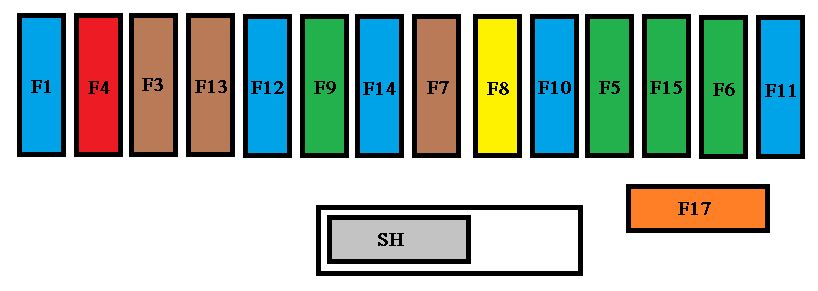
Passenger fuse box F1-F17 and PARC shunt
Unlike the standard hatchback, cabin F5 30 A protects the CC’s rear electric windows and roof equipment, and F12 15 A participates in roof-control signals. Front windows and folding mirrors use F6 30 A. F3 5 A protects the airbags, F8 20 A supplies radio and controls, F9 30 A the front 12 V socket, and F17 40 A the heated rear screen and mirrors. F1 and F2 are unoccupied; SH is the PARC configuration shunt, not a normal fuse.
| Pozycja | Amperaż [A] | Chroniony obwód / funkcja |
|---|---|---|
| F1 | – | Unused in this 207 CC dashboard configuration |
| F2 | – | Unused in this 207 CC dashboard configuration |
| F3 | 5 | Airbags and pyrotechnic seatbelt pretensioner ECU |
| F4 | 10 | Clutch switch, diagnostic connector, photochromic mirror, A/C, steering angle sensor and diesel particulate filter additive pump |
| F5 | 30 | Rear electric windows and retractable roof interlock/cover controls |
| F6 | 30 | Front electric windows and electric folding door mirror power |
| F7 | 5 | Cabin courtesy, map-reading, vanity mirror and glovebox lights |
| F8 | 20 | Audio/telephone, multifunction display, steering controls, tyre pressure monitoring, alarm and trailer control |
| F9 | 30 | Front 12 V accessory socket and additional interior supply in specified manuals |
| F10 | 15 | Factory alarm siren and optional directional headlights |
| F11 | 15 | OBD diagnostic socket and automatic gearbox electronic control |
| F12 | 15 | Rain/light sensor, trailer module and retractable roof control signals |
| F13 | 5 | Under-bonnet fuse carrier, ABS relay and dual brake switch |
| F14 | 15 | Instrument cluster, seatbelt warning display, headlamp levelling, climate control, radio and parking sensors |
| F15 | 30 | Central locking and deadlocking |
| F17 | 40 | Heated rear windscreen and exterior mirrors |
| SH | Shunt | PARC transport-mode configuration shunt, not a normal current-rated fuse |
Engine compartment F1-F18
In this CC engine carrier F2 15 A protects the horn, F4 20 A headlamp washers on equipped cars, F5 15 A the fuel pump or THP turbo-control solenoids, F11 40 A the heater blower and F12 30 A the front wipers. Petrol THP and diesel HDi have different injection, turbo and emissions equipment. Engine F8 is rated 20 A in the 2010-2011 Peugeot CC handbook, but some older fuse charts list 25 A. Confirm the actual production variant; do not install a larger fuse by assumption.
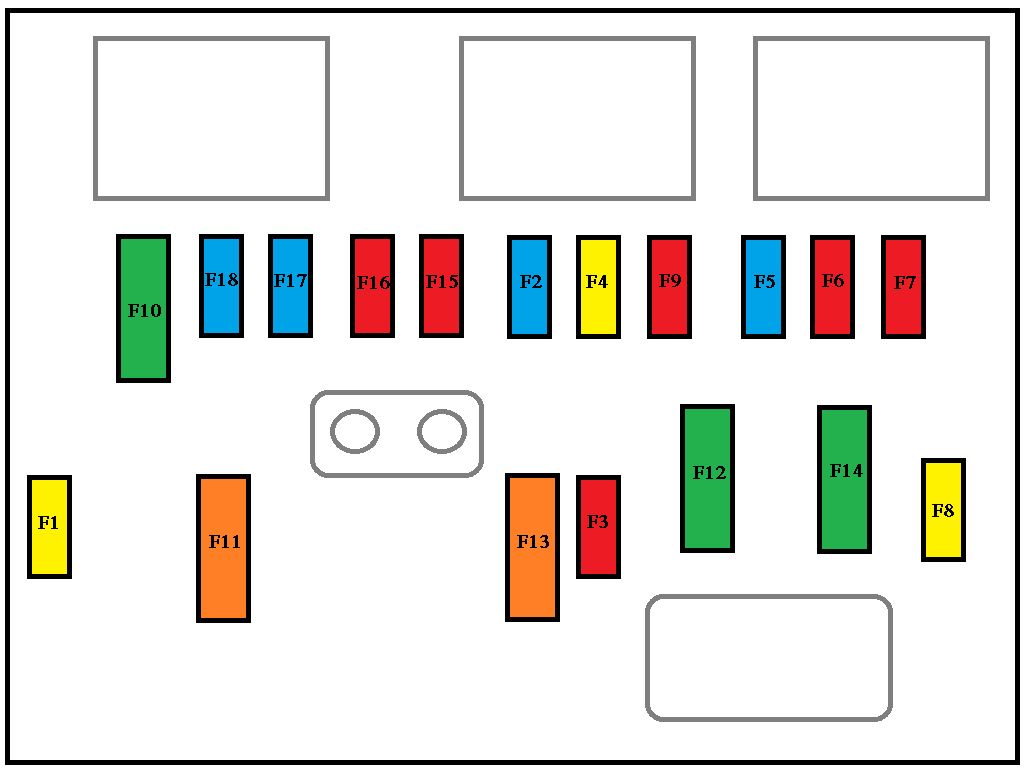
| Pozycja | Amperaż [A] | Chroniony obwód / funkcja |
|---|---|---|
| F1 | 20 | Engine ECU and cooling fan relays; THP variable timing and EVAP; HDi airflow, injection, EGR and air preheat circuits |
| F2 | 15 | Horn |
| F3 | 10 | Front windscreen washer pump |
| F4 | 20 | Headlamp washer pump when fitted |
| F5 | 15 | Petrol fuel pump or THP turbo-control solenoids |
| F6 | 10 | Vehicle speed sensor and automatic gearbox |
| F7 | 10 | Electric power steering control and optional directional headlamps |
| F8 | 20 / 25 | Starter control: Peugeot 207 CC 2010-2011 handbook lists 20 A, while some earlier specifications give 25 A; confirm the fuse cover |
| F9 | 10 | ABS/ESP ECU and brake pedal switch |
| F10 | 30 | Engine management actuators, injection coils, oxygen sensors, solenoids and heaters depending on engine |
| F11 | 40 | Cabin heater and air-conditioning blower motor |
| F12 | 30 | Front windscreen wipers, low and high speeds |
| F13 | 40 | BSI body electronics feed after ignition |
| F14 | 30 | Additional diesel heater circuit when equipped |
| F15 | 10 | Left main-beam headlamp |
| F16 | 10 | Right main-beam headlamp |
| F17 | 15 | Left dipped-beam headlamp |
| F18 | 15 | Right dipped-beam headlamp |
Main high-current fuses MF1-MF7
MF1 70 A is the radiator cooling fan main feed. MF2/MF3 have 20/30 A ABS/ESP variants. MF4 and MF5 at 60 A each supply BSI body electronics; MF6 30 A is an auxiliary fan on the 1.6 THP and MF7 80 A is the passenger-compartment power distribution. The installed radiator and engine specification determine which high-current links are occupied.
| Pozycja | Amperaż [A] | Chroniony obwód / funkcja |
|---|---|---|
| MF1 | 70 | Radiator cooling fan main supply |
| MF2 | 20 / 30 | ABS/ESP hydraulic pump: 20 A or 30 A by fitted version |
| MF3 | 20 / 30 | ABS/ESP valve solenoids: 20 A or 30 A by fitted version |
| MF4 | 60 | First BSI main feed |
| MF5 | 60 | Second BSI main feed |
| MF6 | 30 | Additional cooling fan on 1.6 THP petrol models |
| MF7 | 80 | Passenger fuse box high-current power feed |
Further high-current fuses MF8-MF11
MF8 is unused in the CC handbook. MF9 80 A protects diesel supplementary heating and MF10 80 A powers the electric steering pump. MF11 40 A is for Valvetronic on equipped 1.6 THP petrol engines, not the HDi diesel. The original Polish source includes no independently verified matching Maxi diagram, so the F1-F18 engine drawing is not presented as a diagram of those separate high-current positions.
| Pozycja | Amperaż [A] | Chroniony obwód / funkcja |
|---|---|---|
| MF8 | – | Unused in this CC specification |
| MF9 | 80 | Diesel supplementary heating |
| MF10 | 80 | Electric power-steering pump high-current feed |
| MF11 | 40 | Valvetronic variable valve lift motor in the 1.6 THP petrol engine, not a diesel circuit |
Which 207 CC handbook should you use?
The model’s long production run covers several engine and equipment versions. The two major differences in published sources are the G39 heated-seat option and the engine F8 starter-control rating. Some markets and owner-manual editions leave G39 empty, and 2010-2011 CC handbooks show F8 20 A rather than 25 A from certain earlier listings. The physical fuse carrier, engine code, VIN and market-specific handbook take precedence over an unqualified internet year range.
Why will the retractable roof not open?
Roof is unresponsive: Start by checking G37 30 A, the associated cabin F5 30 A and F12 15 A control circuits, and battery voltage. Then inspect the boot luggage-divider position, boot latch, roof microswitches and hydraulic-system controls. The controller may block the operation even when its fuse is intact. Roof stops partway: Do not force the mechanism by hand, bridge the motors or bypass interlocks; mechanical, hydraulic and sensor faults require diagnosis.
Rear side windows stop moving: Check cabin F5 30 A and the roof control electronics. Front windows only: F6 30 A, switches and door wiring. Heated rear window fails: Cabin F17 40 A, glass contacts and harness. The engine F17 is a 15 A dipped-beam headlamp fuse, not a rear-window heater. Electric steering warning: Engine F7 10 A is control supply, separate from main MF10 80 A.
Horn silent: Engine F2 15 A; front wipers fail: engine F12 30 A; one dipped headlamp is out: engine F17 for left or F18 for right, both 15 A. A repeatedly blown fuse requires tracing a fault rather than increasing the amperage.
Peugeot 207 hatchback and related models
The Peugeot 207 facelift (2009-2012) uses a different G39/G40 arrangement. See the Peugeot 207 (2006-2008) for an earlier hatchback and Peugeot 307 CC (2006-2008) for another PSA folding-roof vehicle with differently numbered roof protection.
Technical references: Peugeot 207 CC manufacturer’s 2010 and 2011 owner’s manuals, Practical Information, dashboard and engine fuse tables. Match each position to the actual car’s production and equipment.