
Renault Scenic I, initially sold as the Renault Mégane Scénic, was produced from 1996 to 2003. Several fuse-box variants were used during this period. The most important change came with the 1999 facelift, but engine type, air conditioning, automatic transmission, the RX4 version and sales market also affect the population of some positions.
For that reason, one table is not correct for every Scenic I. The previous version of this article showed mainly one of the later layouts even though the title covered the whole 1996-2003 production period. The earlier and later passenger-compartment fuse boxes are separated below, while the engine-bay section shows variants that must be identified by the physical appearance of the module.
Contents
- Fuse box locations
- How to identify the correct diagram
- Passenger compartment fuse box – 1996-1999
- Passenger compartment fuse box – 1999-2003
- Passenger compartment relays
- Engine compartment fuse box
- FAQ
Fuse box locations
The main fuse box is located on the left-hand side of the dashboard, below the steering wheel, behind a removable cover. Renault’s 2002 Scenic owner’s documentation confirms this location and recommends identifying fuses using the label fitted next to the fuse box as well.
A second group of fuses and relays is located in the engine compartment, next to the battery. Unlike the passenger-compartment panel, its configuration depends heavily on the engine and equipment.
The Scenic I shares many electrical-system components with the Mégane I. This does not mean that every Mégane I diagram is suitable for the Scenic, however; the documentation includes positions intended for other body styles and markets.
How to identify the correct diagram
The most important step is to compare the physical layout of the fuse slots with the diagram. The production year helps, but it is not always enough.
- Pre-facelift cars may use the layout described in technical documentation as type 3.
- From around 1999, the later type 4 panel with F1-F39 positions became common.
- Several different engine-compartment fuse blocks were used, primarily depending on the engine.
- Diesel, petrol, LPG, automatic-transmission and Scenic RX4 versions may have additional positions or use some positions differently.
On a 1999 vehicle, compare the fuse box with the drawing especially carefully because this was a transitional model year.
Passenger compartment fuse box – 1996-1999
The diagram below shows the earlier panel clearly and presents the complete fuse layout rather than a small cropped section of an owner’s manual page.
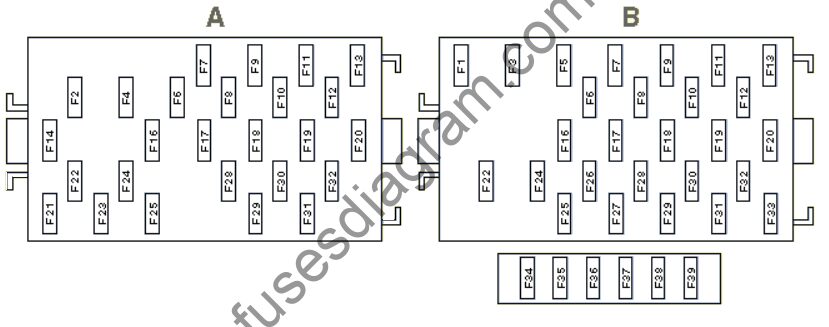
| Fuse | Rating [A] | Function |
|---|---|---|
| F1 | – | Unused in this variant |
| F2 | 15 | Hazard warning lights – depending on fuse-box version |
| F3 | – | Unused in this variant |
| F4 | 25 | Heated rear window |
| F5 | – | Unused in this variant |
| F6 | 15 | Radio, clock, instrument cluster, interior lighting, electric mirrors |
| F7 | 15 | Horn |
| F8 | 5 | Engine control unit, diagnostics, immobiliser and fan control – depending on version |
| F9 | 5 | Rear fog light |
| F10 | 15 | Front fog lights |
| F11 | 7.5 | Left parking lights |
| F12 | – | Unused in some fuse boxes |
| F13 | 7.5 | Right parking lights |
| F14 | 20 | Central locking – depending on panel variant |
| F16 | 5 | ABS |
| F17 | 20 | Windshield wipers – depending on panel variant |
| F18 | 15 | Brake lights, turn signals, instrument cluster, immobiliser and other ignition-switched circuits |
| F19 | 15 | Rear wiper and washer, reverse lights |
| F20 | 7.5 | Air conditioning – if equipped |
| F21 | 25 | Front passenger power window – depending on fuse-box variant |
| F22 | 10 | Left high-beam headlight |
| F23 | 25 | Driver’s power window – depending on fuse-box variant |
| F24 | 10 | Right high-beam headlight |
| F25 | 20 | Sunroof – if equipped |
| F26 | – | Unused |
| F27 | – | Unused in this variant |
| F28 | 20 | Ventilation, heating and air conditioning |
| F29 | 10 | Left low-beam headlight |
| F30 | 15 | Radio, cigarette lighter, clock, daytime running lights – depending on market |
| F31 | 10 | Right low-beam headlight |
| F32 | 20 | Radiator fan on selected versions |
| F33 | – | Unused |
| F34 | 15 | Turn signals and hazard warning lights – type B fuse box |
| F35 | 5 | Additional fuse-box section power supply – type B |
| F36 | 20 | Central locking – type B fuse box |
| F37 | 20 | Windshield wipers – type B fuse box |
| F38 | 25 | Driver’s power window – type B fuse box |
| F39 | 30 | Heated rear window and mirrors – type B fuse box |
Earlier fuse boxes exist in A and B variants. Positions such as F14/F36, F17/F37 and F23/F38 may therefore protect a similar consumer but be located elsewhere on the panel.
Passenger compartment fuse box – 1999-2003
A later layout was introduced after the facelift. This is the variant that corresponds to most of the data previously shown in this article.
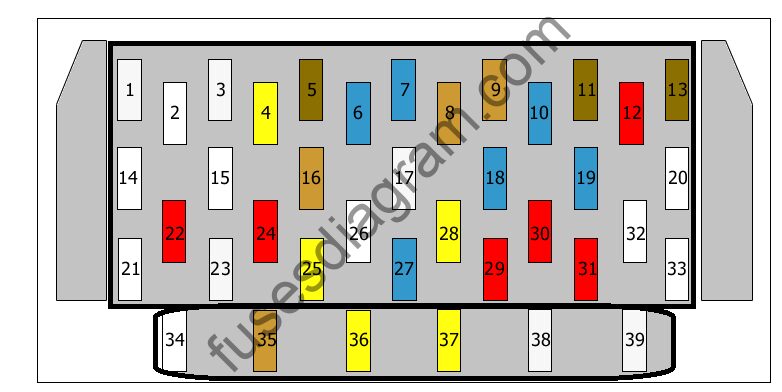
| Fuse | Rating [A] | Function |
|---|---|---|
| F1 | 25 | Left rear power window |
| F2 | – / 5 | Usually unused on European versions; 5 A on selected market variants |
| F3 | 25 | Right rear power window |
| F4 | 15 | Additional 4×4 / RX4 circuit – depending on equipment |
| F5 | 7.5 | Heated exterior mirrors |
| F6 | 15 | Radio, clock, display, electric mirrors, navigation, automatic heating and ventilation |
| F7 | 15 | Horn |
| F8 | 5 | Injection control unit, fan control, diagnostics, automatic transmission, instrument cluster |
| F9 | 5 | Rear fog light |
| F10 | 15 | Front fog lights |
| F11 | 7.5 | Left parking lights |
| F12 | 10 | Headlight washers – if equipped |
| F13 | 7.5 | Right parking lights |
| F14 | – | Unused |
| F15 | – | Unused |
| F16 | 5 | ABS control unit |
| F17 | 25 | Front passenger power window |
| F18 | 15 | Brake lights, instrument cluster, diagnostics, ignition-switched circuits, automatic transmission – depending on equipment |
| F19 | 15 | UCH, wipers and washer, reverse lights and other version-dependent auxiliary circuits |
| F20 | – | Unused |
| F21 | – | Unused |
| F22 | 10 | Left high-beam headlight |
| F23 | 25 | Driver’s power window – on some versions |
| F24 | 10 | Right high-beam headlight |
| F25 | 20 | Sunroof, automatic heating and ventilation – depending on equipment |
| F26 | 10 | Accessory socket; RX4 versions may have two outlets |
| F27 | 15 | Heated seats |
| F28 | 20 | Passenger-compartment heating and ventilation |
| F29 | 10 | Left low-beam headlight |
| F30 | 15 | Cigarette lighter, radio, clock, display and some accessory circuits |
| F31 | 10 | Right low-beam headlight |
| F32 | 20 | Radiator fan on selected market versions |
| F33 | – | Unused / variant-dependent position |
| F34 | 15 | Turn signals and hazard warning lights |
| F35 | 5 | UCH multifunction-module power supply |
| F36 | 20 | Central locking |
| F37 | 20 | Windshield wipers |
| F38 | 25 | Driver’s power window / window circuit – depending on version |
| F39 | 30 | Heated rear window and mirrors |
On the later Scenic I, F30 15 A is the fuse most commonly identified for the cigarette lighter. Do not automatically transfer this number to another Mégane/Scenic fuse-box variant, however; alternative panels may use F28 or F21 instead.
Passenger compartment relays
A relay assembly is located above the main fuse panel. Its population depends on the vehicle’s equipment.
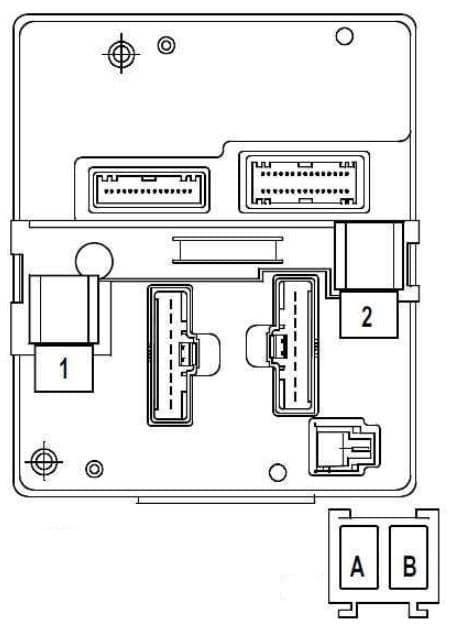
| Position | Function |
|---|---|
| 1 | Ignition-switched power relay – including sunroof and heated seats |
| 2 | Rear power-window enable |
| A | Front fog lights |
| B | LPG system; on RX4 – headlight washers |
Some versions use an additional small relay panel for circuits including the headlight washers and daytime running lights. It is not fitted identically on every market version.
Engine compartment fuse and relay box
There is no single universal under-hood fuse box for every 1996-2003 Scenic I. Technical documentation shows at least several variants. The differences are mainly related to the engine, air conditioning, automatic transmission and market.
Engine-bay fuse-box variant used on some earlier versions
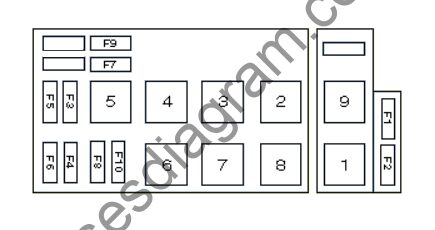
| Position | Rating [A] | Function |
|---|---|---|
| F1 | 2 | Automatic clutch – if equipped |
| F2 | 5 | Reverse lights on automatic-transmission version |
| F3 | 7.5 | Airbags, engine control, seat-belt pretensioners – depending on model year |
| F4 | 20 | 100 W radiator fan on selected versions without air conditioning |
| F5 | 7.5 | Alternator / vehicle-speed sensor – depending on engine |
| F6 | 7.5 | Automatic transmission |
| F7 | – | Air-conditioning system diode |
| F8 | 40 / 50 | 340 W radiator fan |
| F9 | – | Idle-control component diode – selected diesel engines |
| F10 | 40 / 70 | Coolant heating / glow plugs – Turbo Diesel |
In this variant, relays next to the fuses control the fuel pump, engine management, radiator fans, fuel heating and – depending on version – the automatic clutch.
Later engine-bay fuse-box variant
The large diagram below corresponds to the variant whose table was already present in the older version of this article. It is one of the most commonly published layouts, but it must not be treated as correct for every 1996-2003 Scenic.
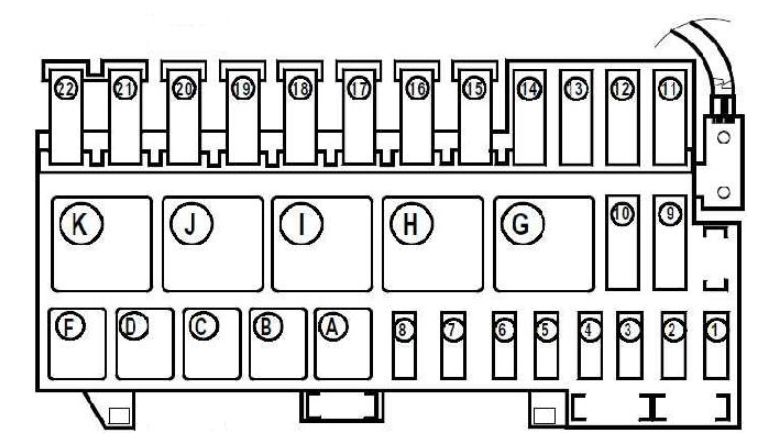
| Fuse | Rating [A] | Function |
|---|---|---|
| F1 | 30 | Radiator fan, diesel fuel heating – depending on version |
| F2 | 30 | Injection system / engine control |
| F3 | 7.5 | Air-conditioning compressor |
| F4 | 3 | Bi-fuel / LPG system – if equipped |
| F5 | 7.5 | Bi-fuel / LPG system – if equipped |
| F6 | 7.5 | Automatic transmission, starter control – depending on version |
| F7 | 7.5 | Airbags, engine control, fuel-filter heating |
| F8 | 7.5 | Bi-fuel / LPG system – if equipped |
| F9 | – | Air-conditioning system diode |
| F10 | – | Air-conditioning system diode |
| F11 | 70 | Glow plugs / diesel engine heating system |
| F12 | – | Unused in this configuration |
| F13 | – | Unused in this configuration |
| F14 | 40 / 50 | Two-speed radiator fan, fuel-filter heating – depending on engine |
| F15 | – | Unused |
| F16 | 60 | ABS |
| F17 | – | Unused |
| F18 | 60 | Heated windshield – if equipped |
| F19 | 40 | Air conditioning / air-conditioning fan |
| F20 | 60 | Passenger-compartment / dashboard module power supply |
| F21 | 60 | Power supply to another fuse panel |
| F22 | 60* | Additional dashboard power supply on some versions of this module |
* F22 is not shown on every drawing of this fuse box. Some documentation ends the table at F21, while other material for the same module type shows an additional F22 60 A. Before working on high-current fuses, follow the numbering visible on the actual module.
Relays in the later engine-bay fuse box
| Position | Function |
|---|---|
| A | Fuel pump or diesel fuel heating – depending on engine |
| B | Injection-system inhibit / control |
| C | Altitude correction or first heating stage – depending on engine |
| D | Radiator fan or air-conditioning compressor clutch – depending on configuration |
| F | Automatic transmission – ignition-switched circuit |
| I | Second auxiliary-heating stage – selected diesels |
| J | Radiator fan – high speed |
| K | Radiator fan – low speed |
The shared platform with the first-generation Mégane means that some technical data appears in documentation for both models. The next generation uses a different system – for example, the Renault Megane II 2003-2009 has a different module layout and numbering scheme.
FAQ – Renault Scenic I 1996-2003
Where is the passenger compartment fuse box?
The main fuse box is on the left-hand side of the dashboard, below the steering wheel, behind a cover. The cover or the area next to the panel should have a label corresponding to the vehicle’s equipment.
Which fuse is for the cigarette lighter?
On the most common post-1999 Scenic fuse box, the cigarette lighter is protected by F30 15 A. F30 is also used in one of the earlier variants. Other Mégane/Scenic-family panels may use F28 or F21, so compare the physical fuse-box layout with the diagram before replacing the fuse.
Which fuses are for the low-beam headlights?
On typical Scenic panels using the F1-F39 layout, the left low-beam headlight is protected by F29 10 A and the right one by F31 10 A.
Which fuses are for the high-beam headlights?
The left high-beam headlight is assigned to F22 10 A, and the right one to F24 10 A.
Which fuse is for the horn?
On the later panel and on the typical earlier F1-F39 fuse box, the horn is protected by F7 15 A.
Which fuse is for the central locking?
In the later configuration, central locking is protected by F36 20 A. On the earlier type A fuse box, F14 20 A may perform this function.
Which fuse is for the windshield wipers?
On the later fuse box it is F37 20 A. On the earlier type A variant, F17 20 A may perform this function.
Which fuse is for the heated rear window?
On the later panel, the heated rear window and mirrors are assigned to F39 30 A. On the older type A fuse box, the heated rear window may be protected separately by F4 25 A.
Does one engine-bay diagram fit every 1996-2003 Scenic?
No. Renault used several fuse blocks depending on engine, transmission and equipment. Before checking an under-hood fuse, first compare the physical appearance of the module with the diagram.
Does the Renault Scenic RX4 use an identical fuse box?
Not always. The RX4 uses the same electrical-system family but has extra circuits and uses some positions differently, including circuits related to accessory sockets and 4×4-specific equipment.