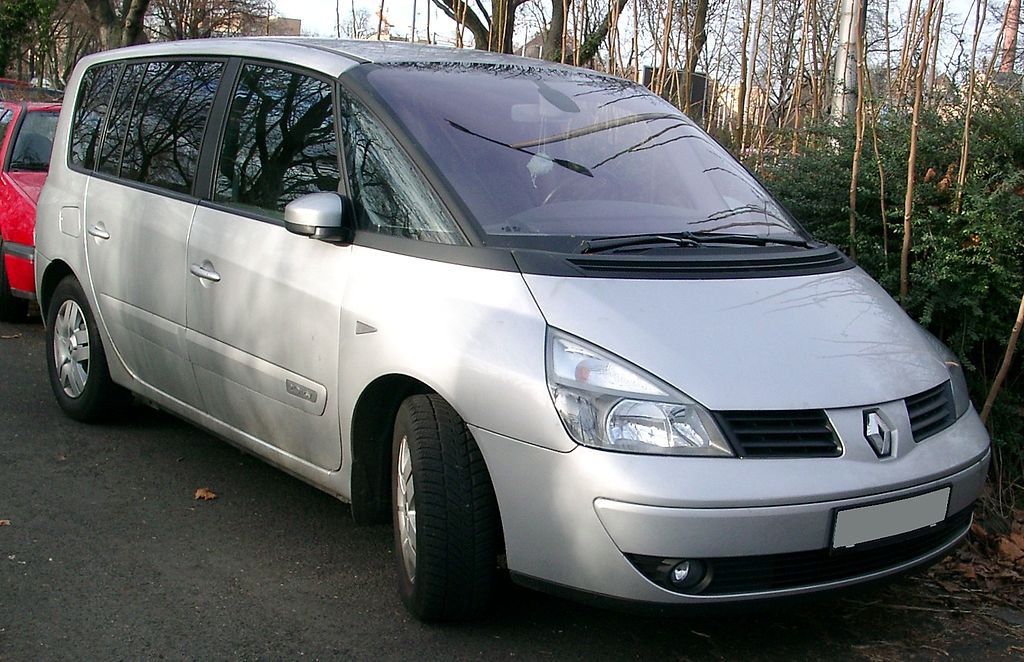
The Renault Espace IV was introduced in 2002. The information below applies mainly to Phase I, meaning vehicles from 2002 to early 2006. Renault introduced Phase II in 2006, so that model year should be treated as transitional. On a late-2006 vehicle, compare the physical fuse-box layout with the diagram before using the tables.
The Espace IV has a more complex electrical system than most Renault models from the same period. In addition to the main F1-F25 panel, there are extra fuse and relay boxes, the separate F50 cut-off fuse, additional equipment fuses and a high-current fuse box in the engine compartment.
From an engineering standpoint, the Espace IV is closely related to the Renault Vel Satis. Both use a similar generation of electronics, the Renault card and UCH modules, but fuse numbers should not be transferred from one model to the other.
Contents
- Espace IV 2006 – important Phase I / Phase II difference
- Fuse box locations
- Main F1-F25 passenger compartment fuse box
- Relays next to the main fuse box
- F50 cut-off fuse
- Additional F26-F37 fuses
- Engine compartment fuses
- FAQ
Renault Espace IV from 2006 – Phase I or Phase II?
Espace IV production began in September 2002. The first facelift, known as Phase II, appeared in 2006. Renault changed the front end, headlights and some equipment, and new engines were added to the range.
For that reason, the model year alone does not guarantee that a 2006 vehicle uses the layout shown below. If the vehicle already has the Phase II appearance, or if the physical fuse panel differs from the illustration, use documentation for that specific fuse-box version.
The same rule is useful for other Renault models from this period. The Renault Megane II, for example, also came with several module configurations depending on model year and equipment.
Fuse box locations
The main F1-F25 passenger compartment fuse box is located in the upper part of the dashboard. Access is gained by opening the cover. Renault’s owner’s documentation recommends identifying positions using the label fitted to the specific vehicle as well.
The F50 fuse is located separately in the center of the passenger compartment, under a flap between the front seats, in the center-console / armrest area.
Vehicles with more extensive equipment may also have additional panels containing fuses F26-F37 and extra relays. Their fitment depends, among other things, on electric seats, the sunroof, rear power windows, trailer wiring and daytime running lights.
The engine compartment fuse box is located near the battery. It contains powertrain and high-current protection, including circuits for ABS/ESP, the radiator fan, heating, wipers and the electric parking brake.
Compared with the older Renault Scenic I, the Espace IV electrical system is much more distributed and relies on a larger number of electronic modules.
Main F1-F25 passenger compartment fuse box
The large diagram below replaces the old 300 px illustration and clearly shows all F1-F25 positions.
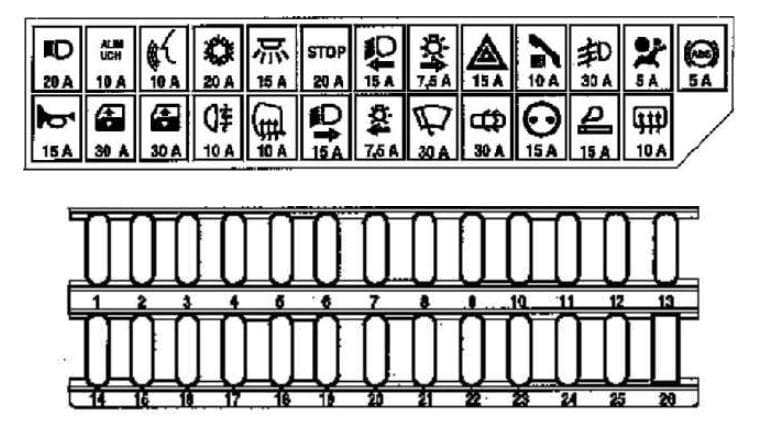
| Fuse | Rating [A] | Function |
|---|---|---|
| F1 | – | Unused |
| F2 | 10 | UCH power supply, Renault card reader, engine start button, automatic parking brake |
| F3 | 10 | Speech synthesizer, xenon headlight levelling, instrument cluster, heated washer jets – depending on equipment |
| F4 | 20 | Reverse lights, heating and air conditioning, parking sensors, rain sensor, electrochromic mirrors, climate-control and wiper control |
| F5 | 15 | Timed interior lighting |
| F6 | 20 | Brake lights, wiper stalk, diagnostic connector, child lock, window controls, cruise control, hands-free system |
| F7 | 15 | Left low-beam headlight, xenon headlight control unit and levelling system |
| F8 | 7.5 | Right parking lights |
| F9 | 15 | Turn signals and hazard warning lights |
| F10 | 10 | Communication system, radio, driver’s seat memory, seat relay, rear-window relay supply |
| F11 | 30 | Speech synthesizer, instrument cluster, front fog lights, air conditioning |
| F12 | 5 | Airbags and seat-belt pretensioners |
| F13 | 5 | ABS and ESP |
| F14 | 15 | Horn / warning buzzer |
| F15 | 30 | Driver’s power window, electric mirrors |
| F16 | 30 | Passenger power window |
| F17 | 10 | Rear fog lights |
| F18 | 10 | Heated exterior mirrors |
| F19 | 15 | Right low-beam headlight |
| F20 | 7.5 | Left parking lights, glove-box and license-plate lighting, cigarette-lighter and switch illumination |
| F21 | 30 | High-beam headlights and rear wiper |
| F22 | 30 | Central locking |
| F23 | 15 | Center-console accessory sockets |
| F24 | 15 | Cigarette lighter / rear accessory socket – depending on version |
| F25 | 10 | Steering-column lock, heated rear-window relay supply |
On the Espace IV, the F23 15 A accessory sockets and the F24 15 A cigarette lighter are protected separately. If one works while the other does not, check the correct circuit instead of looking for one common fuse.
The UCH module and Renault card were widely used across Renault models of this era, but fuse numbering is model-specific. The Renault Modus 2004-2007, for example, uses a completely different fuse arrangement.
Relays next to the main fuse box
The old article contained a small relay drawing. The full-size version is used below.
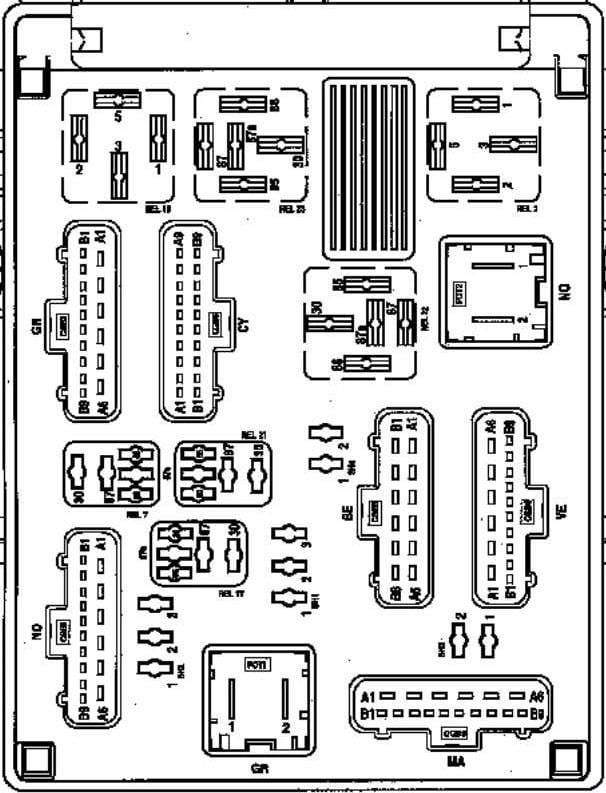
| Position | Function |
|---|---|
| R2 | Heated rear window |
| R7 | Front fog lights |
| R9 | Windshield wipers |
| R10 | Windshield wipers |
| R11 | Rear window / reverse lights |
| R12 | Central locking |
| R13 | Central locking |
| R18 | Timed interior lighting |
| R19 | Relay panel power supply |
| R21 | Engine-start inhibit |
| R22 | UCH – ignition-switched power supply |
| R23 | Accessories, aftermarket radio, rear power windows |
SH shunts
| Position | Function |
|---|---|
| SH1 | Rear power windows |
| SH2 | Front power windows |
| SH3 | Daytime running lights |
| SH4 | Daytime running lights |
Similarly complex equipment modules can be found in the Renault Grand Scenic 2004-2009, but relay assignments are different.
F50 cut-off fuse
A separate F50 20 A fuse is located under a flap between the front seats, in the center-console area. In the documentation it is described as a consumer cut-off fuse.
| Fuse | Rating [A] | Function |
|---|---|---|
| F50 | 20 | Diagnostic connector, radio, seat-position memory, clock and outside-temperature display, navigation, communication module, alarm wiring, tire-pressure monitoring receiver |
F50 is easy to overlook because it is not part of the main F1-F25 row. If several multimedia or communication devices stop working at the same time, include this circuit in the diagnosis.
Additional F26-F37 fuse panels
Depending on equipment, the Espace IV has additional protection for the sunroof, rear power windows, seats and trailer wiring. The physical population of these panels depends on the vehicle specification.
Fuses F26-F31
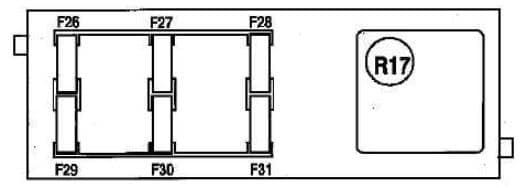
| Fuse | Rating [A] | Function |
|---|---|---|
| F26 | 30 | Trailer / caravan socket |
| F27 | 30 | Sunroof |
| F28 | 30 | Left rear power window |
| F29 | 30 | Right rear power window |
| F30 | 5 | Steering-angle sensor |
| F31 | 30 | Electric sunroof blind / shade |
Fuses F32-F37 and seat relays
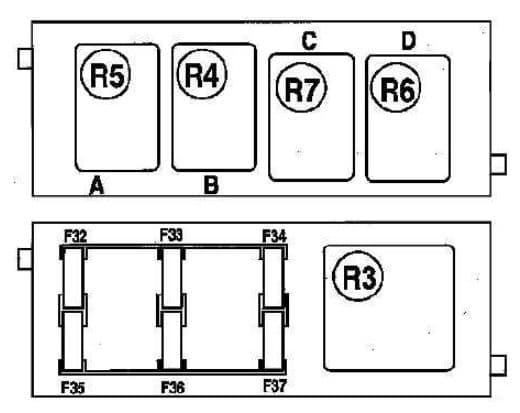
| Fuse | Rating [A] | Function |
|---|---|---|
| F32 | – | Unused |
| F33 | – | Unused |
| F34 | 15 | Driver’s electric seat power supply |
| F35 | 20 | Heated front seats |
| F36 | 20 | Driver’s electric seat |
| F37 | 20 | Passenger electric seat |
| Relay | Function |
|---|---|
| R3 | Seat power supply |
| R4 | Parking lights in the daytime-running-light system |
| R5 | Low-beam headlights in the daytime-running-light system |
| R6 | Headlight washer pump |
| R7 | Brake-light cut-off |
| R17 | Air conditioning |
| R20 | Power windows |
If the vehicle does not have electric seats, a sunroof or factory trailer wiring, it is normal for some of these fuse positions to be empty.
The Renault Kangoo 1997-2007 also has fuse-box population that varies considerably with equipment, but it uses a different electrical architecture.
Engine compartment fuse box
The old version of the article did not clearly show the main powertrain fuse panel. The diagram below shows the under-hood fuse box. Some fuse ratings depend on the engine, particularly on diesel models, vehicles with an automatic transmission and the 2.0 Turbo engine.
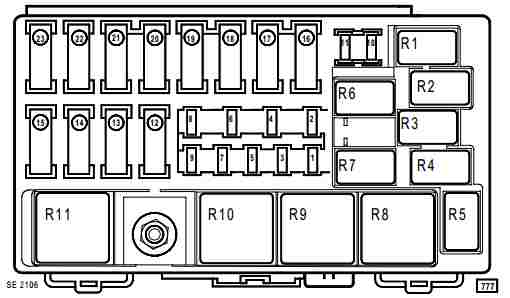
| Position | Rating [A] | Function |
|---|---|---|
| 1 | 7.5 | Automatic transmission – if equipped |
| 2 | – | Unused |
| 3 | 30 | Engine control |
| 4 | 5 / 15 | Automatic transmission – depending on version |
| 5 | 30 | Electric brake vacuum-pump relay – selected F4Rt engines |
| 6 | 10 | Engine control |
| 7 | – | Unused |
| 8 | – | Unused |
| 9 | 20 | Air conditioning |
| 10 | 20 / 30 | ABS / ESP – depending on version |
| 11 | 20 / 30 | Horn – depending on configuration |
| 12 | – | Unused |
| 13 | 70 | Additional coolant heating – if equipped |
| 14 | 70 | Additional coolant heating – if equipped |
| 15 | 60 | Radiator-fan control |
| 16 | 40 | Headlight washers, heated rear window, multifunction module |
| 17 | 40 | ABS / ESP |
| 18 | 70 | Combination switches, daytime running lights, multifunction module |
| 19 | 70 | Heating / air conditioning, multifunction module |
| 20 | 60 | Battery power-management system, combination switches, daytime running lights, multifunction module – depending on version |
| 21 | 60 | Electric seats, multifunction module, center console, sunroof |
| 22 | 80 | Heated windshield – if equipped |
| 23 | 60 | Windshield wipers, electric parking brake |
Positions 13-23 protect very high-current circuits. Ratings such as 60, 70 or 80 A should never be changed based on a diagram for another engine version. If the physical fuse population differs from the table, use documentation that matches the fuse-box part number and the specific vehicle.
Relays under the hood
Renault used at least two relay layouts depending on engine and air-conditioning system. The engine compartment may contain, among others:
- fuel-pump relay,
- engine-management / injection relay,
- radiator-fan relays,
- auxiliary-heater relays,
- air-conditioning compressor relay,
- on selected engines, an electric vacuum-pump relay.
We do not assign one relay numbering scheme to every Espace IV engine because relay locations differ between fuse-box variants.
If you also work on Renault models from a similar period, separate diagrams are available for the Grand Scenic 2004-2009 and Megane II 2003-2009. Despite using electronics from a similar generation, their fuse boxes are not interchangeable with the Espace layout.
FAQ – Renault Espace IV 2002-2006
Which fuse is for the cigarette lighter?
The cigarette lighter is protected by F24 15 A in the main passenger-compartment fuse box. The center-console accessory sockets have a separate F23 15 A fuse.
Which fuse is for the radio?
The radio is connected to several circuits. In the main panel, check F10 10 A; a constant supply for part of the multimedia system also passes through F50 20 A.
Which fuse is for the central locking?
The main central-locking protection is F22 30 A. Relays R12 and R13 are also used in the system.
Which fuses are for the low-beam headlights?
The left low-beam headlight is protected by F7 15 A, while the right one uses F19 15 A.
Which fuse is for the rear fog lights?
The rear fog lights are assigned to F17 10 A.
Which fuse is for the heated seats?
On vehicles equipped with them, the heated front seats are protected by F35 20 A in the additional fuse panel.
Which fuses are for the rear power windows?
The left rear window uses F28 30 A, and the right rear window uses F29 30 A. The system also includes a rear-window power relay.
Which fuse is for the sunroof?
The sunroof is protected by F27 30 A. The electric panoramic-roof blind has a separate F31 30 A fuse.
What should I check if the radio, navigation and several electronic systems stop working at the same time?
In addition to the main fuse panel, check F50 20 A under the flap in the center of the passenger compartment. It protects several communication and multimedia consumers.
Does this diagram fit every 2006 Espace?
No. Espace IV Phase II was introduced in 2006. A vehicle built after the change may have a different electrical configuration. For a 2006 model, first compare the physical fuse-box layout with the diagram.
Is the Renault Vel Satis fuse box the same?
No. The Renault Vel Satis is closely related to the Espace IV and uses a similar generation of electronics, but its fuse numbers and functions are not identical.
Other Renault fuse diagrams from a similar period
The site also includes separate guides for the Renault Modus 2004-2007, Renault Grand Scenic 2004-2009, Renault Megane II 2003-2009, Renault Kangoo 1997-2007 and the earlier Renault Scenic I.