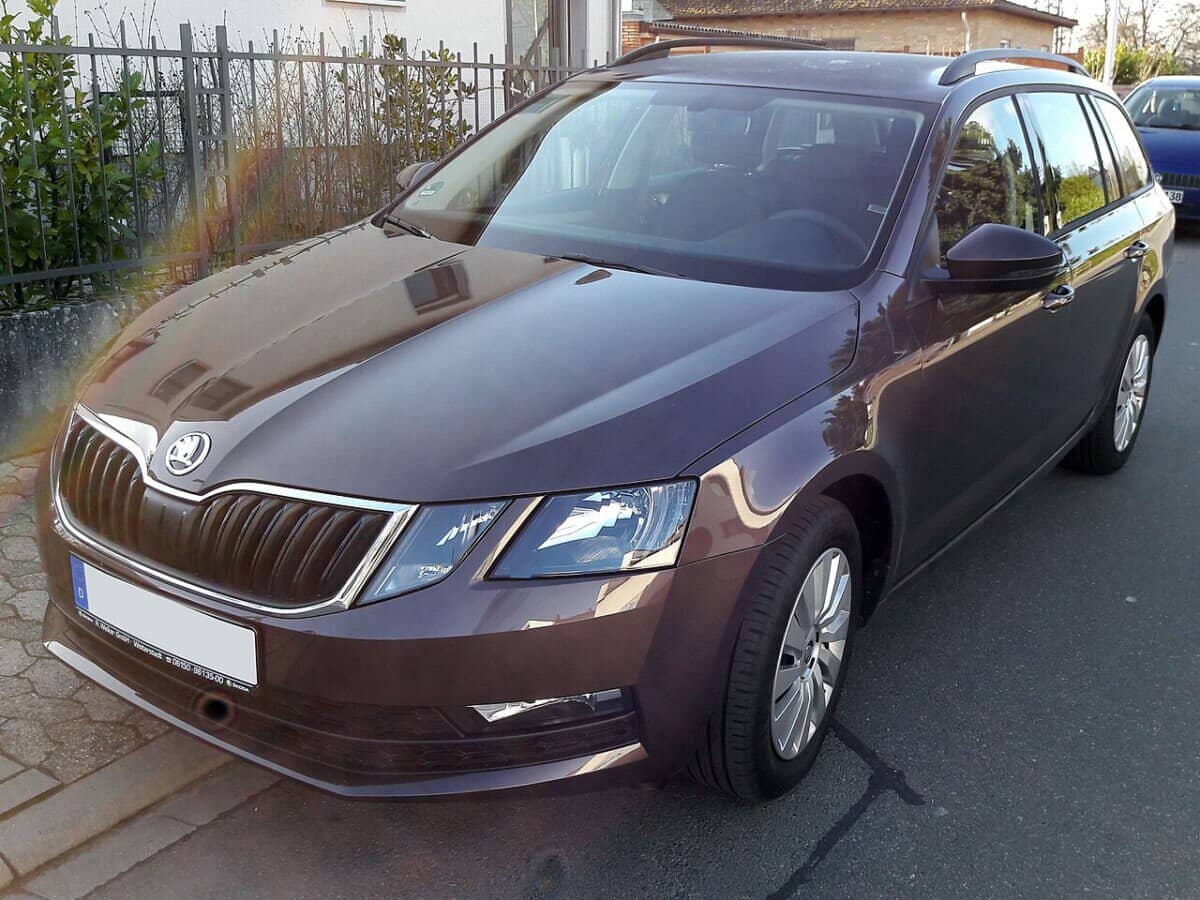
Skoda Octavia III (5E, A7, 2013-2020) is the third generation of the popular Octavia, available as a liftback and estate with TSI petrol, TDI diesel and market-specific CNG powertrains. Its electrical protection is divided between the driver-side cabin dashboard fuse panel and a covered engine-bay unit near the battery. This guide distinguishes 2013-2016 pre-facelift and 2017-2020 facelift fuse assignments.
The Polish reference includes 169 fuse table entries across four tables and six original location and diagram illustrations. Values are given for many pre-facelift fuses; the later tables do not provide a universal amperage, so those ratings remain unspecified. Engine fuse positions such as F25-F30 are preserved as one documented reserved range, not inflated into six invented source entries.
Where is the Skoda Octavia III fuse box?
Cabin, left-hand drive: behind the small lower storage compartment on the driver’s side, under the dashboard. Open it and release its side retaining clips to reveal the numbered fuse holder. On right-hand-drive versions the access location can differ.
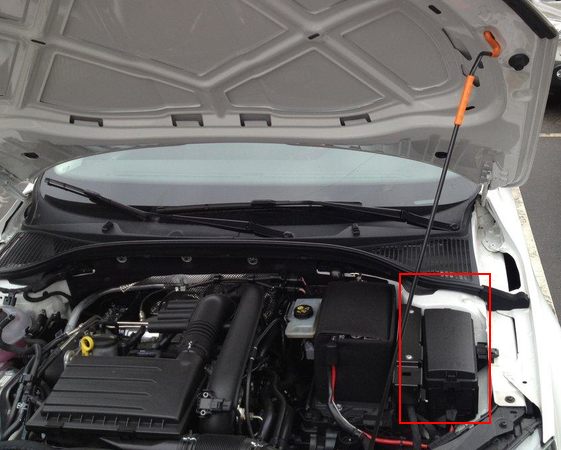
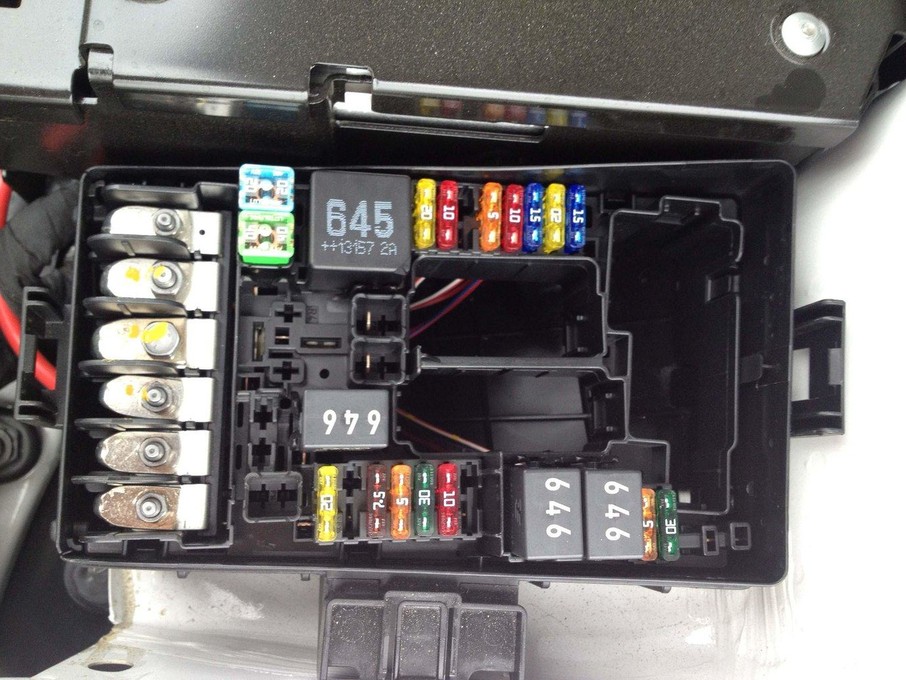
Engine compartment: on the left side near the battery, beneath a black plastic cover held by two clips. Switch the ignition off, release the cover and compare the physical panel layout to the correct year/engine chart.
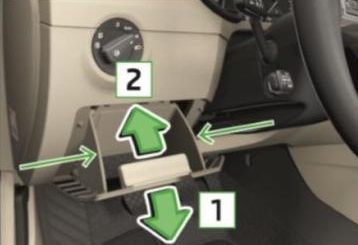
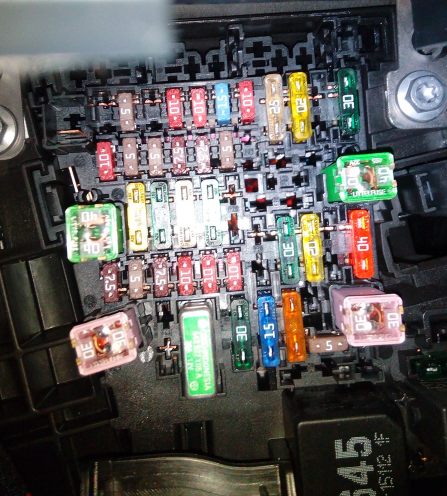
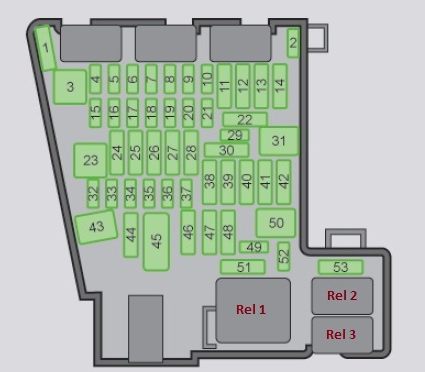
Octavia III 2013-2016 cabin fuses 1-53
In the original pre-facelift diagram, cigarette lighter/12 V sockets: fuse 40 (20 A), rear window wiper: fuse 47 (15 A), radio/infotainment: fuse 12 (20 A), climate blower: fuse 14 (30 A) and heated rear glass: fuse 53 (30 A). The fuse ratings shown can vary by optional systems and engine type.
| Position | Rating [A] | Protected circuit / function |
|---|---|---|
| 1 | – | Unused |
| 2 | – | Unused |
| 3 | – | Unused |
| 4 | – | Unused |
| 5 | 5 A | CAN data bus diagnostic gateway |
| 6 | 5 A | Cabin intrusion and vehicle tilt alarm sensor |
| 7 | 10 A | Heating and air-conditioning, heated rear/front window relays, parking heater receiver and automatic gearbox selector |
| 8 | 10 A | OBD diagnostic socket, humidity sensor, rain/light sensor and headlamp switch |
| 9 | 15 A | Haldex all-wheel-drive controller |
| 10 | 10 A | Infotainment display controller |
| 11 | 25 A | Heated rear seats |
| 12 | 20 A | Radio and infotainment electronics |
| 13 | 25 A | Driver seat-belt pretensioner |
| 14 | 30 A | Heating and air-conditioning blower |
| 15 | 10 A | Electronic steering-column lock |
| 16 | 5 / 7.5 A | Phone preparation and signal booster |
| 17 | 5 A | Instrument cluster |
| 18 | – | Unused |
| 19 | 7.5 A | KESSY keyless entry/start |
| 20 | 5 A | Steering column electronics |
| 21 | – | Unused |
| 22 | 30 A | Power tailgate module |
| 23 | 40 A | Onboard power supply controller and lights |
| 24 | 30 A | Panoramic sunroof and electric blind |
| 25 | 30 A | Driver door controller and left power windows |
| 26 | 25 A | Heated front seats |
| 27 | 30 A | Audio system amplifier |
| 28 | 20 A | Trailer detection module |
| 29 | – | Unused |
| 30 | – | Unused |
| 31 | 40 A | Onboard power controller and headlamps |
| 32 | 7.5 A | Park Assist and parking sensors |
| 33 | 5 A | Airbag module and passenger airbag-off warning |
| 34 | 7.5 A | Headlamp switch, reversing lights, air conditioning pressure sensor, self-dimming rear-view mirror, rear seat heating, 12 V / 230 V converter and additional equipment |
| 35 | 35 A | Headlamp adjustment, OBD, front assistance camera and radar |
| 36 | 10 A | Right headlamp |
| 37 | 10 A | Left headlamp |
| 38 | 20 A | Towbar electrical module |
| 39 | 30 A | Front passenger door controller and right-side power windows |
| 40 | 20 A | Cigarette lighter and front/rear 12 V accessory sockets |
| 41 | – | Unused |
| 42 | 40 A | Onboard electrical controller |
| 43 | 40 A | Onboard electrical controller |
| 44 | 30 A | Trailer detection module |
| 45 | 30 A | Driver’s power seat module or thermal circuit breaker |
| 46 | 30 A | 230 V converter and socket |
| 47 | 15 A | Rear windscreen wiper motor |
| 48 | – | Unused |
| 49 | 5 A | Starter relays and clutch pedal position sensor |
| 50 | – | Unused |
| 51 | 25 A | Passenger seat-belt pretensioner |
| 52 | – | Unused |
| 53 | 30 A | Heated rear window |
Octavia III 2017-2020 facelift cabin fuses
Facelift versions introduce or change equipment such as Phonebox wireless charging (fuse 16), the reversing camera (18), DCC suspension (21), SCR/AdBlue (29 and 51), USB (52) and additional driver-assistance functions. The cigarette lighter remains at position 40, but the source does not specify a universal ampere rating for this newer panel.
| Position | Rating [A] | Protected circuit / function |
|---|---|---|
| 1 | – | Unused |
| 2 | – | Unused |
| 3 | – | Unused |
| 4 | – | Heated steering wheel |
| 5 | – | CAN data bus |
| 6 | – | Alarm sensor |
| 7 | – | Climate control, heating, parking heater receiver, automatic gearbox and heated rear window relay |
| 8 | – | Headlamp switch, rain sensor, diagnostic socket, decorative interior lighting and headlamp controller |
| 9 | – | Four-wheel drive |
| 10 | – | Infotainment touchscreen |
| 11 | – | Left-side lighting |
| 12 | – | Infotainment system |
| 13 | – | Driver seat-belt pretensioner |
| 14 | – | Heating and air conditioning blower |
| 15 | – | Electronic steering column lock |
| 16 | – | Phonebox and wireless phone charging |
| 17 | – | Instrument cluster and emergency call system |
| 18 | – | Rear-view camera |
| 19 | – | KESSY keyless entry/start |
| 20 | – | Steering column switch electronics |
| 21 | – | Adaptive shock absorbers and Dynamic Chassis Control (DCC) |
| 22 | – | Trailer wiring |
| 23 | – | Electric tilt-and-slide sunroof |
| 24 | – | Right-side lighting |
| 25 | – | Left front door central locking, left windows and left exterior mirror |
| 26 | – | Heated front seats |
| 27 | – | Interior lighting |
| 28 | – | Trailer wiring |
| 29 | – | SCR / AdBlue system |
| 30 | – | Heated rear bench |
| 31 | – | Unused |
| 32 | – | Parking assistance and Park Assist |
| 33 | – | Airbags and hazard light switch |
| 34 | – | ASR, ESC, tyre pressure monitoring, A/C, reversing lamp, auto-dimming mirror, Start/Stop and optional equipment |
| 35 | – | Headlamp levelling, diagnostics, front camera and radar |
| 36 | – | Right headlamp |
| 37 | – | Left headlamp |
| 38 | – | Trailer wiring |
| 39 | – | Right-side doors central locking, power windows and right exterior mirror |
| 40 | – | 12 V power sockets and cigarette lighter |
| 41 | – | Passenger seat-belt pretensioner |
| 42 | – | Tailgate central locking, headlamp washer and windscreen washer |
| 43 | – | Audio amplifier |
| 44 | – | Trailer wiring |
| 45 | – | Powered seat adjustment |
| 46 | – | 230 V power socket |
| 47 | – | Rear window wiper |
| 48 | – | Blind spot monitor |
| 49 | – | Engine start and clutch pedal position sensor |
| 50 | – | Power tailgate opening |
| 51 | – | SCR / AdBlue |
| 52 | – | USB socket |
| 53 | – | Heated rear window |
Octavia III engine bay type 1 – early model years
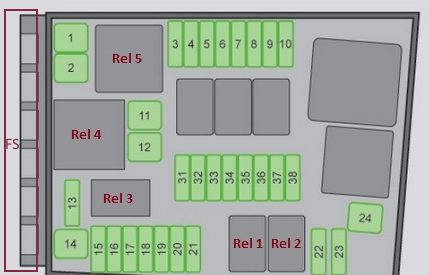
The early engine box protects the ABS unit, ECM, fuel pump, starter, horn, wipers, electric heating and DSG transmission. Fuel pump relay/controller: F10 (15 or 20 A). Front wipers: F19 (30 A). Starter: F23 (30 A). Horn: F15 (20 A). Ratings for engine fuses F1, F3, F4, F7, F8, F9 and F13 differ across engine versions. The gaps F25-F30 and other range labels are preserved.
| Position | Rating [A] | Protected circuit / function |
|---|---|---|
| F1 | 20 / 40 A | Transmission and equipment controller, 20 or 40 A according to version |
| F2 | 40 A | ABS controller |
| F3 | 20 / 30 A | Engine Control Module, 20 or 30 A by version |
| F4 | 5 / 10 A | Engine electronics and supplementary heating relay, 5 or 10 A |
| F5 | 10 A | Ignition cut-off relay and engine electronics |
| F6 | 5 A | Brake pedal sensor |
| F7 | 5 / 10 A | Engine coolant pump/valves and engine controller, 5 or 10 A |
| F8 | 10 / 15 A | Lambda oxygen sensors, 10 or 15 A |
| F9 | 5 / 10 / 20 A | Diesel glow controller and crankcase ventilation, or petrol ignition and ECM, engine-specific |
| F10 | 15 / 20 A | Fuel pump relay on petrol or fuel pump controller on diesel |
| F11 | 40 A | Electric additional air heater |
| F12 | 40 A | Electric additional air heater, second circuit |
| F13 | 15 / 30 A | DSG transmission mechatronics |
| F14 | 30 A | Heated windscreen relay |
| F15 | 20 A | Horn |
| F16 | 20 A | Ignition cut-off relay |
| F17 | 7.5 A | Main relay, ECM and ABS module |
| F18 | 5 A | CAN bus controller and battery monitor |
| F19 | 30 A | Front windscreen wiper motor |
| F20 | 10 A | Alarm horn |
| F21 | 20 A | ABS controller |
| F22 | 5 A | Engine Control Module |
| F23 | 30 A | Starter |
| F24 | 40 A | Supplementary electric air heater |
| F25-F30 | – | Unused fuse slots F25 through F30 |
| F31 | 15 A | Brake-system vacuum pump |
| F32-F33 | – | Unused positions F32 and F33 |
| F34 | 30 A | Second heated windscreen relay |
| F35-F36 | – | Unused fuse slots F35 and F36 |
| F37 | 20 A | Parking heater controller |
| F38 | – | Unused position |
Early engine-bay relay assignments
Rel 1: starter relay 1; Rel 2: starter relay 2; Rel 3: horn relay; Rel 4: high-power heater relay; Rel 5: main relay.
Octavia III engine bay type 2 – facelift layout
The later arrangement includes engine management, ABS/ESC, radiator cooling, fuel injection, optional CNG controls, SCR/AdBlue, front wipers, horn, heated windscreen, starter and gearbox protection. The front wipers are at position 19 and the starter at position 23 in the later numbered table. Empty ranges and unoccupied positions remain explicitly labelled.
| Position | Rating [A] | Protected circuit / function |
|---|---|---|
| 1 | – | ESC, ABS and electric parking brake |
| 2 | – | ESC and ABS |
| 3 | – | Engine management |
| 4 | – | Radiator cooling fan, engine oil temperature and mass airflow sensors, fuel pressure regulation, additional heating, EGR, diesel glow system and SCR/AdBlue (engine dependent) |
| 5 | – | Ignition, CNG relay, injectors and fuel metering valve |
| 6 | – | Brake pressure sensor |
| 7 | – | Engine coolant pump, radiator shutter, engine/gearbox oil pressure control and crankcase breather heating |
| 8 | – | Oxygen lambda sensor |
| 9 | – | Ignition and exhaust system flap |
| 10 | – | Fuel pump and ignition |
| 11 | – | Supplementary electric heater |
| 12 | – | Supplementary electric heater, second circuit |
| 13 | – | Heated windscreen, left side |
| 14 | – | Heated windscreen, right side |
| 15 | – | Horn |
| 16 | – | Ignition, fuel pump and CNG relay |
| 17 | – | ABS/ESC, ECM and heated windscreen relay |
| 18 | – | CAN data bus and battery monitor |
| 19 | – | Front windscreen wipers |
| 20 | – | Alarm |
| 21 | – | Automatic transmission |
| 22 | – | Engine management |
| 23 | – | Starter motor |
| 24 | – | Supplementary electric heater |
| 25-30 | – | Reserved slots 25-30 |
| 31 | – | Brake booster vacuum pump |
| 32 | – | Unused |
| 33 | – | Automatic gearbox oil pump |
| 34 | – | Front electronic differential lock |
| 35-36 | – | Unused slots 35-36 |
| 37 | – | Heater and parking-heater equipment |
| 38 | – | Unused |
Most frequently checked Skoda Octavia III fuses
Cigarette lighter and 12 V sockets: dashboard 40, 20 A in the documented pre-facelift version. Rear wiper: cabin 47. Heated rear window: cabin 53. Front wipers: engine F19 (type 1) or position 19 (type 2). Starter: engine F23 / position 23. Fuel pump: engine F10 in the early type, later position 10; the later table must be checked for the exact function and ampere rating. Washers: the facelift cabin chart includes washer and headlamp-washer circuits at position 42; older panel assignments differ.
For the previous generations, see the Skoda Octavia I / Tour and Skoda Octavia II. For the newer generation, compare the Skoda Octavia IV NX. For another Skoda of a similar production period but with a different electrical system, see Skoda Superb III 3V (2015-2016). Older Skoda Yeti 5L and Skoda Roomster have different fuse positions.
Skoda Octavia III 2013-2020 fuse box FAQ
Where is the cigarette lighter fuse?
Dashboard position 40. Its rating is 20 A for the documented 2013-2016 configuration; verify facelift versions separately.
Where is the USB fuse?
In facelift cars, the source lists a USB socket at cabin position 52. Pre-facelift wiring can differ.
Where is the front wiper fuse?
Engine compartment F19 (30 A) in the early type, or position 19 in the later type.
Why are there two separate engine fuse tables?
The electrical layout changed with engine equipment and the facelift. Their slot numbers and current ratings are not automatically interchangeable.
Replace fuses with the exact type and current rating specified for the car, not the largest rating from another engine variant. Repeated failures require electrical diagnosis.