
Peugeot 107 (2005-2014) uses a passenger compartment fuse panel and a separate fuse and relay assembly beside the battery. Importantly, the engine compartment layout was revised for the 2012 facelift. The diagrams below separate the later 17-position cabin listing, the earlier 12-position engine bay arrangement and the revised 21-position engine bay layout. Do not use the post-2012 numbering to identify fuses in a pre-facelift vehicle.
Fuse box locations and how to reach them
Inside the car: Turn off the ignition. Remove the lower trim around the instrument panel to reach the passenger compartment fuse assembly. The panel has 17 numbered protection positions in the later arrangement, with higher-current fuses 15-17 mounted behind the instrument cluster. The manufacturer recommends workshop replacement of these rear-mounted fuses. Access varies with steering position and production year, so compare the illustrated panel with your handbook before dismantling trim.
Under the bonnet: Locate the fuse box next to the battery. Depress the right-hand cover catch, marked E in the owner’s handbook, and lift the lid. The box includes a fuse removal tool (A) and storage for spare fuses (B). After inspection, secure the cover to prevent moisture entry.
Models included a 1.0-litre petrol engine and a 1.4 HDi diesel, with manual or 2-Tronic automated transmission. Air conditioning, ABS/ESP and the cooling fan may use different ratings by engine and production year.
Dashboard fuses – positions 1-17 (2012-2014 arrangement)
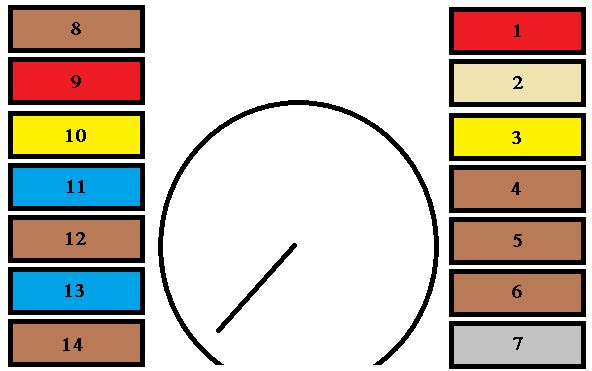
| Pozycja | Amperaż [A] | Chroniony obwód / funkcja |
|---|---|---|
| 1 | 10 | Brake lights, ABS and 2-Tronic automated gearbox, where fitted |
| 2 | 25 | Central door locking and remote locking control |
| 3 | 20 | Heated rear window |
| 4 | 7.5 | Tail and position lamps, number-plate lights, instrument cluster and display, headlamp levelling and LED daytime running lights on later models |
| 5 | 7.5 | OBD diagnostic socket |
| 6 | 7.5 | 2-Tronic gearbox, rear fog lamp, ESP and instruments; assignments vary by model year |
| 7 | 7.5 | Heating and window demisting controls; unused in certain earlier model years |
| 8 | 7.5 | ABS/ESP, electric power steering, air conditioning and radiator fan |
| 9 | 10 | Reversing and rear lamps, central locking, electric windows, heated rear window, instruments and cabin heating |
| 10 | 20 | Front and rear windscreen wipers and washers |
| 11 | 15 | Audio system and 12 V socket, maximum 120 W |
| 12 | 7.5 | Rear-window demister, ABS, radiator fan, wipers, power steering, central locking, air conditioning and electric windows |
| 13 | 15 | SRS airbags, fuel injection, 2-Tronic transmission, instrument cluster and LED daytime running lights |
| 14 | 7.5 | Air conditioning and cabin heater controls |
| 15 | 40 | Accessory supply including radio, 12 V socket, wipers, ABS/ESP, power steering and cooling fan; fuse behind the dashboard |
| 16 | 30 | Electric window supply; fuse behind the dashboard |
| 17 | 40 | Heating and air conditioning; fuse behind the dashboard |
Engine compartment – earlier layout, mainly 2007-2011
The earlier fuse box contains 12 labelled positions. Early 2005-2006 cars may differ in occupation and rating, so alternatives in the table are not interchangeable fuse sizes. Verify the installed arrangement against the cover label and the handbook for the specific production date.
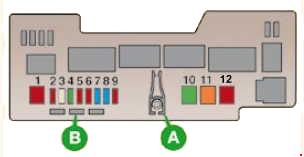
| Pozycja | Amperaż [A] | Chroniony obwód / funkcja |
|---|---|---|
| 1 | 50 | 2-Tronic automated transmission; also the cooling fan supply on diesel variants |
| 2 | 10 / 20 | Headlamp circuit: 10 A on standard layouts, or 20 A on certain daytime-running-light versions |
| 3 | 25 / 30 | ABS/ESP controller; 25 A is listed for some 2005-2006 vehicles, 30 A on later layouts |
| 4 | 30 | Ignition switch and ignition power supply |
| 5 | 10 | Hazard warning lamps, turn signals and instrument indicators |
| 6 | 10 | Second headlamp circuit |
| 7 | 15 | Interior lighting, clock, audio and instrument cluster |
| 8 | 15/25 | Engine management: 15 A on petrol, 25 A on diesel |
| 9 | 10 | Horn |
| 10 | 30 | Petrol engine radiator fan |
| 11 | 40 / 50 | ABS/ESP power supply; the rated value depends on the production year and system |
| 12 | 50 | Electric power steering supply; verify position and equipment on the earliest vehicles |
Engine compartment – revised 2012-2014 layout
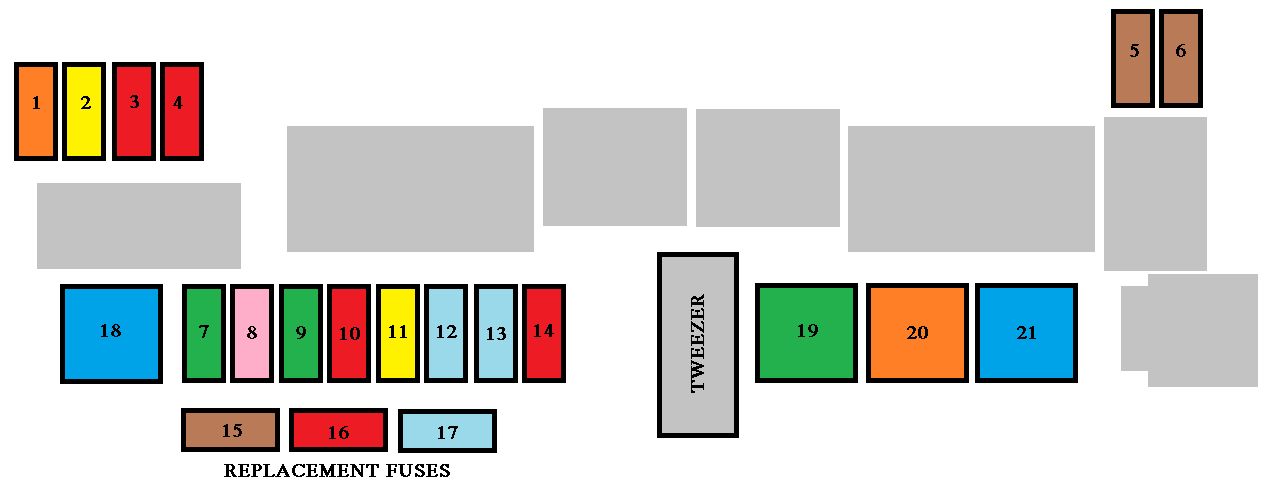
| Pozycja | Amperaż [A] | Chroniony obwód / funkcja |
|---|---|---|
| 1 | 5 | LED daytime running lights |
| 2 | 20 | Front fog lamps, where fitted |
| 3 | 10 | Left-hand front headlamp |
| 4 | 10 | Right-hand front headlamp |
| 5 | 7.5 | 2-Tronic automated transmission and fuel injection, first circuit |
| 6 | 7.5 | 2-Tronic automated transmission and fuel injection, second circuit |
| 7 | 30 | LED daytime running lights and front fog lamp supply |
| 8 | 25 / 30 | ABS with a 25 A fuse, or ABS/ESP with VSC at 30 A, depending on specification |
| 9 | 30 | Starter supply, heated rear window, ABS, radiator fan, wipers, power steering and body electronics |
| 10 | 10 | Hazard warning lights, turn indicators and instrument panel |
| 11 | 20 | Left- and right-hand headlamp supply |
| 12 | 15 | Cabin lighting, instrument cluster and radio |
| 13 | 15 | Fuel injection and radiator fan control |
| 14 | 10 | Horn |
| 15 | 7.5 | Spare fuse, no connected circuit |
| 16 | 10 | Spare fuse, no connected circuit |
| 17 | 15 | Spare fuse, no connected circuit |
| 18 | 50 | 2-Tronic automated transmission, where fitted |
| 19 | 30/40 | Radiator fan, 30 A or 40 A depending on the electrical specification |
| 20 | 40 / 50 | ABS at 40 A or ABS/ESP with VSC at 50 A |
| 21 | 50 | Electric power steering |
Year, engine and equipment variations
On the older engine panel, position 3 is listed at 25 A on some 2005-2006 cars and 30 A in later references. Position 2 may use 10 A for standard headlamps or 20 A on certain daytime-running-light layouts. The ABS/ESP rating at position 11 can also change. After the 2012 facelift, position 8 uses 25 A for ABS or 30 A for ABS/ESP with VSC; position 20 uses 40 A or 50 A, respectively. The ratings must be matched to the actual installation.
On 2012-2014 cabin panels, position 11 (15 A) supplies the radio and 12 V socket, and position 15 (40 A) is an upstream accessory supply fuse. Some 2005-2006 cabin positions, notably 7-9, may differ. The later dashboard table should not be applied indiscriminately to the earliest 107 models.
Cigarette lighter, wipers, horn and headlamps
If the 12 V socket stops working in a later car, begin with cabin fuse 11 (15 A). The upstream accessory supply is protected separately by fuse 15 (40 A) behind the dashboard and is harder to access. For front or rear wiper failure, inspect cabin fuse 10 (20 A), the wiper motor and rear-hatch loom. The heated rear window is protected by cabin fuse 3 (20 A).
A non-working horn in the revised engine layout points to fuse 14 (10 A); on the earlier layout it is position 9 (10 A). On facelift models, the headlamp circuits include positions 3, 4 and 11, whereas the earlier layout uses positions 2 and 6. Matching the correct diagram to the production year avoids testing the wrong fuse.
The Aygo family and the shared city-car origins
The Peugeot 107 was developed alongside the first-generation Toyota Aygo and Citroen C1 on the B-Zero platform. Their mechanical layouts have much in common, but exact fuse assignments can vary by build year and equipment. Toyota continued the Aygo name into the much newer Aygo X (2022) fuse box guide, which documents its own later electrical layout rather than the 107-era panel.
Technical references: Peugeot 107 owner documentation for 2005-2014, earlier 2007-2010 fuse specifications and the revised 2012 fuse box and access diagrams.