
The Peugeot 206 CC (2003-2008) is the Coupé Cabriolet version of the 206, with an electrically controlled retractable metal roof, hydraulic roof pump and specific power-window interlocks. It has a high-current Maxi fuse group and engine-bay fuse board next to the battery, plus the driver’s lower dashboard panel associated with the BSI module. This reference follows the 21 June 2004 Peugeot 206 CC owner’s handbook, preserving all 42 original fuse and shunt positions. Ratings for other production years and equipment should be checked against the vehicle’s actual panel.
Where are the Peugeot 206 CC fuse boxes?
Passenger compartment: Stop the engine and turn the ignition off. On a left-hand-drive car, locate the cover beneath the left side of the steering column, at the bottom of the dashboard. Rotate the catch one quarter-turn with a coin and fold down the access flap. The fuse puller and spare blades are carried on or near the cover. The adjacent BSI wiring must not be pulled when servicing the fuse panel.
Engine compartment: Open the bonnet and locate the covered fuse unit next to the battery. Release its clips carefully, inspect the correct diagram on the lid, then refit the cover so that water cannot enter. The larger Maxi links supply the cooling fan, ABS/ESP, body controller and ignition switch; Peugeot recommends workshop servicing for these links rather than treating them like small blade fuses.
Maxi fuse block – MF1 to MF8
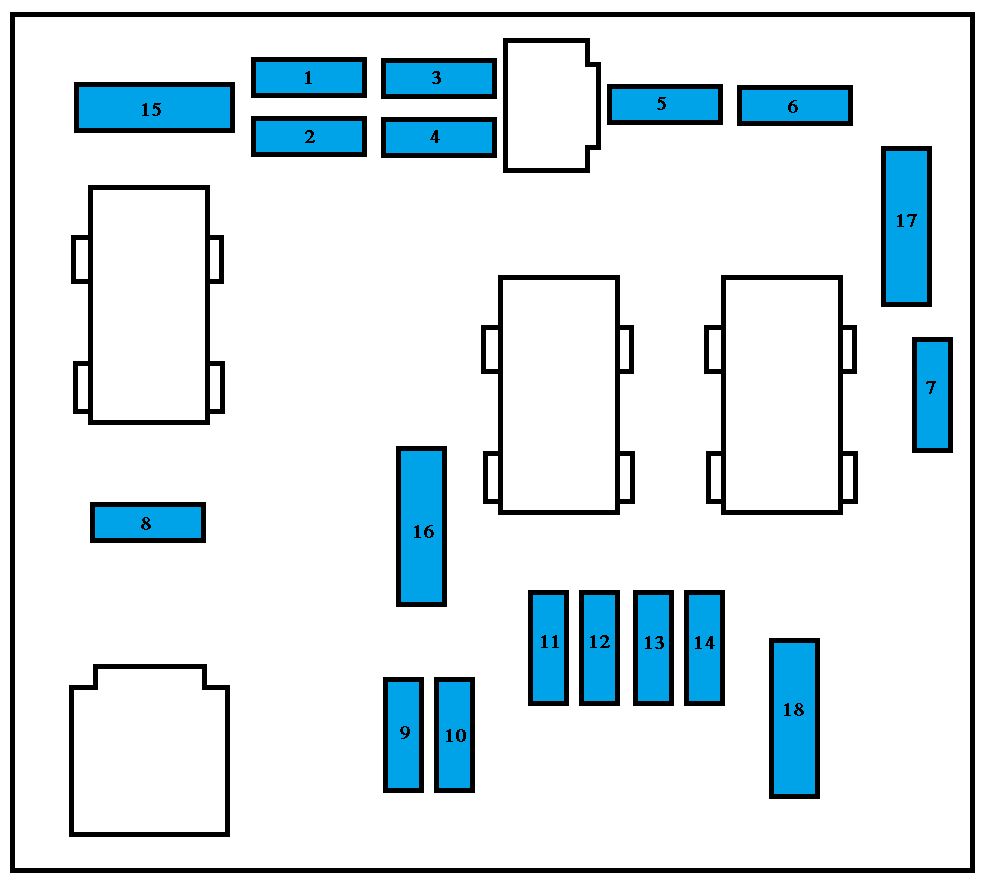
The eight Maxi sockets include two unused positions, MF6 and MF8. In the 2004 handbook, MF1 is 20 A for the cooling fan, MF2 is 60 A and MF3 is 30 A for ABS/ESP supplies, MF4 and MF5 are each 70 A for the BSI, and MF7 is 30 A for the ignition switch. Other 206 models and later equipment variants must not be used as a source of interchangeable ratings.
| Pozycja | Amperaż [A] | Chroniony obwód / funkcja |
|---|---|---|
| MF1 | 20 | Cooling fan – 2004 Coupe Cabriolet reference configuration |
| MF2 | 60 | ABS/ESP pump main supply, where these systems are installed |
| MF3 | 30 | ABS/ESP valve circuit, separate high-current protection |
| MF4 | 70 | Built-in Systems Interface (BSI), primary power supply |
| MF5 | 70 | Built-in Systems Interface (BSI), second main power feed |
| MF6 | – | Unused Maxi-fuse position |
| MF7 | 30 | Ignition switch high-current feed |
| MF8 | – | Unused Maxi-fuse position |
Engine fuse box – positions 1 to 18
The engine-board fuses protect fuel supply, ABS/ESP control, headlamps, horn, windscreen wipers and climate equipment. The illustration below shows the second physical engine-panel arrangement used during this 206 generation. It should be matched to the installed box rather than assumed to apply to every model year. Position 5 is unused on the specified 2004 chart.
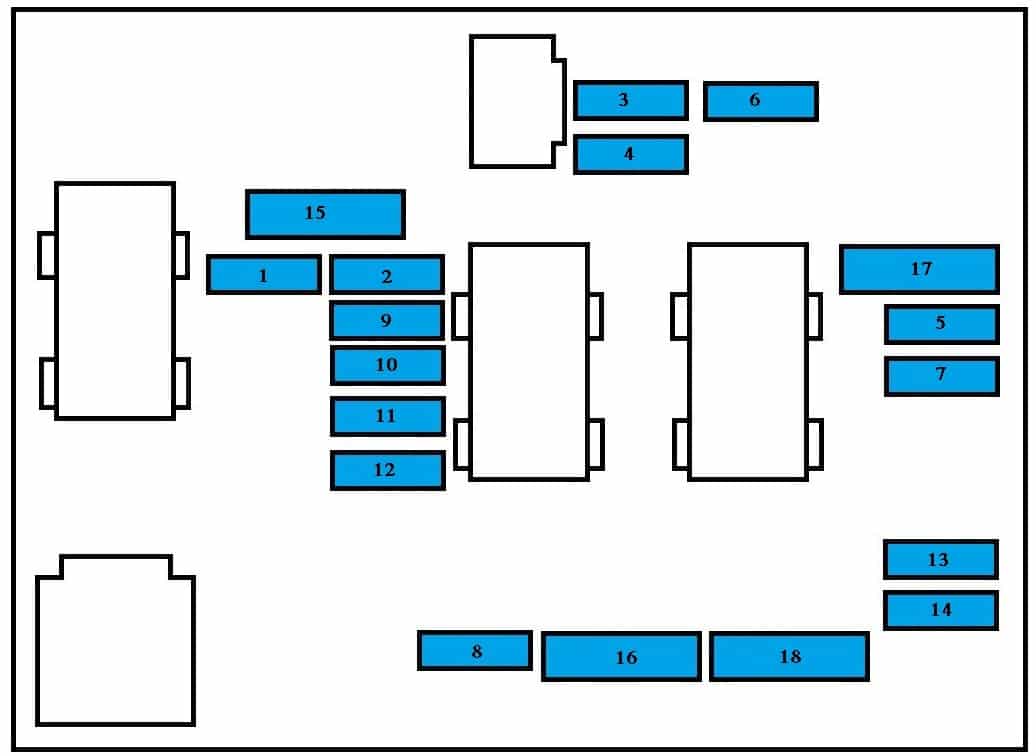
| Pozycja | Amperaż [A] | Chroniony obwód / funkcja |
|---|---|---|
| 1 | 10 | Reversing lamps, vehicle speed sensor and engine-dependent diesel fuel management |
| 2 | 15 | Electric fuel pump and petrol fuel-vapour canister purge solenoid |
| 3 | 10 | ABS/ESP controller and stability-control brake pedal switch |
| 4 | 10 | Engine management controller and automatic transmission ECU, if fitted |
| 5 | – | Unused socket in the reference configuration |
| 6 | 15 | Front fog lamps |
| 7 | 20 | Windscreen washer pump circuit in the 2004 manufacturer’s diagram; other model-year installations may differ |
| 8 | 20 | Radiator fan relay, engine management ECU and engine-control solenoids |
| 9 | 15 | Left dipped-beam headlamp |
| 10 | 15 | Right dipped-beam headlamp |
| 11 | 10 | Left main-beam headlamp |
| 12 | 15 | Right main-beam headlamp |
| 13 | 15 | Horn |
| 14 | 10 | Front screen washer pump, second control/feed circuit |
| 15 | 30 | Throttle-body heater, lambda sensor, engine ECU, ignition coils, fuel injectors and control valves, depending on petrol engine |
| 16 | 30 | Secondary air-injection pump relay on suitable petrol engine installations |
| 17 | 30 | Front windscreen wiper motor, low- and high-speed feeds |
| 18 | 40 | Heating and air-conditioning cabin blower motor |
Dashboard fuse panel – retractable roof, power windows and 12 V socket
The Coupé Cabriolet has two critical roof-related circuits: position 4 (20 A) includes the retractable roof control unit, and position 9 (30 A) supplies the roof’s hydraulic pump. These functions are not the rear power-window and tailgate circuits of a 206 SW estate. Position S1 is the PARC configuration shunt, not a fuse with a replaceable amperage.
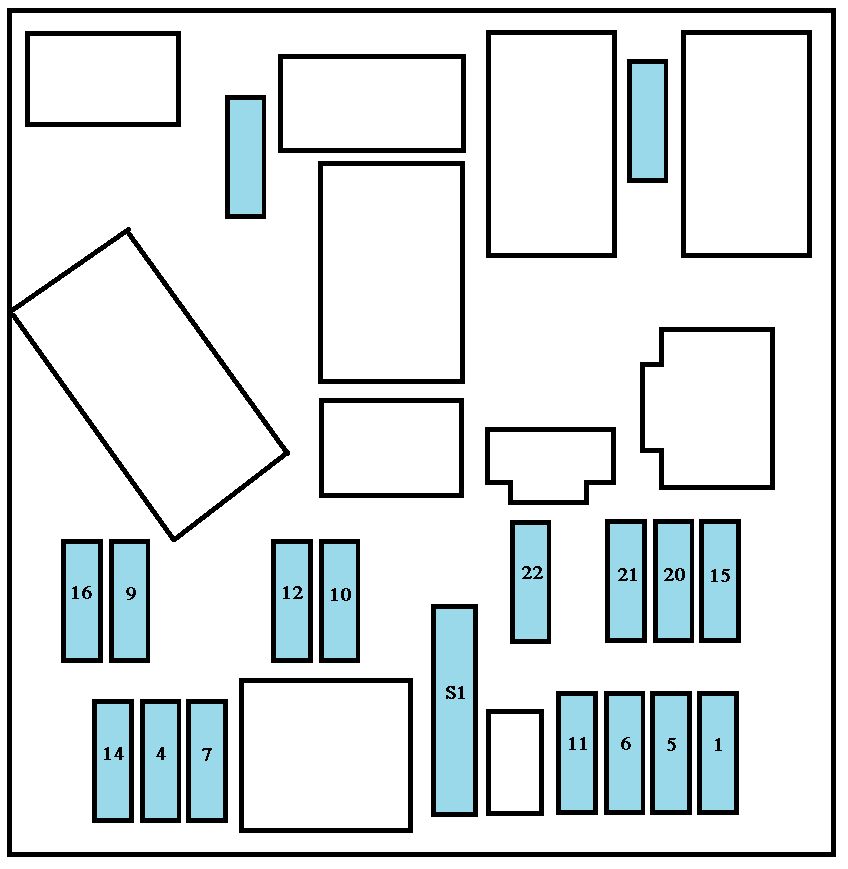
| Pozycja | Amperaż [A] | Chroniony obwód / funkcja |
|---|---|---|
| 1 | 15 | Heated front seats and factory alarm, if installed |
| 4 | 20 | Multifunction display, navigation, radio, luggage illumination, roof controller, steering-wheel switches and optional trailer wiring |
| 5 | 15 | Automatic transmission diagnostic circuit |
| 6 | 10 | Coolant level sensing, automatic transmission and radio equipment, and ESP steering-angle sensor |
| 7 | 15 | Accessory alarm installed after vehicle delivery |
| 9 | 30 | Hydraulic pump driving the electrically retractable hardtop |
| 10 | 40 | Electrically heated external door mirrors |
| 11 | 15 | Windscreen wiper electrical control |
| 12 | 30 | Front power windows, working alongside the convertible roof mechanism |
| 14 | 10 | Engine electronics, SRS airbags, steering column controls and rain sensor |
| 15 | 15 | Instrument cluster, multifunction display, navigation, air conditioning and audio |
| 16 | 30 | Central locking and unlocking of doors |
| 20 | 10 | Right rear brake lamp |
| 21 | 15 | Left brake lamp and high-level third brake light |
| 22 | 20 | Cabin and glovebox lamps plus 12 V cigarette lighter – 20 A in the June 2004 handbook |
| S1 | Shunt | S1 PARC configuration shunt – not a normal current-rated blade fuse |
Which model year and equipment does this reference apply to?
The 21 June 2004 Peugeot handbook specifies F22 as 20 A for the cigarette lighter and interior lighting. This differs from some older internet charts that give 30 A and from the values used on certain early 206 SW estates. The correct fuse rating for any car must come from its own production specification and cover label, not from a differently bodied vehicle. Petrol and HDi diesel injection systems also differ in the occupation of engine-management positions.
The ordinary Peugeot 206 hatchback and 206 SW estate do not have the CC’s hydraulic roof pump. The later 206+ likewise uses a distinct electrical configuration. Even where the fuse-box case looks similar, a different BSI revision may change the role or occupancy of a given socket.
Why does the Peugeot 206 CC roof fail to open?
If the folding roof does not move at all, check the 30 A dashboard position 9 supplying the hydraulic pump and the 20 A dashboard position 4 associated with the roof controller, using the 2004 specification. A failed roof operation can also be caused by low system voltage, luggage-divider position, boot-latch or cover microswitches, the hydraulic pump or fluid leakage. Do not force the roof mechanism or bypass interlocks to make it move.
Cigarette lighter, headlamps, windows and wipers
12 V cigarette lighter fails: Check dashboard F22 (20 A in the 2004 reference) and the socket terminals. One front window fails: Dashboard F12 (30 A) feeds the front windows; check switches and door hinge wiring as well as roof-related interlock behaviour.
Left dipped beam fails: Engine F9 (15 A) serves the left headlamp, F10 (15 A) the right. Front wipers fail: Check engine F17 (30 A) and cabin F11 (15 A) according to the wiring version, then inspect the motor and mechanism. ABS warning light: Verify the correct Maxi MF2/MF3 supplies and engine F3 (10 A), then diagnose sensors or pump electronics if the supply is intact.
Brake light fault: Dashboard F20 (10 A) serves the right stop lamp; F21 (15 A) serves the left and high-level third stop lamps on the source specification. Check bulbs, connector corrosion and the pedal switch before replacing components.
Other 206 electrical configurations
The Peugeot 206 CC 2000-2002 is covered in a separate early roof and BSI guide. The Peugeot 206 SW 2003-2008 has estate rear-window and tailgate circuits rather than a hydraulic roof. The Peugeot 206+ 2009-2012 uses different engine fuse and cabin allocations.
Technical basis: Peugeot 206 CC owner’s handbook, 21 June 2004, “Practical Information” fuse diagrams and assignments. Exact year, engine and market equipment take precedence over general model-family tables.