
The Peugeot 206+ (2009-2012), sometimes sold as a facelifted version of the 206, retained familiar compact-car mechanical components but has a distinct electrical fuse allocation. It has two principal distribution areas: a covered under-bonnet box alongside the battery with conventional and Maxi fuses, and a passenger-compartment BSI fuse panel beneath the driver’s dashboard. This guide preserves the 42 positions in the model-specific fuse listing, including unused sockets, alternative high-current ratings and the S1 PARC shunt. The ratings should not be copied into an earlier 206, SW or CC without checking compatibility.
Where are the Peugeot 206+ fuse boxes?
Under the bonnet: Switch off the ignition and electrical consumers. Lift the bonnet and find the black fuse distribution unit adjacent to the battery. Release its retaining clips and lift the cover. The engine fuses 1-18 and the Maxi block MF1-MF8 are separately identified; compare the panel and lid before selecting a position. Protect the box from water and secure the cover after inspection.
In the passenger compartment: On a left-hand-drive model, the dashboard fuse flap is beneath the steering column on the driver’s side. Turn the retaining latch one quarter-turn, lower the cover and locate the numbered fuse row and S1 shunt. Some cars store a fuse puller and spare blades on the inside of the access panel. Do not pull at the BSI wiring looms or insert a fuse into a socket marked as unused for the particular vehicle.
Main under-bonnet Maxi fuses – MF1 to MF8
These high-current links distribute power to the radiator fan, ABS/ESP, BSI and ignition switch. On this 206+ layout, MF1 can be 20 A without air conditioning or 50 A with it. MF2 and MF3 may be 20 or 30 A depending on ABS/ESP specification. These are alternative factory configurations, not upgrade options for a failed fuse. MF6 and MF8 are unused; MF4 and MF5 are rated 70 A.
| Pozycja | Amperaż [A] | Chroniony obwód / funkcja |
|---|---|---|
| MF1 | 20/50 | Engine cooling fan, 20 A without air conditioning or 50 A with air conditioning; select exact factory installation |
| MF2 | 20/30 | ABS/ESP first high-current supply, 20 A or 30 A depending on fitted system |
| MF3 | 20/30 | ABS/ESP second high-current supply, 20 A or 30 A depending on fitted system |
| MF4 | 70 | BSI body electronics module, first 70 A main supply |
| MF5 | 70 | BSI body electronics module, second 70 A main supply |
| MF6 | – | Unused Maxi-fuse position |
| MF7 | 30 | Ignition switch main power supply |
| MF8 | – | Unused Maxi-fuse position |
Engine compartment – standard fuses 1-18
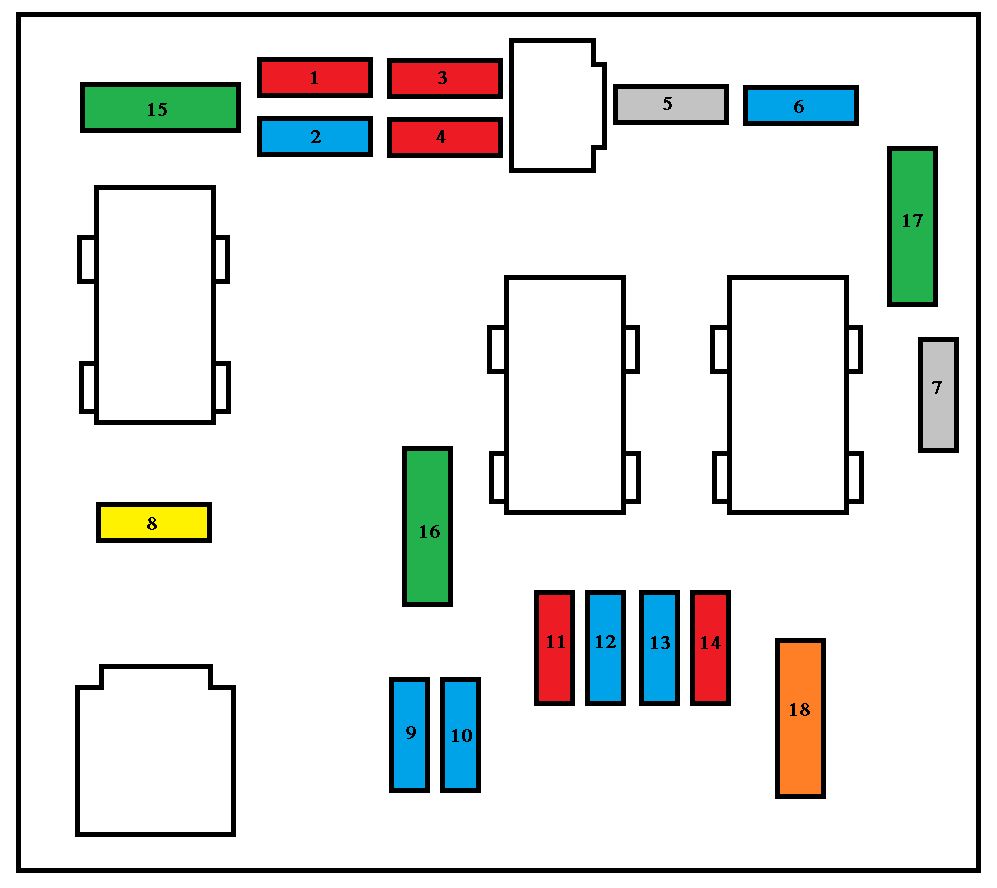
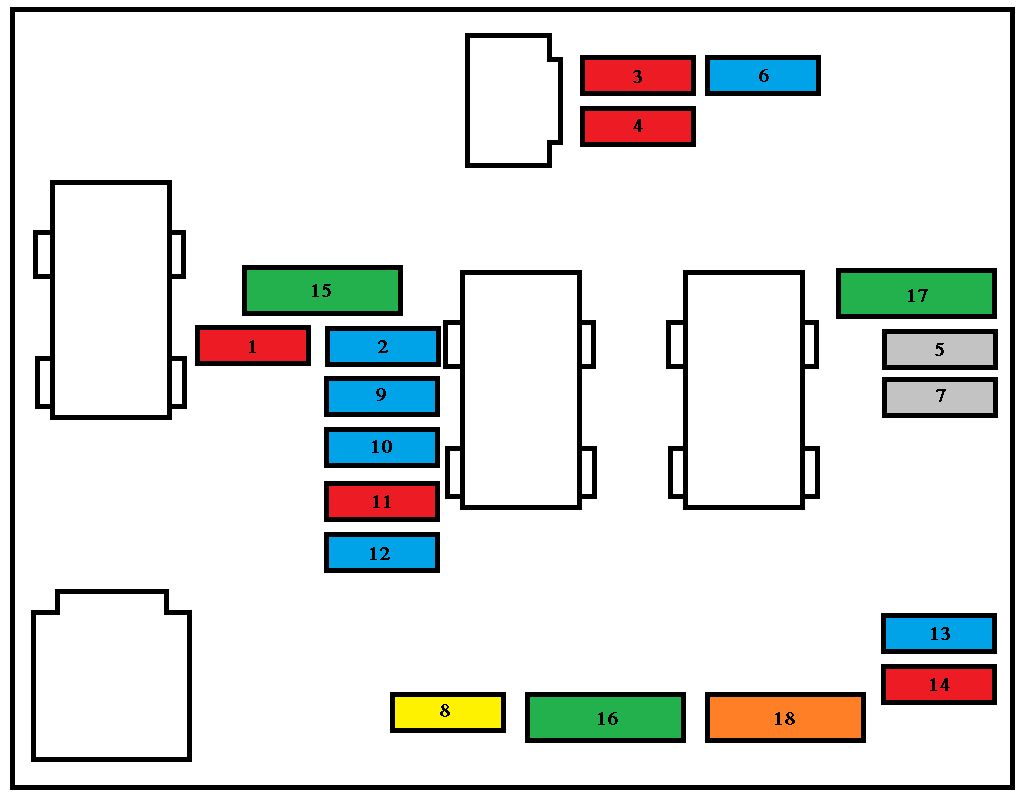
This block protects the fuel pump, injection system, engine cooling, headlamps, wipers, horn and heater blower. In the 206+ list, positions 5 and 7 are unused, unlike some related 206 electrical panels. A second original schematic is provided because there are different physical fuse-board arrangements; use the one matching the car rather than assigning a position by visual similarity alone.
| Pozycja | Amperaż [A] | Chroniony obwód / funkcja |
|---|---|---|
| 1 | 10 | Diesel pre-heater controller, water-in-fuel detection, reversing light switch, vehicle speed sensor and diesel mass airflow sensor as applicable |
| 2 | 15 | Fuel pump and petrol vapour canister purge solenoid |
| 3 | 10 | ABS controller supply |
| 4 | 10 | Engine management unit |
| 5 | – | Unused socket |
| 6 | 15 | Front fog lamps, where fitted |
| 7 | – | Unused socket in the 206+ installation |
| 8 | 20 | Cooling fan relay, engine ECU, diesel injection pump, pressure control valve and engine management solenoids as fitted |
| 9 | 15 | Left dipped-beam headlamp |
| 10 | 15 | Right dipped-beam headlamp |
| 11 | 10 | Left main-beam headlamp |
| 12 | 15 | Right main-beam headlamp |
| 13 | 15 | Horn |
| 14 | 10 | Windscreen washer pump |
| 15 | 30 | Engine sensors, ignition coils, injectors, diesel control valves and ECU, depending on powertrain |
| 16 | 30 | Secondary air-injection pump relay on certain petrol engines |
| 17 | 30 | Front wiper motor, high and low speeds |
| 18 | 40 | Heater and air-conditioning blower motor |
Dashboard fuse panel and S1 PARC configuration shunt
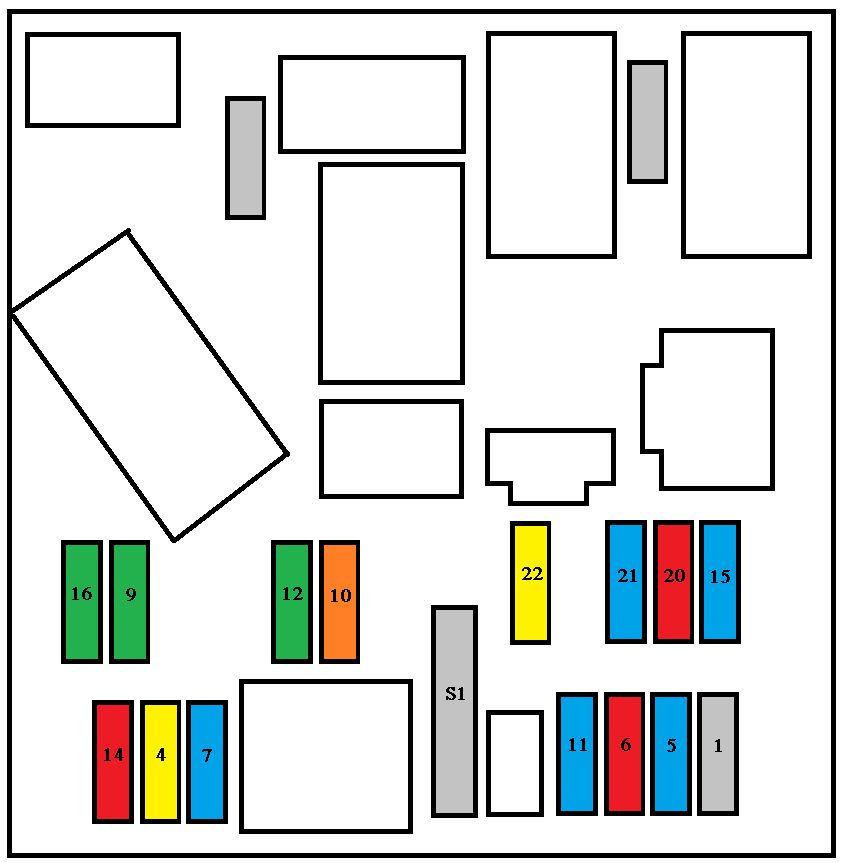
The dashboard group controls the radio, rear demister, central locking, rear wiper, electric windows, interior lighting and 12 V accessory socket. The positions numbered 1, 5 and 9 are unused in this model-specific listing, which is one reason not to apply the retractable-roof allocation of a 206 CC to a 206+. S1 is a PARC transport/configuration shunt rather than a 0 A fuse.
| Pozycja | Amperaż [A] | Chroniony obwód / funkcja |
|---|---|---|
| 1 | – | Unused on this 206+ dashboard board |
| 4 | 20 | Multifunction display, luggage compartment lighting, radio, steering wheel controls and trailer connector |
| 5 | – | Unused on this version |
| 6 | 10 | Coolant level warning and radio supply |
| 7 | 15 | Driving school installation and additional alarm |
| 9 | – | Unused on this configuration; do not copy a CC roof pump assignment |
| 10 | 40 | Heated rear window circuit |
| 11 | 15 | Rear tailgate windscreen wiper |
| 12 | 30 | Front electrically operated windows |
| 14 | 10 | Engine controller, SRS airbags, steering wheel controls and rain sensor |
| 15 | 15 | Instrument cluster, display, climate control and audio system |
| 16 | 30 | Door and tailgate locking/unlocking |
| 20 | 10 | Right-hand brake lamp |
| 21 | 15 | Left-hand and high-mounted third brake lamps |
| 22 | 30 | Interior courtesy lights and the 12 V power outlet |
| S1 | Shunt | S1 PARC configuration shunt – not a rated fuse |
Equipment-dependent fuse differences
Air conditioning: MF1 has an installation-dependent 20/50 A rating for the engine cooling system and engine fuse 18 (40 A) supplies the cabin blower. ABS/ESP: MF2 and MF3 may be specified as 20 or 30 A. The engine box F3 (10 A) feeds the ABS controller, where fitted.
Diesel: Engine position 1 (10 A) includes pre-heating and water-in-fuel detection on appropriate diesel configurations. Engine positions 8 and 15 also involve diesel fuel injection control where installed. Petrol: Fuel-pump and secondary-air equipment are engine dependent. No fuse listed as unused should be populated simply because a related Peugeot 206 has a consumer at the same number.
Practical checks for common electrical failures
12 V socket or interior lamp not working: Dashboard F22 (30 A) covers both in this specific 206+ list. If only the socket fails, inspect its contacts. No heater blower: Engine fuse 18 (40 A) is the blower feed; a fan that works only on maximum speed may indicate a resistor or controller problem instead.
Dipped beam headlamp fault: Engine F9 (15 A) protects the left lamp and F10 (15 A) the right. Rear wiper stops: Dashboard F11 (15 A), then the tailgate wiring and motor. Front wipers use engine F17 (30 A), while engine F14 (10 A) supplies screen washing.
Central locking not operating: Dashboard F16 (30 A) is the locking feed; faults affecting only one door can arise from a damaged door wiring loom. Rear-window heater fails: Dashboard F10 (40 A). ABS fault warning: Check the correct installed MF2/MF3 values and engine fuse F3 (10 A); if they are healthy, fault-code diagnosis of wheel sensors and control electronics is necessary.
How the 206+ differs from older 206 models
The Peugeot 206 hatchback (2000-2002) is an earlier electrical reference, while the Peugeot 206 CC (2003-2008) has hydraulic roof circuits not present in the 206+. A Peugeot 206 SW (2003-2008) uses estate wiring for the rear windows and tailgate. Always identify the exact body and production-era fuse box.
Technical basis: Peugeot 206+ 2009-2012 model fuse allocation and original engine/cabin drawings; factory equipment and regional specifications can alter individual socket ratings.