
The facelift Peugeot 307 CC (Coupé Cabriolet, 2006-2008) has its own electrical architecture for the hydraulically operated folding metal roof. Its fuse protection is distributed between the dashboard/BSI board and the engine compartment box alongside the battery, with additional high-current Maxi links. This guide preserves all 45 technical positions plus eight common-fault reference rows, including the roof-pump F40, the Hi-Fi amplifier F36, optional F39 heated-seat protection and the PARC mode shunt. These functions must not be copied into the 307 hatchback or SW estate.
Where are the Peugeot 307 CC fuse boxes?
Passenger compartment: Switch off the ignition and turn off the electrical consumers. In the usual European left-hand-drive 307 CC, the fascia fuse panel is under the lower dashboard on the driver’s side; release the cover and inspect the numbered blade fuses. The 2006 English owner manual for a right-hand-drive market instead directs access through the passenger glovebox. Always follow the fitted fuse cover and vehicle specification rather than assuming the same side on all markets. The roof-related F36-F40 protection is in the supplementary fascia electrical section, not among the main engine fuses.
Engine bay: Open the bonnet and locate the covered fuse block next to the battery. Unclip the lid, read the F1-F18 labels on the installed carrier and refit the cover to maintain its water seal. Maxi fuses protect the heavy-current supply to the BSI, pump and cooling systems and require appropriate service procedures.
Frequently searched Peugeot 307 CC fuses
This eight-entry reference repeats important positions from the detailed tables, distinguishing engine compartment positions F2, F12 and F5 from the numbered cabin fuses. The retractable-roof hydraulic pump is supplied through the CC-specific 30 A F40 protection.
| Pozycja | Amperaż [A] | Chroniony obwód / funkcja |
|---|---|---|
| F9 | 30 | Front and rear 12 V accessory sockets |
| F40 | 30 | Retractable roof hydraulic pump |
| F36 | 20 | Hi-Fi audio amplifier |
| F39 | 20 | Optional heated seats; only on cars equipped and rated accordingly |
| F17 | 40 | Heated rear window |
| F2 | 15 | Horn in the engine compartment |
| F12 | 30 | Front windscreen wipers in the engine compartment |
| F5 | 15 | Fuel pump in the engine bay, engine dependent |
307 CC dashboard fuse board F1-F17
The facelift board includes 17 positions. F1 is unoccupied, F2 and F15 supply different aspects of central locking at 30 A, F9 supplies the front/rear 12 V sockets (30 A), and F17 supplies the heated rear screen (40 A). The source labels F16 as the PARC shunt, which is not a standard fuse. The original large schematic is retained for the exact CC dashboard carrier.
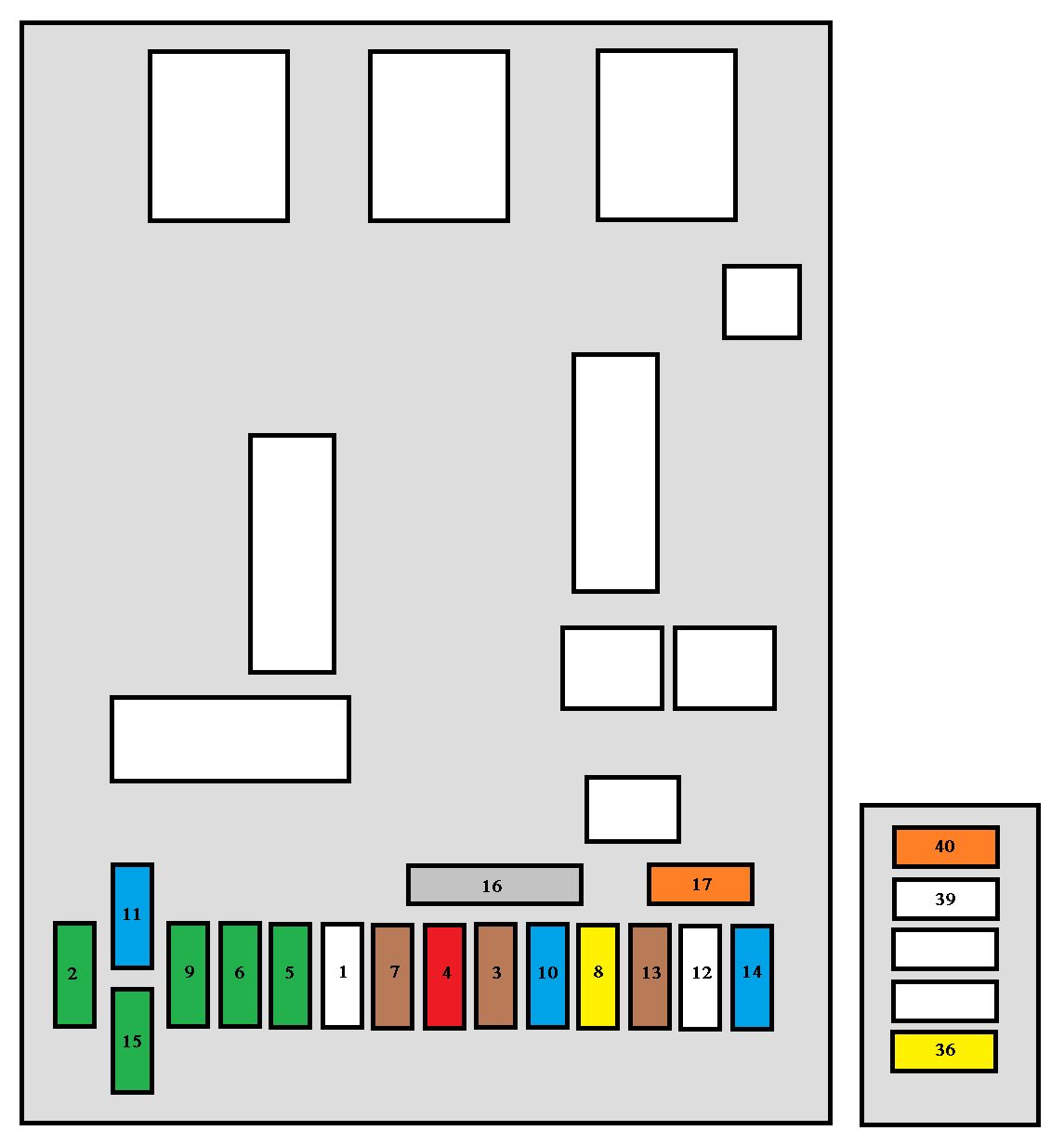
| Pozycja | Amperaż [A] | Chroniony obwód / funkcja |
|---|---|---|
| F1 | – | Unused fuse location in this 307 CC version |
| F2 | 30 | Central door locking and deadlocking |
| F3 | 5 | Airbag ECU and pyrotechnic seat-belt pretensioners |
| F4 | 10 | Brake and clutch pedal switches, coolant level sensing, steering angle/ESP, diagnostic connector, FAP additive pump and auto-dimming mirror |
| F5 | 30 | Front electrically operated windows and heated exterior mirrors |
| F6 | 30 | Rear electric windows and parts of the folding roof’s cover/flap mechanism |
| F7 | 5 | Front and rear courtesy lamps, reading lights and glovebox lamp |
| F8 | 20 | Radio/telephone, multifunction display, alarm, trailer service module and steering wheel controls |
| F9 | 30 | Front and rear 12 V accessory sockets |
| F10 | 15 | Automatic gearbox electronics, stop-light switch and tyre-pressure monitoring |
| F11 | 15 | Diagnostic connector, FAP control module and ignition low-current feed |
| F12 | 15 | Rear parking sensors and Hi-Fi amplifier power |
| F13 | 5 | Engine fuse box supply and automatic rain/light sensors |
| F14 | 15 | Trailer module, instrument cluster, automatic climate control, airbags and rollover protection hoops |
| F15 | 30 | Central locking and deadlocking power feed |
| F16 | Shunt | PARC transport/parking mode configuration shunt, not a standard replaceable fuse |
| F17 | 40 | Heated rear windscreen |
CC supplementary fuses – Hi-Fi, heated seats and retractable roof
F40 (30 A) is the retractable roof hydraulic-pump supply. F36 (20 A) powers the optional Hi-Fi amplifier, and both positions are explicitly present in the Peugeot 307 CC owner handbook. The source article also identifies F39 (20 A) for heated front seats on equipped vehicles. That socket is absent from some manufacturer’s handbook tables, so it must not be assumed to exist on every market or trim level. Inspect the actual supplementary fuse carrier before using it.
| Pozycja | Amperaż [A] | Chroniony obwód / funkcja |
|---|---|---|
| F36 | 20 | Hi-Fi audio amplifier |
| F39 | 20 | Optional heated driver and passenger seats; factory occupation and amperage must be confirmed on the specific vehicle |
| F40 | 30 | Electric-hydraulic retractable hardtop roof pump |
307 CC engine compartment fuses F1-F18
The engine box controls ABS/ESP, fuel supply, starter, cooling fan, windscreen wipers, headlights, horn, auxiliary diesel heating, air conditioning and engine management. In the 2006 owner’s handbook, F2 has 15 A for the horn, F8 is 20 A for the starter control, F12 is 30 A for the front wipers, and F11 has 40 A for the heater blower. The next diagram is the matching original CC engine fuse carrier, not a hatchback’s pre-facelift drawing.
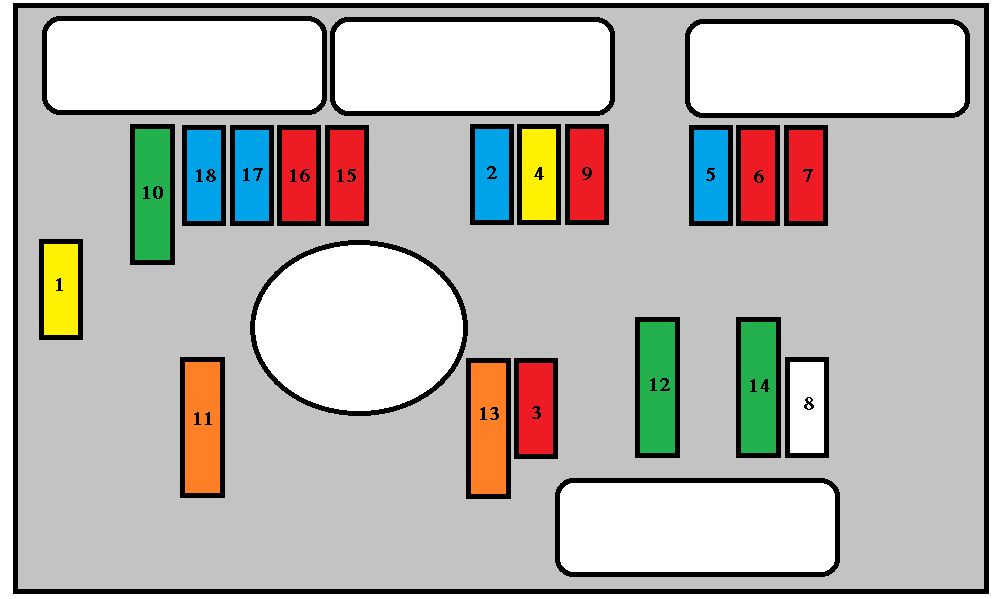
| Pozycja | Amperaż [A] | Chroniony obwód / funkcja |
|---|---|---|
| F1 | 20 | Engine ECU and high-speed radiator cooling fan relays |
| F2 | 15 | Horn |
| F3 | 10 | Front windscreen washer pump |
| F4 | 20 | Headlamp washer pumps, where fitted |
| F5 | 15 | Fuel pump and petrol EVAP vapour purge solenoid according to engine |
| F6 | 10 | Four-speed automatic gearbox ECU, selector interlock and cooling fan relays; Xenon lights on equipped cars |
| F7 | 10 | ABS/ESP controller and electro-hydraulic power steering controller |
| F8 | 20 | Starter solenoid control |
| F9 | 10 | Additional diesel engine heating and engine coolant level sensor |
| F10 | 30 | Engine injection actuators, ignition coils, oxygen sensors, injectors, heaters and solenoids |
| F11 | 40 | Cabin air-conditioning blower motor |
| F12 | 30 | Front wiper motor at low and high speeds |
| F13 | 40 | BSI supply on ignition-positive feed |
| F14 | 30 | Secondary air pump on relevant 2.0-litre petrol engines |
| F15 | 10 | Right-hand main beam headlamp |
| F16 | 10 | Left-hand main beam headlamp |
| F17 | 15 | Left-hand dipped beam headlamp |
| F18 | 15 | Right-hand dipped beam headlamp |
High-current fuses and engine cooling alternatives
Maxi links are separate from the 18 standard engine fuses. MF1 is 30 A with a 200 W fan motor or 50 A with a 400-460 W motor; MF2/MF3 supply ABS/ESP at 30 A each. MF4 and MF5 are 80 A BSI main feeds, MF6 is an 80 A passenger fuse carrier supply, and MF8 at 70 A protects the electric power steering pump. Position MF7 is not listed in this specific chart and has not been added from another generation.
| Pozycja | Amperaż [A] | Chroniony obwód / funkcja |
|---|---|---|
| MF1 | 30 / 50 | Engine cooling fan: 30 A for 200 W motor or 50 A for 400-460 W motor |
| MF2 | 30 | ABS/ESP hydraulic pump high-current supply |
| MF3 | 30 | ABS/ESP solenoid-valve supply |
| MF4 | 80 | BSI body systems interface main feed |
| MF5 | 80 | Second BSI body systems main supply |
| MF6 | 80 | Passenger compartment fuse box high-current supply |
| MF8 | 70 | Electric power-steering pump, 70 A |
Why will the Peugeot 307 CC retractable roof not open?
Start with the CC-specific F40 (30 A) hydraulic-pump supply and the dashboard electrical control feeds. The roof system has additional checks for the boot divider, boot locking, articulated cover flaps, battery voltage and the initialisation of the four windows. The owner handbook explains that low battery power or the vehicle’s economy mode can interrupt roof operation. A jammed mechanical part or a failed microswitch is not cured by installing a larger fuse; do not bypass the safety interlocks.
2006, 2007 and 2008 equipment differences
Optional heated seats and audio equipment affect F39 and F36 occupancy. Different automatic gearbox, HDi particulate-filter and petrol engine setups also change engine management circuits. The 2006 handbook is used as the base for the main CC fuse arrangement; individual 2007/2008 and left-/right-hand-drive vehicles must be checked using their actual manufacturer’s fuse allocation and installed cover. Earlier 2003-2005 CC electrical boxes have different assignments and must not be merged with these lists.
Peugeot fuse box guides for other body styles
The regular Peugeot 307 hatchback (2001-2004) uses an earlier fuse architecture without the CC hydraulic roof. The Peugeot 307 SW (2003) has its own estate and roof blind equipment, while the Peugeot 206 uses different numbered fuse boxes.
Technical sources: Peugeot 307 CC 2006 Owner’s Manual, Practical Information, changing a fuse, pages 105-109, and the original 2006-2008 CC source chart. Any equipment-specific differences must be matched to the actual vehicle.