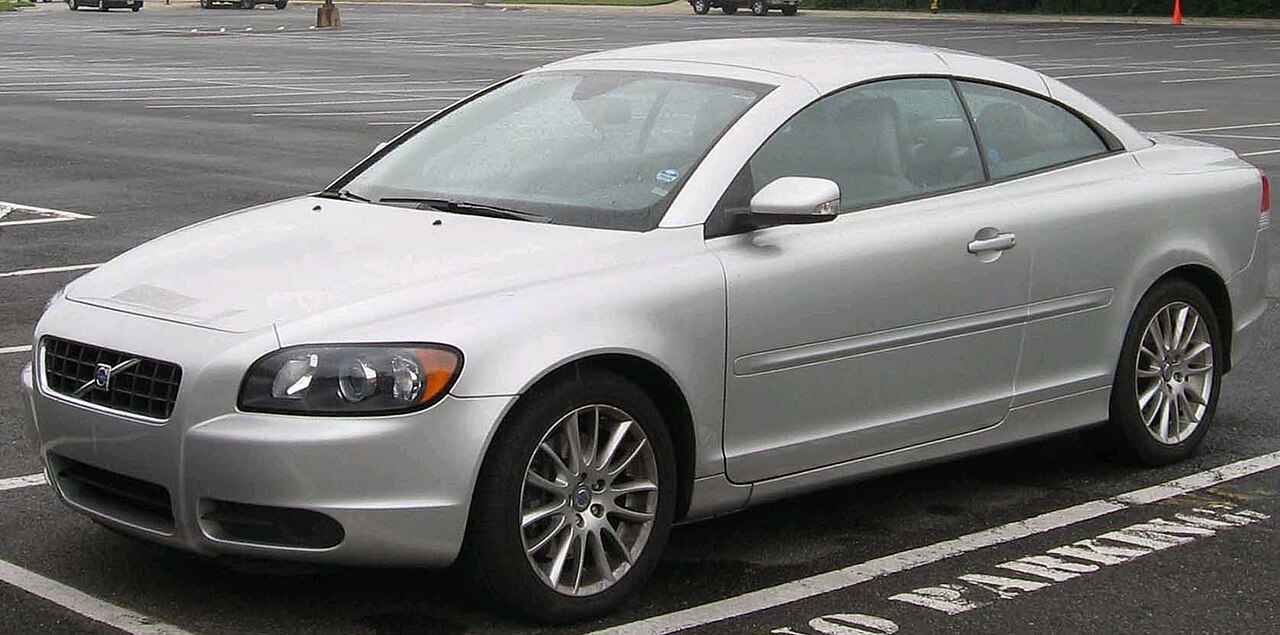
The second-generation Volvo C70 II (2009) is a two-door coupe-convertible equipped with a three-piece power retractable hardtop. It has two main fuse boxes: a 36-position unit under the bonnet, near the battery, and a 50-position panel beneath the passenger glovebox. The tables below reproduce all 86 numbered fuse positions from the corresponding model-year reference, including unassigned sockets.
Important: the hardtop has additional hydraulic and electronic controls. Its fuses must not be mixed with those in the earlier soft-top Volvo C70 I or the related Volvo C30. Individual ampere ratings can differ between Europe and North America, petrol and diesel engines, and model years. Always match the original car’s exact fuse label and handbook.
Where are the Volvo C70 2009 fuse boxes?
Engine compartment: the covered main distribution box sits near the 12 V battery and contains positions 1-36. Volvo’s general instruction advises that the high-current fuses in positions 1-18 should be checked and replaced by appropriately qualified service personnel; the lower-current positions 19-36 can be inspected by following the vehicle owner’s guide.
Passenger compartment: the fuse holder for positions 37-86 is beneath the glovebox on the passenger side, not by the driver’s knee. The lower trim fasteners are released, after which two retainers allow the panel to lower toward the passenger seat. Reinstall the holder and trim securely after checking fuses.
The folding roof hydraulic pump and control modules are separate assemblies, not a universal third fuse panel. The under-bonnet box supplies the roof’s main operating circuit, and four independently protected side windows must work correctly during folding.
Volvo C70 2009 – engine compartment fuses 1-36
This diagram retains the factory’s 36-position numbering. Core consumers include the radiator fan, electric power steering, ABS, starter, cabin blower, front wipers and engine controls. Fuse 11 (20 A) is associated with headlamp washers and certain roof/storage functions; fuse 15 (30 A) is a main supply for the electrohydraulic folding hardtop. Fuse 17 (30 A) supplies the front wiper motor.
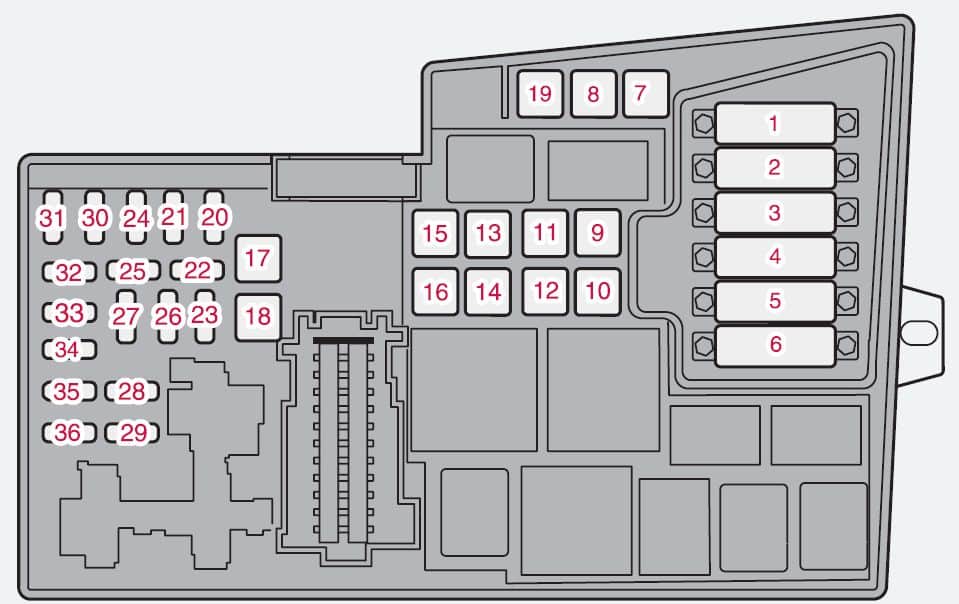
| Position | Rating [A] | Protected circuit / function |
|---|---|---|
| 1 | 50 | Engine radiator cooling fan |
| 2 | 80 | Electric power steering |
| 3 | 60 | First main power feed to passenger-compartment fuse box |
| 4 | 60 | Second main power feed to passenger-compartment fuse box |
| 5 | 80 / – | Optional PTC electric heater, depending on European equipment |
| 6 | 70 / – | Diesel glow plugs, if fitted; unused in standard USA petrol models |
| 7 | 30 | ABS hydraulic pump |
| 8 | 20 | ABS hydraulic valve controller |
| 9 | 30 | Main engine management power |
| 10 | 40 | Cabin heating and A/C blower motor |
| 11 | 20 | Headlamp washers, folding hardtop auxiliary control and lockable storage circuits |
| 12 | 30 | Heated rear window main power |
| 13 | 30 | Starter relay power supply |
| 14 | 40 / – | Factory trailer electrical connector, if fitted |
| 15 | 30 | Electrohydraulic folding hardtop drive and control system |
| 16 | 40 | Factory audio and infotainment main supply, 40 A in the USA 2009 handbook |
| 17 | 30 | Front windscreen wiper motor |
| 18 | 40 | Additional main passenger-compartment fuse box feed |
| 19 | – | Unused position |
| 20 | 15 | Horn |
| 21 | 20 / – | Auxiliary fuel-fired cabin heater, if fitted in certain markets |
| 22 | 25 | Original-equipment audio subwoofer, if fitted |
| 23 | 10 | Engine ECM and automatic gearbox TCM on relevant engine configurations |
| 24 | 20 / – | Diesel fuel filter heating and crankcase breather PTC, on certain variants |
| 25 | – | Unused position |
| 26 | 15 | Ignition switch |
| 27 | 10 | Air-conditioning compressor clutch control |
| 28 | – | Unused position |
| 29 | 15 / – | Front fog lamps, if fitted |
| 30 | 3 / – | Four-cylinder diesel ECM auxiliary feed on applicable earlier European versions; not universal |
| 31 | – | Unused position |
| 32 | 10 | Petrol injectors or MAF airflow measurement and turbo control on diesel variants |
| 33 | 20 | Heated oxygen sensor and vacuum pump on petrol variants; diesel ECM equipment on relevant models |
| 34 | 10 | Ignition coils and A/C pressure sensor on petrol cars; glow-plug or EGR controls on diesels |
| 35 | 15 | Engine sensors, solenoids, A/C relay, EVAP, crankcase PTC and MAF depending on powertrain |
| 36 | 10 | Engine ECM, throttle or accelerator pedal sensors and emission-control equipment by engine |
Volvo C70 2009 – passenger compartment fuse box 37-86
The cabin diagram retains all fifty positions, including empty positions 37-42 and other unpopulated slots. Fuse 45 (15 A) protects the interior 12 V power outlet; fuse 57 (15 A) supplies the OBD II connector and brake light switch; and fuse 74 (15 A) serves the fuel pump relay. The rear side windows are on 63 and 81 (20 A each).
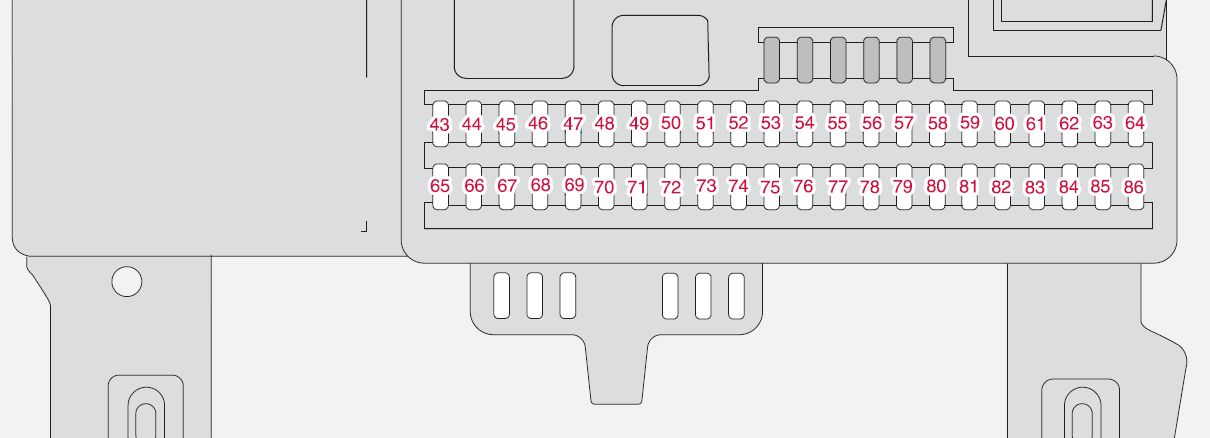
| Position | Rating [A] | Protected circuit / function |
|---|---|---|
| 37 | – | Unused position |
| 38 | – | Unused position |
| 39 | – | Unused position |
| 40 | – | Unused position |
| 41 | – | Unused position |
| 42 | – | Unused position |
| 43 | 15 | Factory audio, integrated telephone or Volvo RTI navigation, where fitted |
| 44 | 10 | Airbag and belt pretensioner SRS controller and relevant ECM circuits |
| 45 | 15 | Interior 12 V accessory socket |
| 46 | 5 | Glovebox, dashboard and footwell illumination |
| 47 | 5 | Passenger compartment interior lighting |
| 48 | 15 | Front windscreen washer pump |
| 49 | 10 | SRS airbags and occupant weight sensor (OWS) |
| 50 | – | Unused position |
| 51 | 10 / – | Diesel fuel filter heating relay or related cabin-heater controller, if equipped |
| 52 | 5 | Automatic gearbox TCM and ABS control electronics |
| 53 | 10 | Electric power steering control |
| 54 | 10 | Parking sensors and optional Bi-Xenon or active-bending headlamp electronics |
| 55 | – | Unused in basic equipment; optional Keyless equipment in certain 2009 variants, depending on panel |
| 56 | 10 | Remote-control receiver, navigation accessory and factory alarm siren |
| 57 | 15 | OBD II diagnostics connector and brake light switch |
| 58 | 7.5 | Right high-beam headlamp and optional auxiliary light relay control |
| 59 | 7.5 | Left high-beam headlamp |
| 60 | 15 / – | Driver heated seat, if equipped |
| 61 | 15 / – | Passenger heated seat, if equipped |
| 62 | – | Unused; folding hardtop has separately documented engine-compartment fuses |
| 63 | 20 | Right rear side power-window motor, integral to roof opening sequence |
| 64 | 5 | Lock illumination or RTI navigation; optional satellite radio on some later USA vehicles |
| 65 | 5 | Audio system electronics |
| 66 | 10 | Infotainment control module (ICM) and climate controls |
| 67 | – | Unused position |
| 68 | 5 | Cruise control |
| 69 | 5 | Climate controls, rain sensor and optional BLIS button |
| 70 | – | Unused position |
| 71 | – | Unused position |
| 72 | – | Unused position |
| 73 | 5 | Overhead interior light console and seatbelt warning equipment |
| 74 | 15 | Fuel pump relay power circuit |
| 75 | – | Unused position |
| 76 | – | Unused position |
| 77 | 15 / – | Luggage-compartment 12 V outlet and accessory electronic module (AEM), if fitted |
| 78 | – | Unused position |
| 79 | 5 | Reversing lamps |
| 80 | – | Unused position |
| 81 | 20 | Left rear side power-window motor, integral to roof opening sequence |
| 82 | 25 | Right front power-window motor and passenger door module |
| 83 | 25 | Left front power-window motor and driver door module |
| 84 | 25 / – | Electric passenger seat, if fitted |
| 85 | 25 / – | Electric driver seat, if fitted |
| 86 | 5 | Interior lighting relay, cargo light and electrically operated seat controls |
Volvo C70 Power Retractable Hard Top fuses
Under the bonnet: F11 (20 A) includes certain retractable roof controls and lockable storage circuits; F15 (30 A) feeds the main electrohydraulic folding roof system. These are different from sunroof protection on the Volvo C30. In the cabin, F63 (20 A) feeds the right rear side window, F81 (20 A) the left rear side window, and F82/F83 (25 A each) the front windows.
If the roof stops, confirm the car is stationary, the brake is operated, luggage compartment lid and separator are secured, and the battery voltage is adequate. Fault messages and roof position sensors may block operation even if all fuses are intact. Do not bypass interlocks or force the hydraulic mechanism.
Cigarette lighter, cargo outlet, OBD, wipers and audio
Interior 12 V accessory socket: cabin F45 (15 A). Optional luggage compartment socket: cabin F77 (15 A) where fitted. Each is on a separately labelled circuit. Disconnect faulty chargers before changing an original-rated fuse.
OBD II diagnostics: cabin F57 (15 A). Front wipers: engine F17 (30 A); washer pump: cabin F48 (15 A). Right and left high-beam headlights: cabin F58 and F59 (7.5 A each).
Audio: the main infotainment feed is engine F16, whose rating must be verified for the correct market and year. Optional factory subwoofer power is engine F22 (25 A); additional radio and display control feeds include cabin F43, F65 and F66. Fuel pump relay: cabin F74 (15 A).
Differences between production years, EU and USA models
The 2009 USA owner’s guide lists audio F16 at 40 A, and ABS hydraulic pump F7 at 30 A. Optional diesel equipment is not universal to USA petrol vehicles. Optional engine-bay F5 (PTC electric heating), F6 (diesel glow plugs), F21 (auxiliary heating), F24 (fuel filter heater) and F30 (diesel ECM) are not installed identically across markets. Empty slots must not be filled just because another C70 version uses them.
Also compare Volvo C70 II 2006-2008 and Volvo C70 II 2010-2013. The position numbering can appear familiar, but a shared number does not prove an identical consumer or ampere rating across all three revisions.
For the earlier car with a fabric roof, use the Volvo C70 I 2003-2005 fuse reference, which has a completely different fuse-box arrangement.
Volvo C70 II 2009 fuse box FAQ
Where is the interior fuse box?
Beneath the front passenger’s glovebox, after removing the lower trim panel.
Which fuses protect the folding hardtop?
Under-bonnet F11 (20 A) and F15 (30 A) are principal related circuits. Rear side windows also depend on cabin F63 and F81, each 20 A.
Which fuse protects the cigarette lighter?
Cabin F45 (15 A), in the referenced layout.
Where is the OBD II diagnostic connector fuse?
Cabin F57 (15 A), also associated with brake-switch power.
Is the main audio fuse F16 always the same amperage?
No. Europe and USA references can give different ratings. Use the specification for the car’s engine, market and production year.
Always use the exact fuse rating and type confirmed by the vehicle handbook or the original fitted protection. A fuse that repeatedly blows requires electrical diagnosis rather than a higher-current substitute.